Building a bigger chest without weights might seem impossible, but prisoners have been doing it for decades.
Their secret? A modified push-up technique that maximizes chest activation while allowing significantly more repetitions than traditional variations.
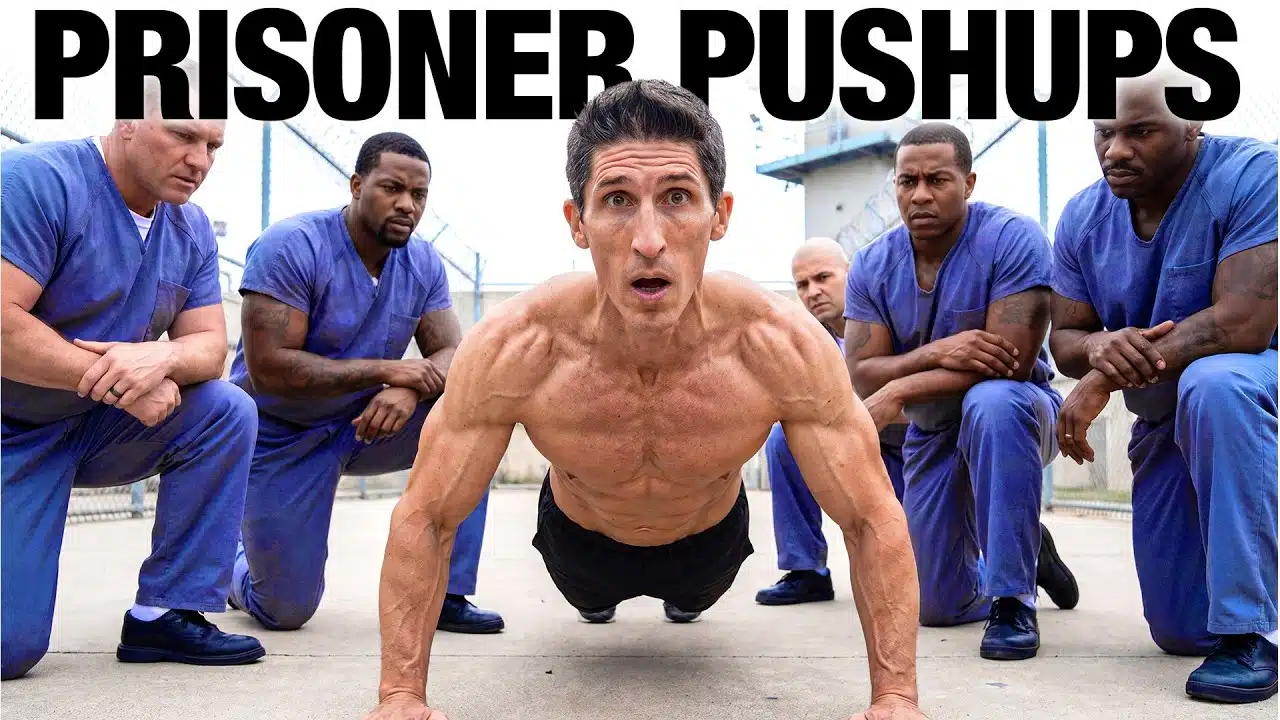
In a recent video, fitness expert Jeff Cavaliere revealed why this unconventional approach works so well for muscle growth—and why half reps might actually be better than full range of motion when bodyweight is your only tool.
The technique challenges everything most people believe about proper push-up form.
Jump to:
Why Prisoner Push-Ups Work Better for Chest Growth
Prisoner push-ups focus exclusively on the bottom portion of the movement, eliminating the full extension at the top.
While this might look like cheating, there’s solid science behind the approach.

If you want something simple that actually works, this is one of the most effective tools I’ve used to build strength, conditioning, and endurance without needing a full gym setup.
- Full-body training with one weight using swings, squats, and presses
- Solid cast iron build that feels stable and lasts for years
- Comfortable grip that makes high-rep workouts easier to handle
I know what you’re thinking. Those look like half reps, Jeff. Those aren’t even full range of motion. That’s the point.
The upper portion of a standard push-up heavily involves triceps to complete the lockout. This creates fatigue that limits total repetitions before the chest reaches meaningful exhaustion.
By staying in the lower range, the chest maintains primary responsibility for the movement. Research on bench press mechanics shows approximately 75% chest contribution in the bottom portion versus only 60% in the upper portion.
The Volume Equation for Bodyweight Muscle Building
Building muscle with bodyweight exercises requires a different approach than weighted movements.
When we’re looking to build any muscle with just a bodyweight exercise, your volumes are going to have to be higher because your overall mechanical tensions are going to be lower.
Push-ups simply can’t generate the same mechanical tension as heavy dumbbell or barbell bench pressing. The solution? Dramatically increase volume.
Prisoner push-ups deliver approximately 1.5 to 2 times more repetitions per set compared to traditional full-range variations. This volume increase compensates for lower absolute tension on muscle fibers.
The faster tempo possible in this shortened range also maximizes metabolic stress—one of three primary muscle-building mechanisms alongside mechanical tension and eccentric overload.
If you want something simple that actually works, this is one of the most effective tools I’ve used to build strength, conditioning, and endurance without needing a full gym setup.
- Full-body training with one weight using swings, squats, and presses
- Solid cast iron build that feels stable and lasts for years
- Comfortable grip that makes high-rep workouts easier to handle
Progressive Overload Variations
Repeating identical workouts indefinitely won’t produce continuous results.
I’m also an advocate for not just continuing to do the same thing over and over again and expect a different result. You want to find either how to do more repetitions or how to increase the difficulty.
Several advanced variations maintain the prisoner push-up principle while increasing stimulus:
Angled Push-Ups
Descend toward one side before pushing up, maintaining position in the bottom range. This creates uneven loading that challenges stability while keeping chest emphasis.
Staggered Plyometric Push-Ups
Add explosive power by briefly lifting hands between repetitions. The plyometric component increases intensity without requiring full extension, compensating for reduced volume capacity.
Archer Push-Ups
Shift weight side-to-side while staying low, pushing through the heel of alternating hands. This variation dramatically increases single-arm loading while preserving the bottom-range focus.
The Three Pillars of Muscle Growth
Understanding why muscles grow clarifies why prisoner push-ups work despite seeming counterintuitive.
If you want something simple that actually works, this is one of the most effective tools I’ve used to build strength, conditioning, and endurance without needing a full gym setup.
- Full-body training with one weight using swings, squats, and presses
- Solid cast iron build that feels stable and lasts for years
- Comfortable grip that makes high-rep workouts easier to handle
It’s mechanical tension, eccentric overload, metabolic stress. Those are three things that build muscle.
Bodyweight movements fall short on mechanical tension and eccentric overload compared to heavy weights. However, they excel at generating metabolic stress through high-repetition sets with short rest periods.
This metabolic pathway triggers cellular swelling, hormone release, and growth factor accumulation—all powerful muscle-building signals independent of heavy loading.
Implementation Strategy
Making prisoner push-ups effective requires strategic programming:
- Minimize rest periods: Keep breaks between sets short (30-60 seconds) to maximize metabolic stress accumulation
- Train to near-failure: Push each set until form breaks down or speed significantly decreases
- Progressive overload: Either increase repetitions per set or advance to more difficult variations weekly
- Frequency matters: Train chest 3-4 times weekly with bodyweight-only approaches to accumulate sufficient weekly volume
- Track progress: Monitor total repetitions across all sets to ensure volume increases over time
Reality Check on Bodyweight Training
Prisoner push-ups offer genuine muscle-building potential, but context matters.
Those with access to progressive resistance through weights will typically achieve faster results. However, for individuals training at home, traveling frequently, or preferring equipment-free workouts, this approach provides a scientifically sound alternative.
The technique proves particularly valuable during cutting phases when preserving muscle matters more than building new tissue. High-volume bodyweight work maintains stimulation while managing fatigue under caloric restriction.
If you want something simple that actually works, this is one of the most effective tools I’ve used to build strength, conditioning, and endurance without needing a full gym setup.
- Full-body training with one weight using swings, squats, and presses
- Solid cast iron build that feels stable and lasts for years
- Comfortable grip that makes high-rep workouts easier to handle
Consistency ultimately determines success. A mediocre program executed faithfully outperforms a perfect program followed sporadically. Prisoner push-ups remove equipment barriers that often derail training consistency.
The bottom line? Building muscle with bodyweight movements is absolutely possible—but it requires intelligent programming focused on the right variables. By emphasizing volume through shortened range techniques, maintaining progressive overload, and maximizing metabolic stress, prisoner push-ups can deliver impressive chest development without a single weight plate.