Tom Brady played professional football until age 45, a feat almost unheard of for quarterbacks in one of the most physically punishing sports on earth.
His durability wasn’t just impressive—it was statistically anomalous.
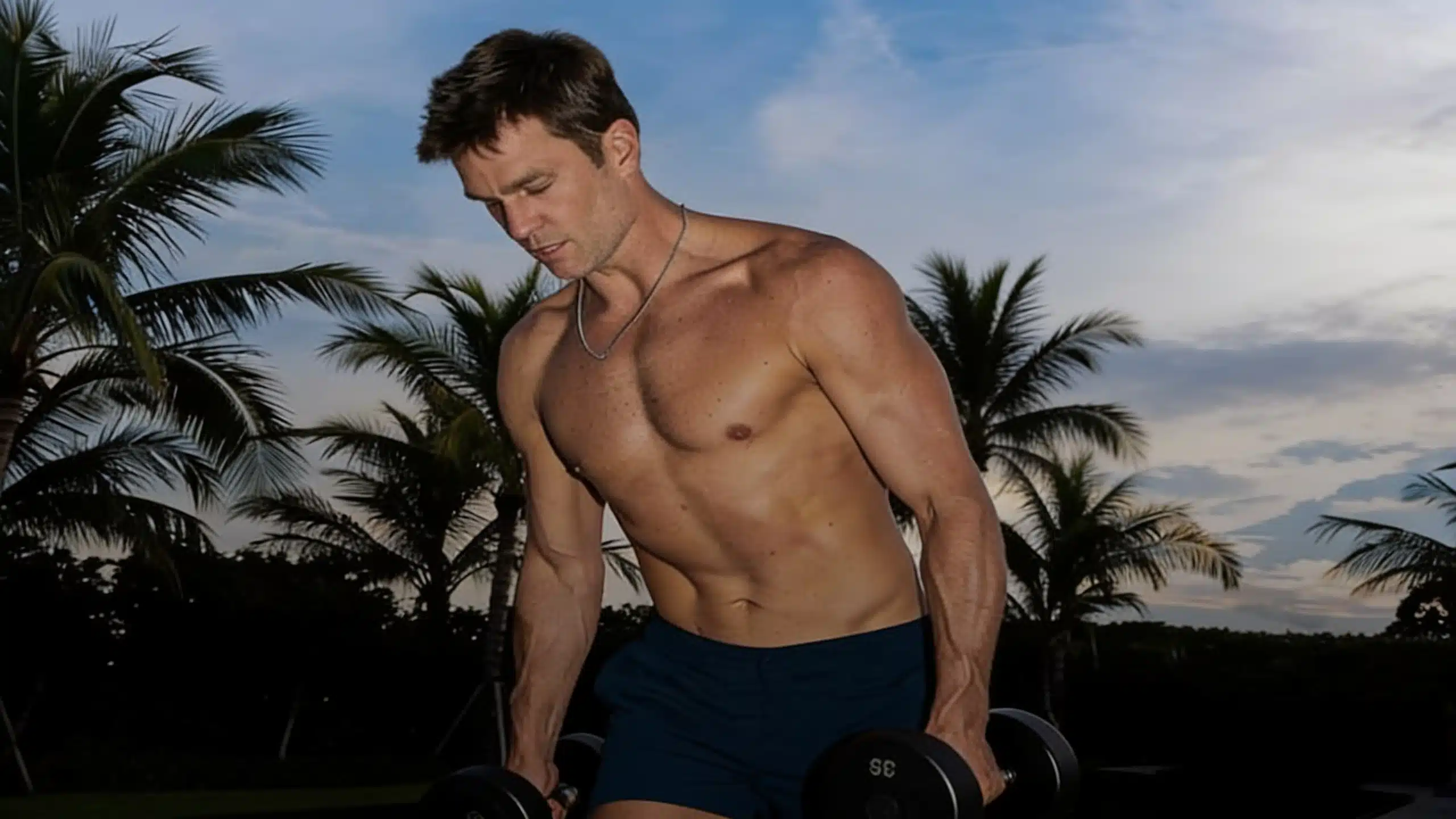
Brady attributed much of his longevity to the TB12 Method, a proprietary wellness system he developed with trainer Alex Guerrero and later commercialized into a full brand.
But when exercise scientists examine the TB12 Method through the lens of peer-reviewed research, a striking pattern emerges: some elements are backed by solid evidence, while others exist primarily as marketing frameworks with no scientific validation.
Jump to:
- Brady’s Exceptional Career Numbers
- What Is the TB12 Method?
- The Science Behind Massage and Soft Tissue Work
- The Problem With ‘Pliability’
- Strength Training: What Actually Prevents Injuries
- What the TB12 Method Doesn’t Account For
- The Commercial Conflict of Interest
- What Actually Works for Longevity
- The Takeaway for Regular Athletes
Brady’s Exceptional Career Numbers
Brady retired in February 2023 after 23 NFL seasons, holding records for career passing touchdowns (624 in regular season) and passing yards. He won seven Super Bowl championships across two decades.
Beyond the statistics, his physical availability stands out most. Outside of a torn ACL that ended his 2008 season after one game, Brady missed almost no playing time across his career.

If you want something simple that actually works, this is one of the most effective tools I’ve used to build strength, conditioning, and endurance without needing a full gym setup.
- Full-body training with one weight using swings, squats, and presses
- Solid cast iron build that feels stable and lasts for years
- Comfortable grip that makes high-rep workouts easier to handle
During the 2020 season—at age 43—Brady took just 21 sacks, making him eighth-best among quarterbacks with at least 300 pass attempts, according to NFL Next Gen Stats. For context, taking fewer sacks typically indicates either exceptional pocket awareness or elite offensive line protection, both factors that reduce cumulative physical trauma.
What Is the TB12 Method?
Brady and Guerrero co-authored The TB12 Method in 2017 and built TB12 Sports, a commercial wellness brand, around these principles. The system centers on several core concepts:
- ‘Pliability’—described as sustained, deep-force muscle softening through specialized bodywork
- Heavy hydration protocols throughout training days
- Anti-inflammatory diet emphasizing plant-based whole foods
- Resistance band-based training as a primary strength method
- Daily soft tissue and massage work for recovery
This created a direct commercial relationship between Brady’s personal routine and products sold to consumers—a detail that becomes important when evaluating scientific claims.
The Science Behind Massage and Soft Tissue Work
On recovery and massage, the peer-reviewed evidence actually supports Brady’s emphasis. A 2018 meta-analysis published in Frontiers in Physiology by Dupuy and colleagues pooled multiple recovery intervention studies.
Researchers found massage produced the largest reductions in delayed onset muscle soreness (DOMS) and inflammatory markers compared to other popular methods including compression garments, cold water immersion, and active recovery protocols.
This validates one pillar of Brady’s routine: daily soft tissue work likely contributed meaningfully to his recovery between games and practices. Sports physiotherapists have used similar approaches for decades with elite athletes across multiple sports.
If you want something simple that actually works, this is one of the most effective tools I’ve used to build strength, conditioning, and endurance without needing a full gym setup.
- Full-body training with one weight using swings, squats, and presses
- Solid cast iron build that feels stable and lasts for years
- Comfortable grip that makes high-rep workouts easier to handle
The Problem With ‘Pliability’
Here’s where science and marketing diverge sharply.
The term ‘pliability’ as Brady and Guerrero define it does not correspond to any established concept in exercise physiology or sports science literature. No randomized controlled trials have been published testing pliability as an intervention.
Exercise physiologists note this represents a common pattern in commercial wellness brands: taking evidence-based practices (like massage therapy), rebranding them with proprietary terminology, then marketing that terminology as a unique breakthrough.
The absence of independent peer-reviewed validation makes it impossible to determine whether ‘pliability’ offers benefits beyond conventional soft tissue work—or whether it’s simply massage with a trademark.
Strength Training: What Actually Prevents Injuries
On injury prevention through resistance training, the evidence base is remarkably robust. A landmark 2014 meta-analysis by Lauersen and colleagues in the British Journal of Sports Medicine pooled 25 randomized trials covering 26,610 participants.
The findings were striking: strength training reduced sports injury rates to less than one-third of control rates—the largest protective effect recorded in injury prevention research.
If you want something simple that actually works, this is one of the most effective tools I’ve used to build strength, conditioning, and endurance without needing a full gym setup.
- Full-body training with one weight using swings, squats, and presses
- Solid cast iron build that feels stable and lasts for years
- Comfortable grip that makes high-rep workouts easier to handle
This benefit, however, is attributed to progressive overload with conventional strength training—meaning gradually increasing resistance over time to build tissue resilience.
The Resistance Band Question
Brady emphasized resistance bands as his primary training tool, but exercise scientists point out that bands typically cannot produce the loading magnitudes achieved with free weights or machines.
While bands offer valuable benefits for activation work, travel training, and specific movement patterns, the injury-prevention effects documented in the Lauersen meta-analysis came from heavier, progressive resistance protocols—not band-only training.
Sports scientists suggest Brady’s durability likely stemmed from doing some form of consistent resistance training over two decades, not from bands specifically.
What the TB12 Method Doesn’t Account For
Sports physiotherapists and performance researchers highlight several factors Brady’s commercial narrative downplays:
- Elite pocket presence: Brady’s ability to read defenses and release quickly reduced hits taken throughout his career
- World-class offensive line support: Particularly in championship years, Brady played behind top-tier protection
- Genetic factors: Tissue resilience, recovery capacity, and injury resistance have significant hereditary components
- Position-specific advantages: Quarterbacks take fewer hits than running backs or linebackers by nature of the position
One public health concern raised by experts: routines optimized for one exceptional athlete operating at the extreme tail of genetic and circumstantial advantage carry serious risks when marketed to general consumers.
If you want something simple that actually works, this is one of the most effective tools I’ve used to build strength, conditioning, and endurance without needing a full gym setup.
- Full-body training with one weight using swings, squats, and presses
- Solid cast iron build that feels stable and lasts for years
- Comfortable grip that makes high-rep workouts easier to handle
What worked for Brady may not translate to recreational athletes with different genetics, injury histories, training backgrounds, and life circumstances.
The Commercial Conflict of Interest
Exercise physiologists emphasize a critical methodological problem: no independent peer-reviewed study has tested the TB12 Method as a complete system.
The commercial wellness brand evaluates its own efficacy through testimonials and case studies, but without controlled trials comparing TB12 protocols to conventional training and recovery approaches, it’s impossible to attribute Brady’s outcomes to any specific intervention.
This represents a fundamental conflict inherent in athlete-endorsed wellness brands: the financial incentive to attribute success to proprietary methods rather than conventional, evidence-based practices anyone can access without purchasing products.
What Actually Works for Longevity
Stripping away marketing terminology, several elements of Brady’s routine align with established sports science:
- Consistent massage and soft tissue work for recovery (supported by Dupuy 2018 meta-analysis)
- Progressive strength training for injury prevention (supported by Lauersen 2014 meta-analysis)
- Adequate sleep for tissue repair and cognitive function
- Whole-food, anti-inflammatory nutrition for general health
- Hydration for performance and recovery
None of these require proprietary frameworks or expensive branded products. They represent fundamental principles sports scientists have recommended for decades across all athletic populations.
If you want something simple that actually works, this is one of the most effective tools I’ve used to build strength, conditioning, and endurance without needing a full gym setup.
- Full-body training with one weight using swings, squats, and presses
- Solid cast iron build that feels stable and lasts for years
- Comfortable grip that makes high-rep workouts easier to handle
The Takeaway for Regular Athletes
Brady’s career longevity deserves recognition as genuinely exceptional. His commitment to recovery, training consistency, and body maintenance clearly contributed to his durability.
But when evaluating wellness systems for personal use, prioritize interventions backed by independent peer-reviewed research over proprietary concepts with commercial ties.
Focus on evidence-based fundamentals: progressive strength training, adequate sleep, regular soft tissue work through massage or foam rolling, whole-food nutrition, and proper hydration. These practices don’t require expensive programs or trademarked methodologies.
Brady’s success likely came from applying proven principles consistently over decades—combined with exceptional genetics, elite coaching, world-class medical support, and the strategic intelligence that made him a seven-time champion.
That’s a more complex and less marketable story than ‘pliability,’ but it’s what the science actually supports.