

Building a strong, well-developed backside doesn’t require crushing your spine under heavy barbells.
That’s the conclusion from a recent 90-day experiment that pitted traditional heavy squats and deadlifts against spine-friendly alternatives.
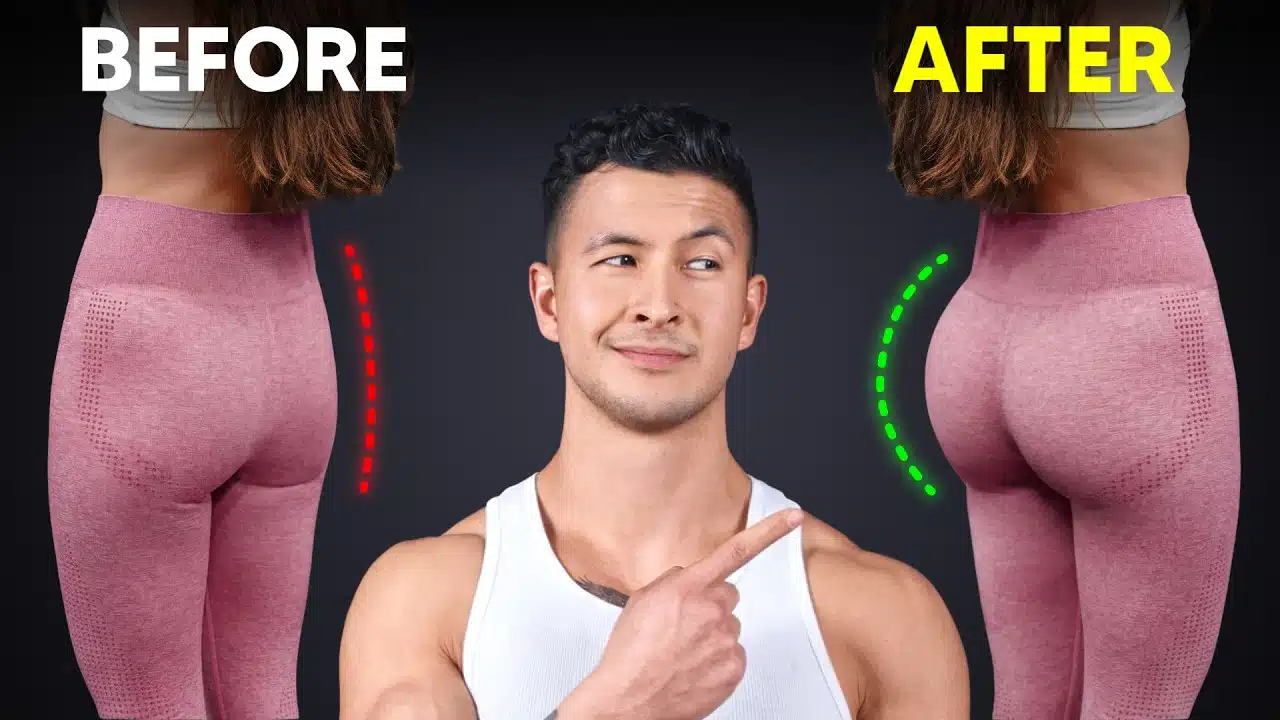
The results might surprise anyone who thinks barbell exercises are non-negotiable for glute growth.
And for those dealing with back pain or injury, this approach offers hope that building impressive glutes is still within reach.
Jump to:
- When Injury Changes Everything
- The Glute Expert’s Alternative Approach
- Starting Measurements and Training Split
- Early Challenges and Misconceptions
- The Heavy Squats Testosterone Myth
- Squats vs. Hip Thrusts: What Science Actually Shows
- Week Three: The Gains Arrive
- Hidden Advantages Women Have for Glute Training
- 30-Day Checkpoint
- The Protein Source Debate
- Ramping Up Volume (and Consequences)
- The Detraining Effect
- Unexpected Athletic Benefits
- The Final Results
- Key Takeaways for Building Better Glutes
When Injury Changes Everything
After a severe back injury from heavy squats five years ago, one woman watched her glutes gradually flatten despite training with an elite personal trainer for a decade. Her husband faced similar struggles, admitting he’d gotten lazy with glute training because it felt uncomfortable.
But weak glutes create problems beyond aesthetics. They compromise movement quality, reduce lifting strength, and contribute to back tightness and knee pain.
So they embarked on a 90-day challenge with different approaches: she would rebuild her glutes without squats, deadlifts, or heavy spinal loading, while he could use any exercises he wanted.
The Glute Expert’s Alternative Approach
Enter Brett Contreras, the researcher who literally invented the hip thrust and has dedicated his career to studying glute development.
Without crazy heavy weights, without squats, without deadlifts, can she still grow her glutes? Yeah, this is a piece of cake.
Contreras designed a program around four essential movement patterns that build complete glute development: lower body press, lower body hinge, squeeze, and abduction.
The genius lies in finding safer alternatives that deliver identical muscle-building stimulus without spinal compression.
Movement Pattern #1: The Press (Without Traditional Squats)
Instead of barbell back squats, Contreras programmed glute-dominant step-ups and box squats with mostly vertical shins. These variations create maximal hip extension torque—the key driver of glute activation—while requiring significantly less weight.
The positioning is critical. Keeping shins vertical and thighs parallel at the bottom creates stretch and torque loading exactly where it’s needed.
Movement Pattern #2: The Hinge (Deadlift Replacement)
Single-leg dumbbell deadlifts became the hinge movement of choice. They challenge glutes as effectively as conventional deadlifts but require far less total load, reducing spinal stress considerably.
Contreras emphasized maintaining a slightly bent knee throughout the movement. This subtle adjustment shifts tension from hamstrings directly into glutes.
I’m not coming like full stand. Yep. Exactly.
Movement Pattern #3: The Squeeze (Hip Thrust Mastery)
The barbell hip thrust—Contreras’s signature exercise—became a cornerstone of her program. But technique details determine whether this movement builds glutes or irritates lower backs.
Most people hyperextend their spine at the top, creating unnecessary back pressure. Contreras teaches the “scoop method” instead: tuck chin down, tilt pelvis upward by squeezing glutes, moving from chest downward.
Range of motion decreases slightly, but glute activation skyrockets while back stress plummets.
Movement Pattern #4: Abduction (Finishing Touch)
Hip abduction movements completed each workout, targeting areas other exercises might miss.
I always call this penalty-free volume. You add it in, it doesn’t beat you up. It adds to the glute hypertrophy stimulus without fatiguing you much.
Sitting upright targets upper glutes. Leaning forward shifts tension to lower glutes. Pairing both positions back-to-back creates comprehensive development without excessive fatigue.
Starting Measurements and Training Split
Day one glute circumference: she measured 92 cm, he measured 92.5 cm—virtually identical starting points.
Her training protocol included glute-focused workouts twice weekly, following Contreras’s exercise selection. His approach incorporated the same glute exercises but added heavy squats, deadlifts, and maintained substantial upper body training volume.
This created an interesting variable: roughly 80% of her training emphasized glutes, while his attention remained divided across multiple muscle groups.
Early Challenges and Misconceptions
Week one brought unexpected concerns. Despite executing exercises correctly, she wasn’t experiencing muscle soreness.
I’m a little concerned because I’ve just finished my first few workouts and my glutes aren’t really sore and to me soreness means growth and development.
This reflects a common misconception. Multiple studies demonstrate that soreness is not an indicator of muscle growth. In fact, Contreras specifically chose exercises that produce less muscle damage and soreness than squats or Bulgarian split squats, enabling faster recovery between sessions.
Meanwhile, she struggled with two psychological barriers: fear of reinjury and anxiety about gaining body fat from increased food intake.
The Heavy Squats Testosterone Myth
Heavy squats do trigger acute testosterone increases of 10-20%, higher than other leg exercises like leg press. Sounds like a significant advantage, right?
Not quite. This hormonal spike lasts only 15-45 minutes post-workout before returning to baseline. While it might explain why heavy squats feel empowering in the moment, research shows these brief elevations don’t provide meaningful muscle-building advantages.
Squats vs. Hip Thrusts: What Science Actually Shows
In 2023, Contreras published research directly comparing squats against hip thrusts for glute development.
Squats produced superior quad and inner thigh growth. But for glutes specifically? Both exercises delivered identical results.
This finding challenges conventional wisdom that squats reign supreme for glute development. Hip thrusts match their effectiveness while eliminating spinal compression—a game-changer for anyone with back concerns.
Week Three: The Gains Arrive
By week three, visible changes emerged. She started setting personal records, eventually hip thrusting 135 pounds—a weight she hadn’t touched in six years.
I’m really proud to be honest cuz I haven’t done this weight in like 6 years. And it actually felt really easy. Like that was 12 reps.
Meanwhile, he noticed his glute training enhanced his squat performance, making movements feel smoother and considerably stronger.
Hidden Advantages Women Have for Glute Training
Based on extensive coaching experience, Contreras observed that women generally recover faster from lower body training than men and can handle greater volume and frequency.
This pattern emerged clearly in their experiment. When she felt ready for another workout, he still needed one or two additional recovery days. She consistently accumulated more total weekly sets targeting glutes.
Her second advantage stemmed from training focus. With 80% of her program dedicated purely to glutes versus his divided attention across multiple muscle groups, her body could allocate more recovery resources toward one specific area.
While unstudied for glutes specifically, this principle has proven effective for other muscle groups. When your body has fewer competing priorities, growth accelerates.
30-Day Checkpoint
After one month of training, measurements revealed surprising results: both gained exactly 1 cm of glute circumference. Dead even.
However, she wasn’t consistently hitting calorie targets based on app tracking. If this continued, progress might eventually stall regardless of training quality.
The Protein Source Debate
Does protein source matter for muscle growth? Recent research provides clarity.
One study compared vegan lifters (eating tofu, soy, lentils) against meat eaters (consuming animal protein, shakes, eggs). Both groups consumed 0.7g protein per pound of bodyweight daily.
After 12 weeks: identical muscle and strength gains between groups.
Conclusion: As long as total protein intake reaches adequate levels, the source matters far less than once believed.
Ramping Up Volume (and Consequences)
For clients seeking maximum growth, Contreras prescribes 30-40 weekly sets of glute training. She decided to increase from two to three weekly sessions, jumping from 20 to 30+ sets.
Initially, everything felt manageable. But tightness gradually accumulated in her upper left glute, spreading into her lower back. Eventually, she reaggravated her injury.
I hurt my back at the gym yesterday and I came today to try to work out and it’s very clear that I’m going to need a few days off, which is really frustrating for me.
After several rest days, her back improved. They scaled training back to two weekly sessions—a sustainable frequency that balanced growth stimulus against injury risk.
The Detraining Effect
After just one week off, her glutes looked and felt noticeably flatter. She worried about losing muscle.
What actually happened: muscles store less glycogen during training breaks. Since glycogen pulls water into muscle tissue, they appear less full—like deflating a balloon slightly.
Research indicates actual muscle loss doesn’t begin until at least three weeks of complete inactivity. Her concerns, while understandable, weren’t supported by physiology.
Unexpected Athletic Benefits
Beyond aesthetics, he discovered his glute training delivered genuine performance improvements. Running felt easier, with glutes contributing noticeably more power to each stride.
His vertical jump increased 5 cm over 90 days—jumping from average to above-average performance without any jump-specific practice. Broad jump distance improved 2 cm despite already scoring “excellent” on day one.
These gains came primarily from adding just three hard sets of hip thrusts per leg workout.
The Final Results
After 90 days of consistent training, final measurements told the story:
- Her progress: 92 cm to 94 cm (2 cm growth)
- His progress: 92.5 cm to 94 cm (1.5 cm growth)
She won—building more glute mass without squats or deadlifts than he achieved with heavy compound movements.
But both walked away winners. She overcame injury fears and rediscovered genuine enjoyment in training. He developed newfound appreciation for glute training’s impact on overall athleticism and movement quality.
Key Takeaways for Building Better Glutes
This experiment demolishes several persistent myths while highlighting practical strategies anyone can implement:
- Heavy squats aren’t mandatory. Hip thrusts, step-ups, and single-leg deadlifts produce equivalent glute growth with less spinal stress
- Soreness doesn’t indicate growth. Exercises causing less muscle damage enable faster recovery and potentially more frequent training
- Testosterone spikes from squats are irrelevant. Brief post-workout elevations don’t translate to meaningful muscle-building advantages
- Exercise selection should match your body. Choose movements that feel good and allow progressive overload without pain
- Women may handle glute volume better. Faster recovery potentially allows higher training frequency
- Focused training accelerates results. Dedicating more resources to one muscle group may enhance growth compared to divided attention
- Protein source matters less than amount. Hit adequate total protein intake regardless of whether it comes from plants or animals
For anyone struggling with back issues or simply looking to build stronger, more athletic glutes, this approach offers a proven alternative to conventional wisdom. Start with three challenging sets of hip thrusts added to existing leg workouts, master the four movement patterns, and adjust volume based on individual recovery capacity.
Strong glutes improve far more than appearance—they enhance movement quality, athletic performance, and long-term joint health. And as this experiment proves, you don’t need to sacrifice your spine to build them.










