Two Belgian brothers walked into what would become the most transparent fitness challenge of their lives.
They weren’t just signing up for another workout program—they were stepping into a complete lifestyle overhaul, cameras rolling, with nothing to hide.
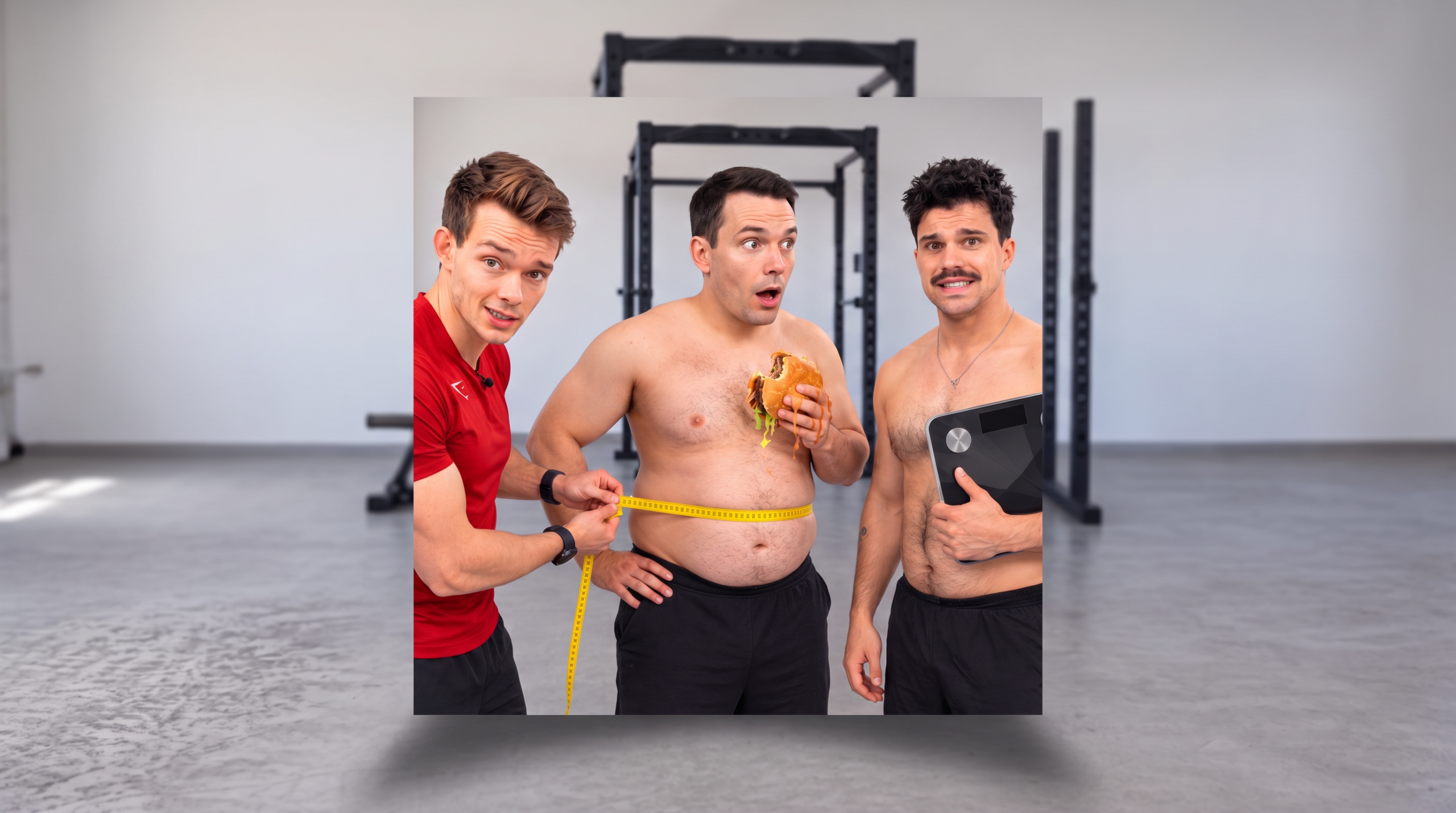
Popular fitness coach Stan Browney recently pulled back the curtain on what “day one” really looks like in his famous 90-day transformation challenges, and the raw honesty is refreshing.
From embarrassing weigh-ins to strength tests that humble even the most optimistic participants, this is where motivation either crystallizes into commitment or evaporates into excuses.
Jump to:
- Meeting Two Brothers Ready for Change
- The Power of Documentation
- Beyond Physical Goals: Mental Health Connection
- Metabolic Age Reveals Hidden Truth
- The Measurements That Matter
- The Strength Tests: Reality Check
- Setting the App and Coaching Structure
- Learning to Train: Failure as Success
- Diet: Where 90% Fail
- The Real Challenge: Time and Priorities
- Motivation Versus Discipline
- The 90-Day Timeline: What Science Says
- Support System: Supplements and Gear
- What Happens Next
- Sources
Meeting Two Brothers Ready for Change
The brothers, fans of Browney’s transformation series for years, arrived with a mix of excitement and nervous energy. One weighed in at 104.1 kg with 29.1% body fat. The other hit 82.3 kg with 21% body fat.
Their goals? Ambitious but different.
No products found.
I want to have like good endurance, basic fat loss to be more lean than muscular cuz we already have like a genetic muscular base. I don’t want to be as buff as you.
The older brother, at 34, wanted to drop 20 kg. The younger one, 27, aimed for 18 kg lost during a live stream commitment.
Both had athletic backgrounds—one as a top recruit football player, the other as a high-level swimmer—but years of neglect had buried those physiques under layers of poor habits.
The Power of Documentation
Browney emphasized something most people skip: recording everything from day one.
Photos, measurements, body composition data—all logged into the app as an immutable starting point. This isn’t vanity; it’s strategic.
These will be so important in the future because you can look back on these photos. The difference you can see in 90 days or even just 30 days are crazy.
The brothers revealed tattoos that told their own story—food ink commemorating a failed 10,000 calorie challenge, a crab patty for burger love, Belgian fries as a favorite dish.
These weren’t just tattoos. They were monuments to a lifestyle both men were ready to leave behind.
No products found.
Beyond Physical Goals: Mental Health Connection
What stood out wasn’t just their weight loss targets—it was why they wanted change.
I actually have another goal. I want to be physically fit so that my mental health can follow along. I think that’s my number one goal.
Sleep quality emerged as another major concern. Poor sleep had become routine, creating a vicious cycle affecting recovery, energy, and mental clarity.
Browney confirmed what research consistently shows: inadequate sleep sabotages everything. A 2010 study in *Annals of Internal Medicine* found that sleep-restricted dieters lost 55% less fat compared to well-rested participants, despite identical calorie deficits.
When the younger brother was healthy before, he slept well. Now the opposite was true—and breaking that pattern would be crucial.
Metabolic Age Reveals Hidden Truth
Body composition scans delivered surprising news. The older brother’s metabolic age came in at 31—three years younger than his actual age of 34, likely thanks to decent cardiovascular health from past swimming.
The younger brother scored even better: metabolic age of 25 at actual age 27.
No products found.
These measurements, taken via bioelectrical impedance analysis, provide useful baselines. A 2016 study in the *Journal of Clinical Densitometry* validated BIA devices as correlating well with gold-standard DEXA scans, though accuracy depends on device quality and hydration status.
What both brothers had: significant muscle mass hiding under body fat, creating enormous transformation potential.
The Measurements That Matter
Browney took detailed measurements of chest, arms, waist, belly, and legs—creating a complete baseline map.
The older brother’s arms measured impressively lean at 36.5 cm despite never doing resistance training. His chest came in at 115 cm, belly at 113 cm.
The younger brother showed remarkable symmetry: both arms at 41 cm flexed, both legs at exactly 69 cm.
Very symmetrical physiques, which is good. Also, most of the time a sign for people that don’t work out because they don’t grow the muscle.
These measurements would become benchmarks for tracking progress beyond just scale weight—capturing where fat disappeared and muscle appeared.
No products found.
The Strength Tests: Reality Check
This is where day one gets brutally honest. Pull-ups and push-ups reveal functional strength—or lack thereof.
The younger brother managed 5 pull-ups, exactly what he predicted. The older brother completed 2, struggling with his bodyweight.
I am so heavy. This is heavy.
Browney noted this feeling would transform dramatically. Pull-ups become the ultimate measure of relative strength—how efficiently your muscles move your body through space.
Push-ups told a different story. The younger brother pumped out 26 repetitions, the older brother hit 25—both far exceeding expectations.
Hidden strength existed, waiting to be unleashed through proper training.
Setting the App and Coaching Structure
Browney’s 90-day challenge operates through a dedicated app that personalizes workout plans based on available time, equipment, location (gym vs. home), and specific goals.
No products found.
The brothers would have three coaches: Browney himself, Vincent (the cameraman), and another team member—all accessible 24/7 for questions, adjustments, and accountability.
This structure addresses what research shows about transformation success: accountability dramatically increases adherence.
The Tattoo Bet
To raise the stakes, Browney proposed consequences for failure: both brothers would get tattoos of a brownie with a six-pack.
The brothers agreed without hesitation—confident they wouldn’t need that ink.
Learning to Train: Failure as Success
Coach Vincent immediately noticed something common among beginners: they quit reps before actual muscular failure.
I could see when you wanted to stop. You could do five more. That’s where you get the growth from.
This is where the science gets interesting. A 2021 meta-analysis in *Sports Medicine* examined training to failure versus leaving reps in reserve. Results showed similar muscle growth when volume was matched, but training to absolute failure increased injury risk and central nervous system fatigue.
No products found.
The practical takeaway: beginners should push close to failure—learning where true limits exist—but don’t need to reach complete failure every set. Experienced lifters can strategically use failure training, but it’s not mandatory for growth.
Browney also taught fundamental gym safety: proper deadlift form for picking up dumbbells, how to safely position weights, and explosive movements without injury.
Diet: Where 90% Fail
Training creates the stimulus. Nutrition determines the results.
Neither brother had ever counted calories. Their eating patterns revealed the usual suspects:
- Convenience eating: grabbing burgers and fries when out
- Weekly family ritual: “fritkot” (Belgian fries) almost every Sunday
- Hidden calories: mayonnaise, sugary drinks, alcohol
- Irregular meal timing: healthy dinners but chaotic daytime eating
Browney introduced them to high-protein recipes from the app—meals his girlfriend created that surprised both brothers with their taste.
This kind of food I actually really like.
Research strongly supports high-protein approaches. A 2020 meta-analysis in *Advances in Nutrition* found protein intakes of 1.6-2.2 grams per kilogram of body weight preserved lean muscle during calorie deficits and increased satiety compared to lower protein diets.
No products found.
The Alcohol Challenge
Browney threw down a gauntlet: no alcohol for 90 days.
One brother accepted immediately. The other, who regularly enjoyed beers, agreed after clarifying zero-alcohol beer would be allowed.
This isn’t arbitrary restriction. A 2013 review in *Current Obesity Reports* documented how alcohol derails body composition through multiple mechanisms: empty calories at 7 per gram, disrupted sleep architecture, impaired muscle protein synthesis, and increased fat storage particularly around the midsection.
Removing alcohol eliminates these barriers entirely.
The Real Challenge: Time and Priorities
When asked about their biggest fear, both brothers identified the same obstacle: time management.
The most difficult for me is to prioritize health, which is the stupidest thing to say because it should always be a priority.
This honesty cuts to the heart of why most transformations fail. It’s not lack of knowledge or even motivation—it’s the daily decision to prioritize health when everything else screams for attention.
No products found.
Browney reframed it simply: “It’s all about priorities.”
Motivation Versus Discipline
The younger brother outlined his timeline expectations, predicting the first 30 days would be “a bit tough, but manageable.” He worried about days 30 to 90.
1 to 30 is hype. 30 to 90 is discipline.
Browney’s response captured the entire transformation journey in one sentence. Initial motivation carries people through early wins—the first few pounds lost, initial strength gains, compliments from friends.
But transformation happens when discipline replaces motivation—when you train even though you don’t feel like it, when you prep meals despite being tired, when you choose water over beer at social events.
That’s the 30-to-90-day reality that separates successful transformations from abandoned attempts.
The 90-Day Timeline: What Science Says
Can someone truly transform in 90 days? The research offers a nuanced yes.
No products found.
A 2017 systematic review in *Obesity Reviews* examined 8-12 week intervention studies combining diet and exercise. Previously untrained individuals achieved significant fat loss and muscle gain within this timeframe.
Individual results varied significantly based on:
- Starting body composition and training history
- Adherence to nutrition and training protocols
- Sleep quality and stress management
- Genetic factors affecting metabolism and muscle building
The brothers’ advantages: previous athletic backgrounds, decent starting muscle mass, and high motivation levels. Their challenges: no resistance training experience, poor sleep patterns, and ingrained eating habits.
Support System: Supplements and Gear
Browney equipped both brothers with essentials from MyProtein—protein powder, creatine, electrolytes, protein bars, and peanut butter (though he noted bars are calorically dense).
Gymshark provided workout clothing for the journey, with the expectation they’d need new sizes by day 90.
While supplements aren’t magical, creatine monohydrate stands out as one of the most researched and effective supplements for strength and muscle gains, while protein powder offers convenient nutrition when whole food options aren’t practical.
No products found.
What Happens Next
Day one ended with both brothers fully committed, equipped, educated, and ready. The measurements were logged. The strength baselines established. The diet plan activated. The coaching structure in place.
Browney’s parting thought captures the real work ahead:
I really hope they stay this dedicated when they notice it’s getting harder and motivation fades and it’s just discipline. 90-day challenge is very possible. You can change your entire life in 90 days, but it’s not easy.
The transparency of this day-one process reveals something crucial: transformation isn’t mysterious. There’s no secret formula, no hack, no shortcut.
There’s measurement, accountability, proper programming, nutritional discipline, and the willingness to push past comfort—repeatedly, for 90 consecutive days.
The brothers left with everything except one thing: the 89 days of decisions still ahead of them.
Sources
- Journal of Clinical Densitometry, 2016: https://www.clinicaldensitometry.com
- Obesity Reviews, 2017: https://onlinelibrary.wiley.com/journal/1467789x
- Annals of Internal Medicine, 2010: https://www.acpjournals.org/journal/aim
- Sports Medicine, 2018 and 2021: https://www.springer.com/journal/40279
- Current Obesity Reports, 2013: https://www.springer.com/journal/13679
- Advances in Nutrition, 2020: https://www.sciencedirect.com/journal/advances-in-nutrition