Strong in the gym, fragile everywhere else.
That’s the reality for most people who train consistently but still deal with chronic tightness, nagging pain, and mysterious tweaks that seem to come out of nowhere.
The problem isn’t weakness—it’s what one fitness expert calls a “movement gap,” and it’s hiding in plain sight.
In a recent deep dive into human movement patterns, the expert revealed five foundational movements that modern training has completely abandoned, and why adding them back could be the missing piece in your fitness routine.
Jump to:
The Four-Song Playlist Problem
Most gym programs are built around an incredibly narrow movement vocabulary: push, pull, hinge, squat. That’s essentially it.
That’s not fitness. That’s repetition masquerading as progress.
Most gym training is built around a very narrow range of human movement. Push, pull, hinge, squat. That’s about it. That’s not fitness. That is a playlist with four songs on repeat.
Human bodies evolved over hundreds of thousands of years to perform an enormous range of movement patterns. But somewhere around age five—when floor time got replaced with chair time—most people stopped accessing those patterns entirely.
What’s left are joints that only move in one plane, muscles that only fire in isolation, and bodies that look capable but feel fragile.
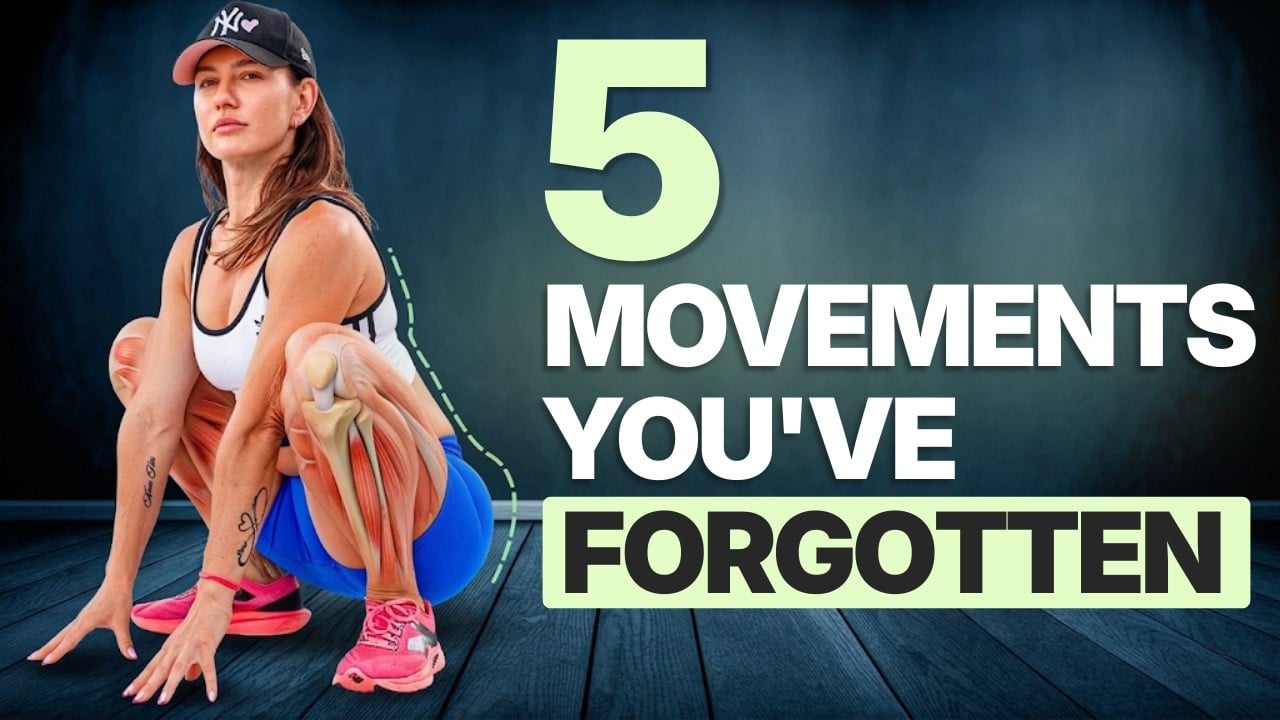
Movement One: The Deep Squat
Not a barbell squat. Not a goblet squat. A full-depth, heels-down, spine-upright resting squat.
Before chairs dominated daily life, humans spent hours each day in this position. In most of the world, it’s still a natural resting posture. In Western adults, it’s become a mobility test that most people fail spectacularly.
What it restores:
- Hip and ankle mobility
- Lumbar decompression
- Internal hip rotation
- Pelvic floor function
How to start: Hold onto something stable. Lower yourself into your deepest squat. Spend 2 to 5 minutes there daily.
Movement Two: The Passive Hang
Arms overhead, feet off the ground, spine decompressing under body weight.
Shoulder joints were engineered for overhead loading. Modern life has systematically eliminated that demand, and the consequences show up as the single most common source of chronic pain in adults: shoulder impingement, rotator cuff issues, relentless upper back tightness.
60 seconds of hanging per day does more for shoulder health than most people’s entire upper body routine.
How to start: Hang from a bar for as long as possible. Work toward accumulating 60 seconds daily, even if that means multiple short sets.
During a 30-day experiment with these movements, the expert found hanging to be immediately humbling.
I thought my shoulders were healthy. I do handstands, but it turns out that passive hanging uses entirely different structures. My first hang felt like traction. Two weeks in, the chronic tension I’d normalized in my upper back started to lift.
Movement Three: The Bear Crawl
Hands and feet on the ground, knees elevated, moving in a cross-body pattern—right arm with left leg, left arm with right leg.
This was the first full-body movement pattern humans ever learned. It wires cross-body connections between brain hemispheres while building shoulder stability, hip stability, and coordinated core control simultaneously.
Nobody does this after age three. That’s exactly the problem.
How to start: Crawl forward for 20 seconds. Rest. Repeat. Gradually add time each week.
The crawl made me feel stupid, which is exactly the point. Your nervous system doesn’t like novel movement. The discomfort is information. Push through it.
Movement Four: The Roll
Full-body rolling—forward, backward, sideways—requiring floor contact, movement through space, and return to standing.
Rolling trains the nervous system to absorb and redirect force. It’s how humans fall without injury. It’s how the floor becomes a three-dimensional surface instead of just something to stand on.
It also demands more spinal segmentation than almost any other movement pattern. Most adults roll like a plank, which reveals just how much spinal control has been lost.
How to start: Practice a slow side roll, ensuring each vertebra contacts the floor in sequence rather than moving as one rigid block.
Movement Five: Floor Get-Up (No Hands)
Sit cross-legged on the floor. Stand back up. No hands. No knees. No pushing off anything.
If this is impossible, there’s a problem that no gym routine can fix.
This isn’t a strength issue. It is a coordination, mobility, and neuromuscular control issue. This matters more than any lift in your program.
How to start: Practice daily. Use one hand initially if necessary, but work systematically toward zero support.
Even with years of practice, the expert discovered hidden asymmetries when filming the movement.
I filmed myself and I noticed that I was still slightly favoring one side. Small asymmetries compound over decades.
Why These Movements Matter More Than Your PR
These aren’t trendy mobility drills or ancient wellness secrets. They’re basic biomechanical requirements of a functioning human body.
Gym routines train performance. These five movements maintain the foundation that performance sits on.
When foundation cracks, it doesn’t matter how much gets built on top.
During the 30-day test period, each movement revealed something different:
- Deep squats exposed hidden hip dysfunction that had been easy to ignore
- Hanging immediately revealed normalized tension patterns
- Crawling created productive nervous system discomfort
- Rolling transformed relationship with the floor from threat to tool
- Floor get-ups uncovered subtle but significant asymmetries
The Movement Gap Assessment
Try all five movements today:
- Squat as deep as possible for 60 seconds
- Hang for as long as possible
- Crawl for 30 seconds
- Attempt a controlled roll
- Get up from floor without using hands
Film yourself. Note what was hardest.
That’s your weak link. And your weakest link is precisely where injury lives.
These movements aren’t additions to training—they’re the foundation that makes training sustainable. They’re what keeps bodies resilient when gym strength isn’t enough.
Start with whichever movement exposed your biggest gap. Spend just a few minutes daily. The body remembers patterns it thought were lost; it just needs consistent reminders.