Social media fitness can be deceiving.
Popular fitness YouTuber Geoffrey Verity Schofield recently addressed why so many people overestimate his size, revealing he weighs around 90 kilograms (just under 200 pounds) — not the 110-130 kilograms many assume.
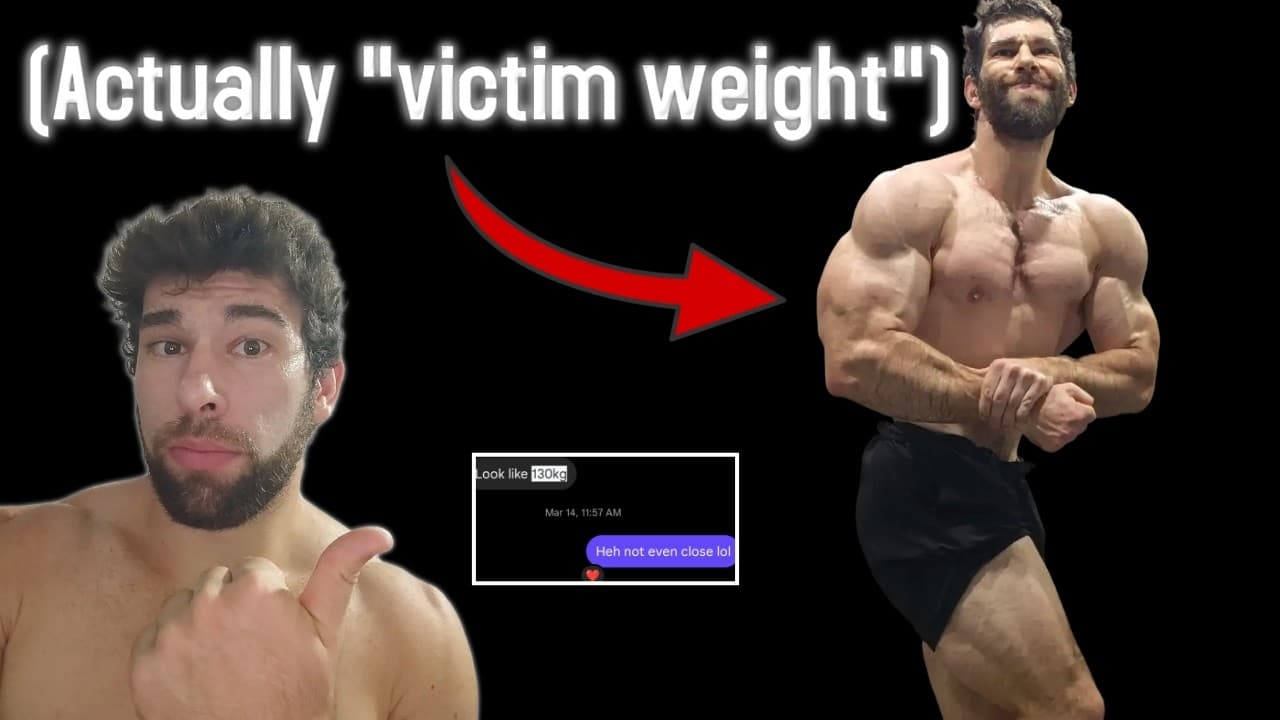
In his latest video, Schofield broke down the key factors that make natural lifters appear significantly bigger than they actually are, ranking them from least to most genetic.
Understanding these variables might change how you view physiques online — and how you approach your own training.
Jump to:
Leanness: The Ultimate Game-Changer
According to Schofield, body fat percentage is the single most controllable factor that dramatically affects perceived size.
If I am 18, 20, 22% body fat at the top of a bulk, I’m not going to get any fake natty accusations. Some people won’t even take me seriously. That is like fitness industry fat.
He emphasizes that while there’s nothing inherently unhealthy about sitting at 18-20% body fat, the visual impact pales in comparison to being 10% or leaner. The leaner someone gets, the more muscle definition becomes visible — striations, individual muscle bellies, and separation around joints all pop dramatically.
Schofield makes a bold claim: most people watching could get “fake natty accusations” if they dieted down to true stage leanness of 5-6% body fat, even without exceptional muscle mass.
The Clothing Paradox
Leanness works both ways. While shredded physiques look impressive shirtless, they often appear smaller in clothing since there’s less mass filling out shirts around delts, chest, and traps.
This creates the classic “sleeper build” phenomenon — appearing normal clothed but surprisingly muscular when revealed.
Fullness and Pumps Matter More Than You Think
Muscle fullness represents another entirely controllable variable that separates impressive physiques from flat, depleted ones.
Oh, he looks too full. Yeah, cuz you can’t have carbs when you’re dieting. It’s not like you have to go low carb. No, you could have pre-workout carbs. You can have sodium. You can train in a way that gets you a pump.
Schofield explains that natural lifters can maintain fullness through strategic nutrition timing, including:
- Pre-workout carbohydrate intake to maximize glycogen stores
- Adequate sodium consumption for muscle cell volumization
- Training protocols designed for pumps (higher rep ranges versus exclusively low reps)
- Refeed days and diet breaks during extended fat loss phases
- Slower dieting approaches to preserve metabolic function
While natural lifters won’t achieve the same inflated, constantly vascular appearance as enhanced athletes, proper diet structure prevents the frail, flat look common with crash dieting.
Posing and Flexing: The Hidden Skill
Most people dramatically underestimate how much posing affects perceived muscularity. Schofield admits he’s not an elite poser but understands which poses highlight his strengths.
He rarely performs front lat spreads because they reveal his narrower clavicle structure. Instead, he gravitates toward side chest, side triceps, and most muscular poses that emphasize his strong points.
Here is a picture of my legs unflexed. Here’s a picture of them flexed. Night and day difference. Huge difference.
Proper flexing becomes exponentially more important when lean, as striations and muscle separation become visible. Schofield specifically mentions flexing the rectus femoris by pushing forward to make quads pop — something most casual gym-goers never learn.
Key flexing techniques include:
- Contracting abs with proper pelvic positioning
- Pressurizing abdominals to enhance definition
- Creating “Christmas tree” lower back appearance
- Showing triceps horseshoe striations
- Individual muscle group activation rather than just “standing there”
Arm Dominance Creates Illusions
Schofield identifies arm development as partially controllable with significant genetic components. He estimates at least 50% of viewers could add an inch to their arms within a year through dedicated specialization.
Interestingly, arm-dominant physiques frequently trigger steroid accusations despite no evidence that anabolic drugs preferentially grow arms. Historical silver-era bodybuilders (pre-steroid) often displayed incredible arm development, while many modern steroid users experience disproportionate leg growth.
I don’t know why having an arm dominant physique gets you more steroid accusations. Doesn’t really make sense. There’s not really any kind of evidence or data there.
Regardless of logic, impressive arms consistently make lifters appear bigger and draw attention — making arm specialization a strategic choice for those wanting to maximize visual impact.
Genetics: Insertions, Waist Size, and Head Proportions
Some factors remain almost entirely genetic, though Schofield cautions against premature self-judgment.
Muscle Bellies and Insertions
Individual muscle definition, shape, and insertion points dramatically affect appearance when lean. Schofield believes most people judge their insertions too harshly, too early — before building sufficient muscle to reveal their unique structure.
Statistically, nearly everyone possesses at least several muscle groups with interesting, advantageous characteristics that simply haven’t been uncovered through adequate development.
Waist Circumference as a Multiplier
Small waist measurements create optical illusions that enhance every pose. Schofield’s 30-30.5 inch waist at 200 pounds amplifies his upper body appearance — purely genetic, not from vacuums or waist trainers.
I have a pretty small waist. At around 200 lb, it’s like 30, 30 and a half — genetic. I didn’t do anything for that. I don’t have like a secret or an ebook for the waist to sell you.
He uses waist structure as a natural versus enhanced indicator. Impressive physiques built on flow, symmetry, and taper (with smaller overall mass) suggest natural development, while massive, blocky physiques with thick waists at extremely high fat-free mass indexes raise questions.
Head Size: The Final Optical Trick
Smaller head circumference makes shoulders, arms, and overall musculature appear larger through proportional comparison. Since social media typically shows individuals alone, viewers subconsciously compare body parts to each other for size estimation.
Combined with a small waist, a smaller head maximizes visual impact without adding actual muscle mass — another entirely genetic advantage.
The Takeaway: Context Matters
Schofield’s analysis reveals that perceived size and actual size diverge significantly when multiple factors align. Leanness, fullness, posing ability, and genetic structure create compound effects that make some natural lifters appear far more massive than their scale weight suggests.
Understanding these variables provides valuable perspective when evaluating physiques online. Many impressive-looking athletes aren’t nearly as big as they appear — they’ve simply optimized controllable factors while capitalizing on genetic advantages.
For those building their own physiques, focusing on getting genuinely lean, maintaining fullness through smart nutrition, learning proper posing techniques, and potentially emphasizing arm development can dramatically improve how you look — regardless of what the scale says.