Elite Hyrox athletes are getting leaner. CrossFit competitors, meanwhile, keep packing on muscle.
Both sports use similar movements—burpees, wall balls, rowing—yet the physiques couldn’t be more different.
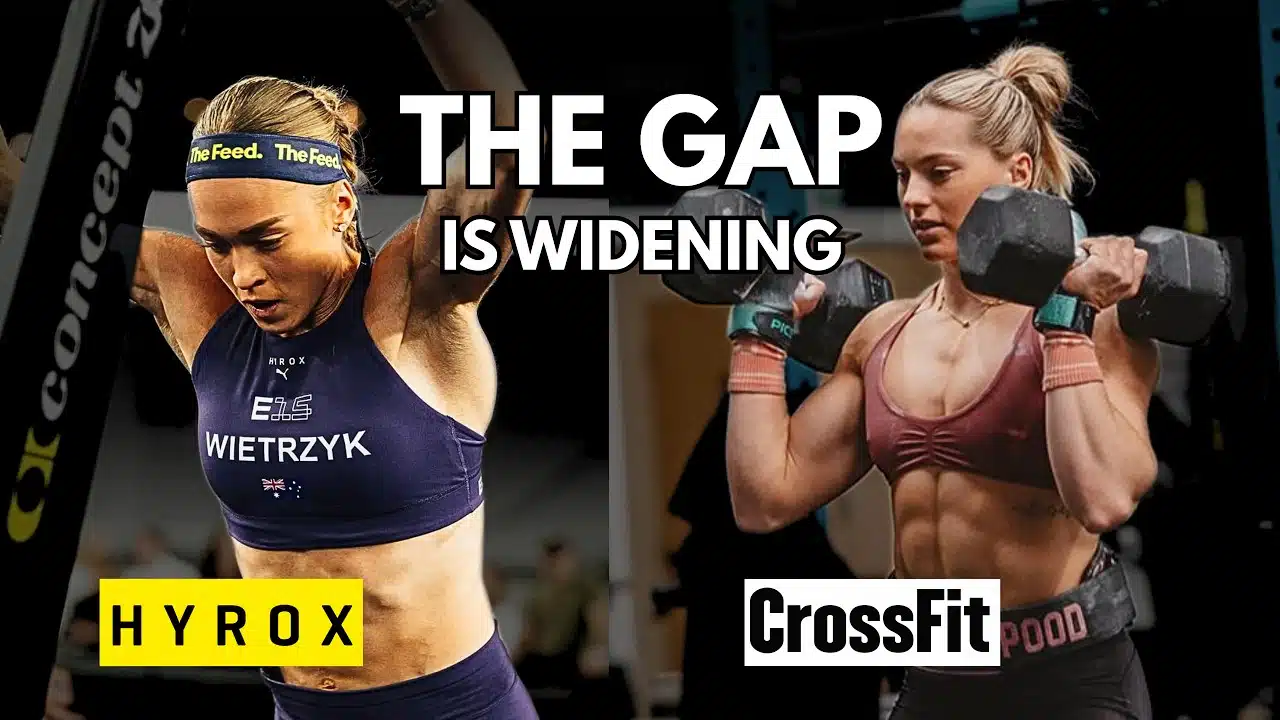
In a recent deep-dive video, ETH Zurich senior scientist Gomar unpacked the fascinating biological reason why bigger muscles actually become a disadvantage in endurance events.
The answer lies not just in practical weight considerations, but in a hard physiological ceiling that even elite athletes can’t break.
Jump to:
Why Hyrox and CrossFit Demand Different Bodies
Gomar, who has studied exercise physiology for over a decade, emphasizes that this isn’t about declaring one sport superior.
It’s about understanding what happens when functional athletes specialize in power versus conditioning.

If you want something simple that actually works, this is one of the most effective tools I’ve used to build strength, conditioning, and endurance without needing a full gym setup.
- Full-body training with one weight using swings, squats, and presses
- Solid cast iron build that feels stable and lasts for years
- Comfortable grip that makes high-rep workouts easier to handle
The goal of this video is really to understand what happens to the physique and the physiology of an athlete when he or she does long-term more of a conditioning based functional sport versus a more power-based functional sport.
CrossFit workouts typically last 3 seconds to 20 minutes. Hyrox races stretch 50 to 100 minutes.
That duration gap drives everything else: energy systems, body composition, even limb length.
The Obvious Differences
- Duration: CrossFit ranges from seconds to 20 minutes; Hyrox is 50–100 minutes of continuous work
- Focus: Power output and strength versus sustained conditioning
- Predictability: CrossFit thrives on the unknown; Hyrox is entirely predictable
- Movement direction: CrossFit emphasizes vertical planes (cleans, snatches); Hyrox is overwhelmingly horizontal
- BMI: Elite CrossFit athletes hover around 26–28; top Hyrox competitors sit below 24
Gomar points out another critical but overlooked distinction: continuity of effort.
Even intense CrossFit workouts involve brief bursts followed by rest periods. Hyrox, by contrast, demands near-constant movement with minimal recovery between stations.
The Biological Ceiling: Why Bigger Muscles Hurt Endurance
Everyone knows carrying extra weight slows endurance performance. Marathon runners stay light for good reason.
But Gomar reveals something far more intriguing: muscle size creates a biological constraint on oxygen delivery.
If you want something simple that actually works, this is one of the most effective tools I’ve used to build strength, conditioning, and endurance without needing a full gym setup.
- Full-body training with one weight using swings, squats, and presses
- Solid cast iron build that feels stable and lasts for years
- Comfortable grip that makes high-rep workouts easier to handle
A 2024 study by researcher Hans Degens analyzed 9,000 individual muscle fibers across multiple species to explore the relationship between fiber size, oxidative capacity, and capillary supply.
Oxygen Diffusion and Capillary Density
Muscles need oxygen to produce ATP aerobically. Capillaries—tiny blood vessels surrounding muscle fibers—deliver that oxygen.
When untrained people begin endurance training, one major adaptation occurs: capillary density increases. More capillaries per square millimeter means more oxygen delivery.
But here’s the problem.
As muscle fibers grow through resistance training, their cross-sectional area expands. Oxygen must diffuse farther to reach the fiber’s center.
Larger fibers face a diffusion constraint—they simply can’t achieve the same capillary density as smaller fibers.
If you want something simple that actually works, this is one of the most effective tools I’ve used to build strength, conditioning, and endurance without needing a full gym setup.
- Full-body training with one weight using swings, squats, and presses
- Solid cast iron build that feels stable and lasts for years
- Comfortable grip that makes high-rep workouts easier to handle
It seems to be that there is indeed an actual ceiling because it seems that large fibers can never reach super high capillary density at least not to the same extent as smaller fibers.
Degens’ research found no exceptions. Large muscle fibers never paired with extremely high capillary density. Small fibers, conversely, were never supplied by extremely low density.
The Square-Cube Law: A Physical Constraint
Beyond diffusion, there’s a literal physical limit on capillary placement.
As muscle fibers enlarge, their area (cross-section) increases quadratically while their perimeter (outer edge) grows only linearly.
This is the square-cube law, a principle from physics that applies across biological systems.
Translation? There’s only so much space around a muscle fiber for capillaries to attach. Bigger muscles hit a ceiling on oxygen supply capacity.
Waste products—lactate, hydrogen ions, heat—also struggle to exit large fibers efficiently, compounding the problem during sustained effort.
If you want something simple that actually works, this is one of the most effective tools I’ve used to build strength, conditioning, and endurance without needing a full gym setup.
- Full-body training with one weight using swings, squats, and presses
- Solid cast iron build that feels stable and lasts for years
- Comfortable grip that makes high-rep workouts easier to handle
Real-World Example: The Transformation of Willie George
Gomar calls CrossFit veteran Willie George “the most versatile athlete in the history of sports.”
George competed at the CrossFit Games in 2018, 2019, and 2022. He then pivoted to weightlifting, cleaning 185 kilograms in June 2024.
One year later, he clocked a 56:29 at Hyrox Paris—elite-15 level performance.
His body weight? It tells the whole story.
- 2022 (CrossFit): 90–92 kg, BMI ~27–28
- 2024 (Weightlifting): 102–104 kg
- 2025 (Hyrox): 85–86 kg, likely dropping further
George shed nearly 20 kilograms to compete at Hyrox’s highest level. His physique transformed to match the sport’s endurance demands.
Why Endurance Athletes Don’t Keep Losing Weight
If smaller muscles maximize capillary density, why aren’t Hyrox athletes skeletal?
If you want something simple that actually works, this is one of the most effective tools I’ve used to build strength, conditioning, and endurance without needing a full gym setup.
- Full-body training with one weight using swings, squats, and presses
- Solid cast iron build that feels stable and lasts for years
- Comfortable grip that makes high-rep workouts easier to handle
Gomar highlights three critical reasons elite endurance athletes maintain some muscle mass:
- Absolute power generation: Moving sleds and machines requires total wattage, not just watts per kilogram
- Glycogen storage: Larger muscles store more fuel for sustained efforts
- Durability: Muscle mass may protect against fatigue accumulation, especially critical for wall balls at race end
I think for Hyrox it’s especially relevant because of the wall balls that you need to be able to do at the end of the race. If you are dead when you don’t have any glycogen and so on then of course your durability will go down.
Top triathletes like Kristian Blummenfelt and cyclists like Tadej Pogačar remain lean but not emaciated. Their coaches have found that extreme leanness hurts performance.
There’s a sweet spot—a Pareto optimum—where strength and endurance demands balance perfectly.
CrossFit Found Its Optimum. Hyrox Hasn’t Yet
Gomar introduces the concept of the Pareto optimum: the ideal trade-off between two competing demands.
CrossFit, nearly three decades old, has likely reached this line. Athletes are bulky, powerful, and aerobically capable—optimized for short, intense, varied workouts.
Hyrox is still evolving. Athletes are getting leaner, times are dropping rapidly, and the sport hasn’t yet hit its physiological ceiling.
If you want something simple that actually works, this is one of the most effective tools I’ve used to build strength, conditioning, and endurance without needing a full gym setup.
- Full-body training with one weight using swings, squats, and presses
- Solid cast iron build that feels stable and lasts for years
- Comfortable grip that makes high-rep workouts easier to handle
Eventually, Hyrox will plateau. Breaking the sub-50-minute barrier will become exponentially harder as athletes approach their biological limits.
For now, though? The leaning-out trend will continue.
Key Takeaways for Hybrid Athletes
Whether training for CrossFit, Hyrox, or general fitness, understanding this trade-off matters.
- Bigger muscles limit capillary density: A biological and physical ceiling exists
- Endurance sports favor smaller fibers: They support higher oxygen delivery and waste removal
- Muscle mass isn’t the enemy: Absolute power, glycogen storage, and durability all benefit from maintaining lean muscle
- Sport specificity drives body composition: CrossFit rewards bulk; Hyrox rewards leanness
Gomar’s analysis offers a powerful lens for anyone navigating strength-endurance training. Your physique should match your sport’s demands—and those demands are dictated by biology, not just preference.
As Hyrox matures, expect athletes to keep trimming down. The science is clear: when endurance is king, less muscle wins.