Dr. Mike Israetel from Renaissance Periodization recently delivered a masterclass on choosing the right cardio for fat loss, and his insights might completely change how you think about burning calories.
Forget everything you thought you knew about jogging being the ultimate fat-burning solution.
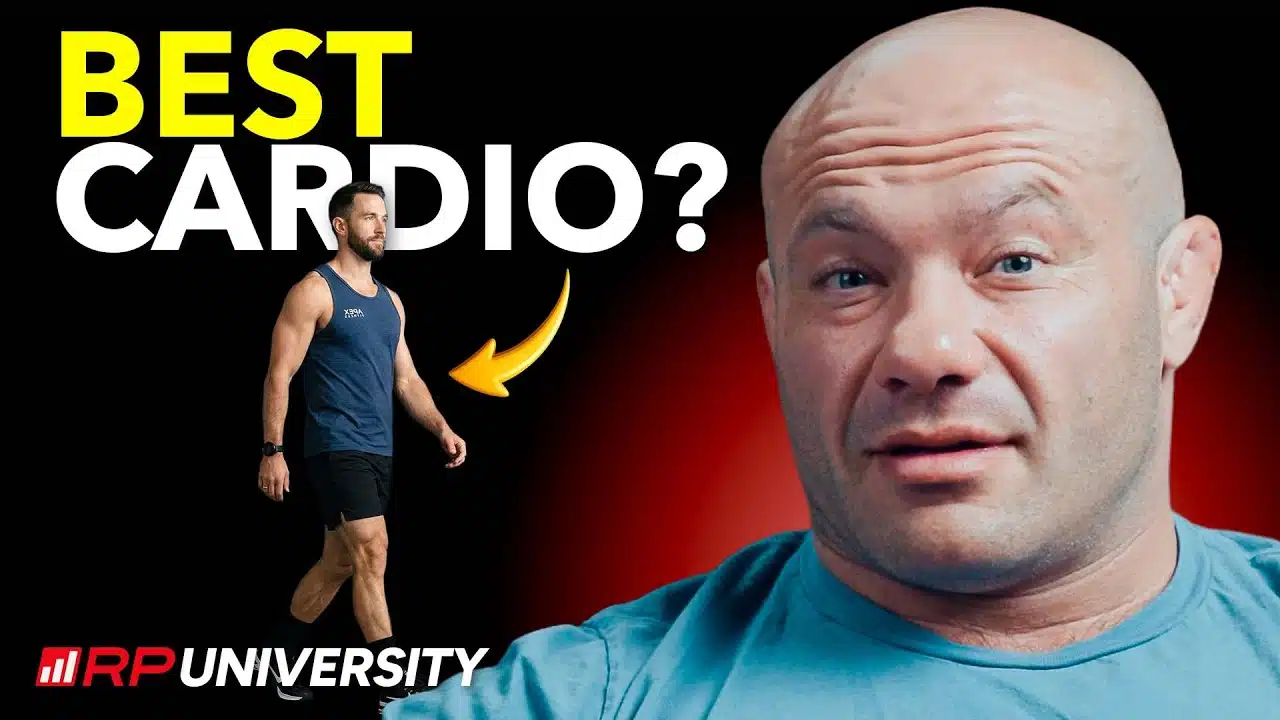
The science behind effective cardio isn’t just about how many calories you burn—it’s about the relationship between stimulus, fatigue, and time investment.
And one method stands head and shoulders above the rest for most people trying to lose fat.
Jump to:
Understanding SFR: The Stimulus to Fatigue Ratio
Dr. Israetel introduces a critical concept that many fitness professionals overlook: the stimulus to fatigue ratio (SFR) applied to cardiovascular training.
In cardio terms, stimulus equals calories burned. Simple enough.

If you want something simple that actually works, this is one of the most effective tools I’ve used to build strength, conditioning, and endurance without needing a full gym setup.
- Full-body training with one weight using swings, squats, and presses
- Solid cast iron build that feels stable and lasts for years
- Comfortable grip that makes high-rep workouts easier to handle
Fatigue, however, encompasses three important factors: joint and connective tissue stress, rating of perceived exertion (RPE), and effects on both lifting performance and daily life activities.
If your cardio drains your legs so much, makes your legs sore, interferes with leg growth so much that it screws up your client’s weight training, or even interferes with upper body training, that’s bad news.
Dr. Israetel uses the stepmill as a perfect example of poor SFR. Yes, it burns calories, but the psychological drain is immense.
That thing burns a lot of calories, but holy crap is it hard. It’s almost like a quitting machine. It will make your clients quit wanting to do cardio because it’s that awful.
STR: The Often-Overlooked Time Factor
Stimulus to time ratio (STR) considers not just direct cardio time, but all associated time costs—including preparation and travel.
Dr. Israetel breaks down a revealing example: burning 500 calories at a gym might take one hour of actual exercise, but factor in 20 minutes driving each way, and suddenly that 500-calorie burn required 1 hour and 40 minutes of commitment.
Opportunity cost matters tremendously. What else could have been accomplished during that time?
This is where one particular cardio method becomes revolutionary. If someone accumulates 4,000 steps while picking up kids from school, walking the dog, shopping for groceries, and handling daily chores, they’ve burned calories during activities they would have done anyway.
If you want something simple that actually works, this is one of the most effective tools I’ve used to build strength, conditioning, and endurance without needing a full gym setup.
- Full-body training with one weight using swings, squats, and presses
- Solid cast iron build that feels stable and lasts for years
- Comfortable grip that makes high-rep workouts easier to handle
For step tracker cardio, in which you’re doing other things that you would have otherwise needed to do, the stimulus to time ratio—the stimulus is whatever, like 400 calories, the time could be up to something like, mathematically, for simplicity purposes, not quite zero.
Three Key Features of High-SFR Cardio
Dr. Israetel identifies three characteristics that typically create superior stimulus-to-fatigue ratios:
Whole Body Versus Isolated Muscle Work
Cardio engaging multiple muscle groups simultaneously burns more calories without creating excessive localized fatigue.
The elliptical machine recruits virtually every major muscle group. Compare that to the recumbent bike, which primarily taxes just quads and glutes.
Local fatigue concentrates in just two muscle groups, potentially interfering with leg training while burning fewer total calories.
Lower Intensity Beats Higher Intensity
Walking and easy jogging typically produce better SFR than sprinting or high-impact activities.
Dr. Israetel uses an extreme example to illustrate: burning 500 calories through maximum vertical jumps would require approximately 100 jumps.
If you want something simple that actually works, this is one of the most effective tools I’ve used to build strength, conditioning, and endurance without needing a full gym setup.
- Full-body training with one weight using swings, squats, and presses
- Solid cast iron build that feels stable and lasts for years
- Comfortable grip that makes high-rep workouts easier to handle
You guys ever try to do 100 maximum jumps? Don’t do that. You will get rhabdo. Seriously, don’t do it. That’s insane.
Intensity creates exponentially increasing fatigue. Walking 25,000 steps at an amusement park leaves most people reasonably comfortable, while sprinting for even a fraction of that calorie burn creates extreme exhaustion.
Lower Impact Trumps Higher Impact
Activities where feet never leave the ground—like the elliptical—produce minimal joint stress compared to basketball, rugby, or even regular jogging.
Millions of former joggers can no longer run because cumulative impact destroyed their knee health over time.
Ranking Common Cardio Methods by SFR
Dr. Israetel provides a definitive hierarchy for stimulus-to-fatigue ratios:
Top Tier: NEAT Walking
Non-exercise activity thermogenesis (NEAT) walking—tracked with a step counter during normal daily activities—delivers exceptional SFR because intensity and impact remain very low while total calorie burn can be substantial.
Excellent: Elliptical Training
Elliptical machines provide whole-body engagement with zero impact. Modern ellipticals with accurate calorie tracking demonstrate just how efficiently they burn energy.
If you want something simple that actually works, this is one of the most effective tools I’ve used to build strength, conditioning, and endurance without needing a full gym setup.
- Full-body training with one weight using swings, squats, and presses
- Solid cast iron build that feels stable and lasts for years
- Comfortable grip that makes high-rep workouts easier to handle
Because moving the machine’s levers requires specific physical work regardless of efficiency, calorie calculations become remarkably precise.
Very Good: Incline Walking
Walking on an incline increases both stimulus and fatigue moderately, maintaining an excellent overall ratio.
Moderate: Jogging
Jogging burns calories effectively but creates significantly more fatigue and joint stress. For decades, Western culture equated “cardio” exclusively with jogging, but that oversimplification causes problems.
There are millions of people in the United States and across the world that can’t really jog anymore because they used to jog, it didn’t gel well with their knees, and they just ran their knees off their bodies.
Limited Application: High-Intensity Interval Training
HIIT delivers massive calorie burn but extreme fatigue. Sprint intervals followed by walking recovery work well for specific clients in specific contexts, but require careful management.
Poor: Recumbent Bike
Dr. Israetel doesn’t mince words about the recumbent bike’s limitations.
Because users sit while moving minimal load, calorie burn proceeds painfully slowly despite significant leg fatigue.
If you want something simple that actually works, this is one of the most effective tools I’ve used to build strength, conditioning, and endurance without needing a full gym setup.
- Full-body training with one weight using swings, squats, and presses
- Solid cast iron build that feels stable and lasts for years
- Comfortable grip that makes high-rep workouts easier to handle
A recumbent bike is a machine designed by people to make it seem like you’re doing cardio when you’re really not.
Worst: Swimming
This ranking surprises many people. Swimming is phenomenal for athletic performance, longevity, and health maintenance in weight-stable individuals.
But for fat loss specifically, swimming has a critical flaw.
The “cold water effect” creates compensatory appetite increases after pool sessions. Immersion in typical pool temperatures triggers feedback mechanisms that dramatically increase hunger after exiting the water.
You get out of the pool and maybe some of you guys have childhood memories about this or adult memories. You get out of that pool, oh my god, it’s picnic time. Food, food, food.
If clients don’t experience this compensatory appetite increase, swimming can work wonderfully. But most people do experience it, making swimming problematic for fat loss despite being excellent exercise otherwise.
Ranking Cardio Methods by STR
Four parameters determine superior stimulus-to-time ratios:
- Whole body work: More muscles engaged simultaneously means more calories per unit time
- Anti-gravity exercises: Standing burns significantly more than seated or reclined positions
- Higher intensity: Burning 600 calories walking slowly takes considerable time; sprint intervals accomplish similar burns in minutes
- Concurrent activity potential: Cardio allowing productive multitasking essentially costs zero opportunity time
Bicycles, while excellent transportation, were specifically designed for caloric efficiency—the exact opposite goal of fat-loss cardio.
If you want something simple that actually works, this is one of the most effective tools I’ve used to build strength, conditioning, and endurance without needing a full gym setup.
- Full-body training with one weight using swings, squats, and presses
- Solid cast iron build that feels stable and lasts for years
- Comfortable grip that makes high-rep workouts easier to handle
The STR Rankings
First place: High-Intensity Interval Training burns extraordinary calories in minimal time, though with significant fatigue costs.
Second place: NEAT Walking ranks here exclusively because concurrent activity potential means essentially zero time cost despite moderate calorie burn.
I’ll get 13,000 steps some days on my fat loss phase. And if I tell someone, yeah, I did all my cardio today, they’re like, oh, must take a lot of time. I’m like, actually, I got all my chores done and walked the dog and did all this other stuff. So, yeah, didn’t cost me any time at all really.
Third: Jogging delivers high calorie burn per unit time through its intensity and anti-gravity nature.
Fourth: Elliptical can match or exceed jogging when intensity increases, with users reaching 150-160 beats per minute and watching calories accumulate rapidly.
Fifth: Incline walking takes longer than more intense options, and concurrent activities become difficult once breathing intensifies.
Sixth: Swimming requires dedicated time with no concurrent activity possibility, plus the cold water effect means consumed calories often get replaced through increased eating.
If you want something simple that actually works, this is one of the most effective tools I’ve used to build strength, conditioning, and endurance without needing a full gym setup.
- Full-body training with one weight using swings, squats, and presses
- Solid cast iron build that feels stable and lasts for years
- Comfortable grip that makes high-rep workouts easier to handle
Last: Recumbent bike combines minimal stimulus with lengthy time requirements and limited concurrent activity potential while pedaling with meaningful intensity.
The Clear Winner for Most People
NEAT walking—non-exercise activity thermogenesis tracked via step counting—emerges as the gold standard cardio approach for fat loss.
It provides excellent SFR with minimal fatigue despite solid calorie expenditure. The STR is nearly unbeatable because steps accumulate during necessary daily activities, creating essentially zero opportunity cost.
Most clients need only moderate to moderately-high activity levels for effective fat loss. NEAT walking can satisfy this requirement entirely.
Dr. Israetel recommends 10,000 to 14,000 steps daily for most clients, with 10,000 being sufficient for the majority. Those who naturally walk more and enjoy it can safely reach 14,000 without problems.
When I discovered personally doing step tracking and doing my cardio like that, I knew theoretically it worked well. When I imposed it in my life, it was like this magic Goldilocks moment that occurred. My cardio became seamless and effortless, and it’s never been a problem since.
Clients often believe they lack time for cardio. Step tracking reveals they can increase activity while simultaneously becoming more productive—taking stairs instead of escalators, walking to work instead of driving short distances, parking at the far end of parking lots.
If you want something simple that actually works, this is one of the most effective tools I’ve used to build strength, conditioning, and endurance without needing a full gym setup.
- Full-body training with one weight using swings, squats, and presses
- Solid cast iron build that feels stable and lasts for years
- Comfortable grip that makes high-rep workouts easier to handle
Small incremental changes compound dramatically over time.
Alternative Options When NEAT Walking Isn’t Enough
Some clients need to compress substantial calorie burns into shorter timeframes. For these situations, elliptical training or brisk incline walking provide the best combination of SFR and STR.
HIIT, swimming, jogging, and other modalities certainly have appropriate applications. But there’s a crucial difference between methods that work in specific contexts and the primary recommendation that should be your first-line approach.
For the vast majority of clients pursuing fat loss, NEAT walking through daily step tracking provides the most sustainable, effective, and time-efficient cardio strategy available.
It seamlessly integrates into existing lifestyles, creates minimal fatigue that might interfere with resistance training, and costs virtually nothing in terms of time opportunity cost.
That’s a combination nearly impossible to beat.
If you want something simple that actually works, this is one of the most effective tools I’ve used to build strength, conditioning, and endurance without needing a full gym setup.
- Full-body training with one weight using swings, squats, and presses
- Solid cast iron build that feels stable and lasts for years
- Comfortable grip that makes high-rep workouts easier to handle