When fitness enthusiasts ask about peptides for muscle growth, they’re often surprised by the answer.
Despite the massive hype surrounding these compounds, there are currently no peptides that directly build muscle mass.
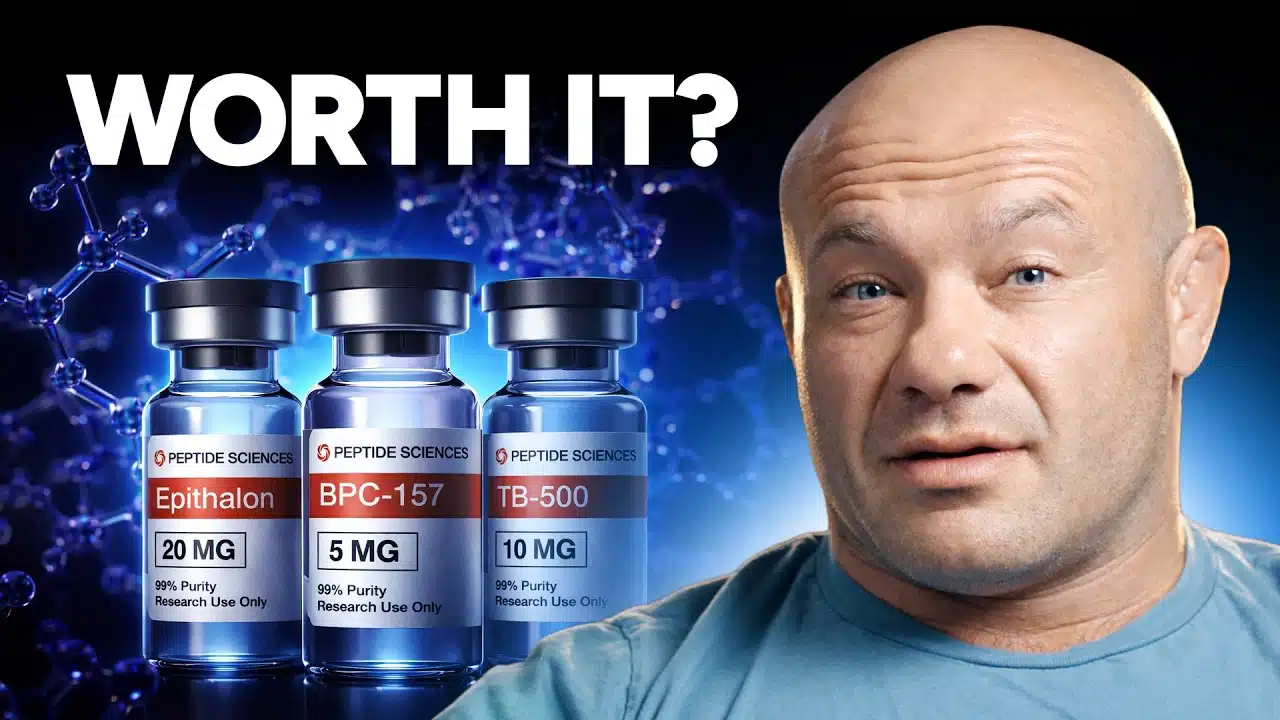
In a recent video for RP Strength, Dr. Mike Israetel—exercise scientist and bodybuilding coach—tackled the peptide craze head-on, explaining what these compounds actually do, what they don’t do, and why so many people misunderstand them.
His insights cut through the marketing noise with science-backed clarity that every lifter needs to hear.
Jump to:
What Peptides Actually Are
Peptides are amino acid chains typically containing fewer than 50 amino acids. Anything longer would be classified as a complete protein.
These molecules function primarily as signaling agents in the body, binding to receptors on cells and triggering specific biological responses—everything from metabolism regulation to tissue repair.
Many hormones naturally occurring in your body are already peptides. Insulin is a peptide. GLP-1 is a peptide. They’re part of normal human physiology.
Synthetic peptides used in medicine are engineered versions of these natural signaling molecules, often modified to be more stable, have longer half-lives, or bind more intensely to receptors.
The Injection Reality
Here’s where things get inconvenient: most peptides must be injected subcutaneously (just under the skin) because the digestive tract breaks down amino acid chains—it’s literally one of its primary jobs.
Dr. Israetel notes there are emerging oral technologies and some nasal or dermal applications, but these remain rare and often inconsistent in bioavailability.
Storage adds another layer of complexity. Peptides are biologically active compounds prone to degradation from heat, light, agitation, and contamination.
Most peptides, once reconstituted with bacteriostatic water, require refrigeration between 2-8°C. Their shelf life after mixing is typically measured in weeks, not months.
I just don’t want people watching this video to think peptides come in a pill. You take it every day and cool things happen.
The Five Classes of Peptides
Dr. Israetel breaks down peptides into five distinct categories, each with vastly different effects and purposes.
Class 1: Modern Weight Loss Drugs
This category includes semaglutide, tirzepatide, and the soon-to-be-approved retatrutide. These compounds are exceptional for health and weight loss but have zero anabolic muscle-building effects.
According to Dr. Israetel, these are essentially “magic fat loss and health elixirs” with incredibly strong safety profiles and multi-year data showing reduced all-cause mortality.
Class 2: Recovery Peptides
BPC-157 and TB-500 fall into this category. People inject these compounds hoping to heal from injuries faster.
The problem? Mixed results and questionable safety data. There’s substantial community hype but virtually no solid human trials demonstrating effectiveness or long-term safety.
More concerning, there are mechanistic reasons to suspect these peptides might assist cancer cell growth if cancer is already developing.
If you’re going to run BPC and TB-500, do it at a dose that you think will work. Don’t microdose the shit so that nothing happens. Do it for the duration that your injury needs to be healed from and then stop.
Class 3: Exercise Mimetics
Compounds like MOTS-c replicate portions of the chemical cascade typically triggered by exercise. They’re promising for aerobic health and energy but remain severely underresearched.
There’s also a potential downside: these exercise mimetics may be somewhat anti-anabolic because they suppress the mTOR anabolic pathway to some extent.
Class 4: Growth Hormone Secretagogues
Sermorelin, CJC-1295, ipamorelin—these are the “morelins” that tell your body to secrete slightly more growth hormone than normal.
Dr. Israetel calls these permissive anabolics. They don’t cause muscle growth directly like anabolic steroids do. Instead, they support muscle growth if everything else is already dialed in.
- They can enhance an already excellent fitness plan
- They offer modest improvements in recovery and joint health
- They promote better sleep quality
- Effects are marginal, not transformative
For those comfortable navigating gray-market peptide sources, these compounds offer a legal alternative to actual growth hormone. But they underperform compared to pharmaceutical GH in nearly every category.
Class 5: IGF-1 Modulators
IGF-1 LR3, IGF-1 DES, and mechano growth factor (MGF) act like insulin-like growth factor on muscle tissue. Unfortunately, they lack massive anabolic drive in real-world applications.
These compounds typically have very short half-lives, require multiple daily injections, and have poor tissue selectivity—meaning they grow everything, which raises significant disease management concerns.
The Missing Category: Actual Muscle Builders
This is the revelation that shocks most people.
There are currently no peptides that directly grow muscle. Not one.
When people ask the question of what peptides do I take to grow muscle, the answer to the question is there are no peptides that grow muscle. If there were very powerful muscle growing peptides around, almost every enhanced bodybuilder would probably know about it by now and be all up in that muscle.
Dr. Israetel points to three lines of evidence supporting this conclusion:
- Mechanism: No peptides mechanistically claim to build significant muscle mass
- Research: Limited studies on peptides show no highly anabolic compounds
- Real-world feedback: Professional enhanced bodybuilders aren’t using muscle-building peptides—because they don’t exist
If such a compound existed with powerful muscle-building properties, elite bodybuilders whose careers depend on finding every possible advantage would already be using it extensively.
Safety Considerations Across Peptide Classes
Safety profiles vary dramatically depending on which peptide class you’re considering.
The GLP-1 agonists (semaglutide, tirzepatide, retatrutide) are incredibly safe when dosed properly with appropriate nutrition. Multi-year data demonstrates they actually reduce all-cause mortality in older populations.
Their anti-inflammatory effects are unprecedented and massive, making them legitimate health and longevity enhancers.
Recovery peptides like BPC-157 have essentially no human safety data. The mechanistic concern about potentially assisting cancer development cannot yet be ruled out.
Exercise mimetics remain largely unvetted in human safety trials. Taking these compounds means accepting significant unknowns about both risks and benefits.
Growth hormone secretagogues likely have neutral effects on longevity while improving quality of life, especially for those with moderate GH deficiency (potentially the majority of people over 40). However, human safety trials remain limited.
IGF-1 modulators are likely bad for longevity and increase cancer risk. Unlike anabolic steroids—which carry similar risks but definitively build muscle—IGF-1 peptides offer minimal muscle growth, making the risk-benefit calculation unfavorable.
How to Source Peptides Responsibly
Vetted compounds like tirzepatide should be obtained through a doctor’s prescription whenever possible.
Many other peptides require navigating gray-market online labs and peptide shops. Gray market means the drugs aren’t illegal, but they’re not approved by medical associations either.
Just know that you’re rolling the dice when you buy through online peptide shops. Don’t just click on things and buy them. Beware.
Dr. Israetel acknowledges that many peptide shops do exceptional work, providing legitimate, uncontaminated products. But some companies are fly-by-night operations selling bunk products or worse.
Due diligence is essential. Research vendors thoroughly, look for third-party testing, and understand that you’re accepting risk when purchasing from unregulated sources.
The Future of Peptides and Small Molecules
Despite current limitations, peptides remain an exciting frontier. They’re phenomenally easy to develop, and muscle-building peptides are likely coming in the near future.
But Dr. Israetel believes the real action will happen across multiple drug classes, especially oral small molecules.
These compounds come in pill form, can be taken daily by mouth, and work with incredibly high target specificity—producing big intended effects with limited side effects.
With AI-assisted drug research accelerating development timelines from years to hours or days, we’re potentially just a few years away from oral small molecule drugs for fat loss, energy, health optimization, and yes—muscle growth.
Until then, Dr. Israetel’s advice is clear: have a specific goal before taking peptides. Don’t get caught up in hype.
For weight loss and metabolic health, talk to your doctor about tirzepatide. For muscle growth and body composition, discuss hormone replacement therapy (testosterone for men; testosterone, estrogen, and progesterone for post-menopausal women) and potentially growth hormone replacement.
Most other peptides simply don’t make sense yet—the effects are underwhelming or questionable, and safety data remains a massive unknown.