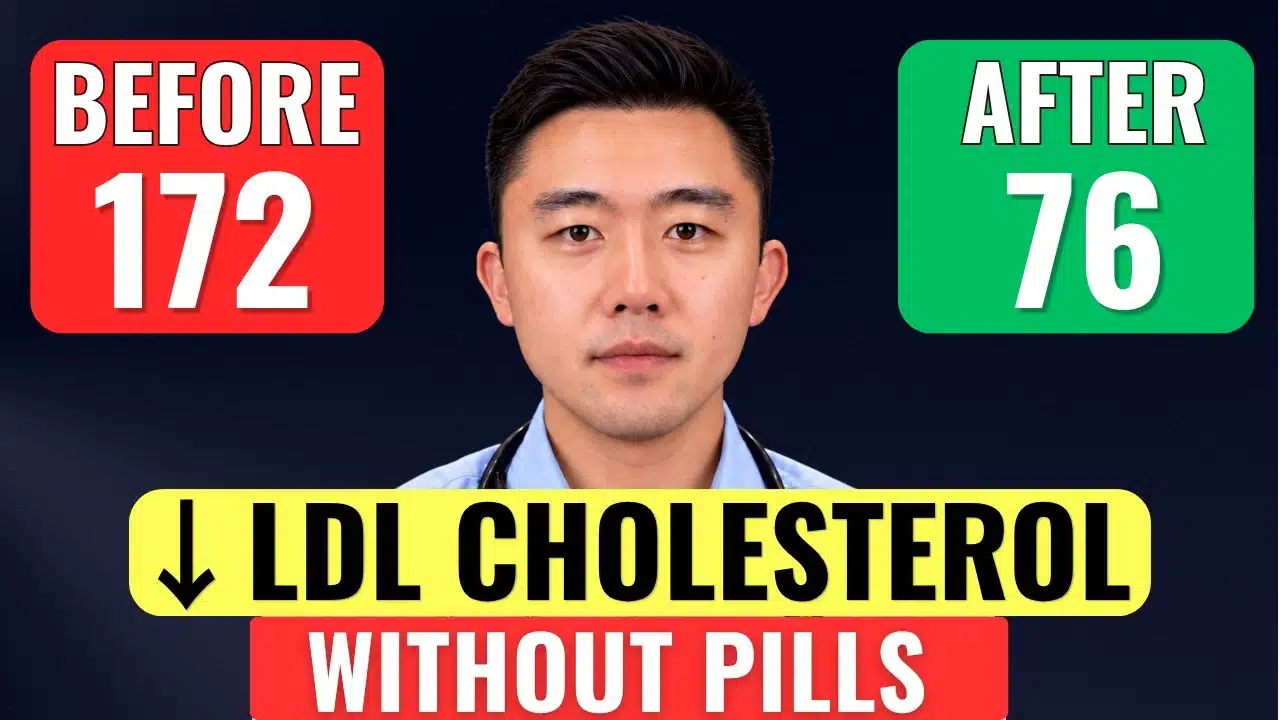
In a recent YouTube video, physician Leonid Kim, MD, FACP, unpacked simple ways to lower LDL cholesterol naturally.
His starting point may surprise you: slashing dietary fat is a small lever for most people.
Your morning coffee, meanwhile, could be quietly pushing your numbers up.
Eggs and red meat get a nuanced verdict, too.
Finally, Kim names two supplements: one he takes daily, and one tied to hospitalizations and even deaths.
Jump to:
- Why Eating Less Fat Misses the Point
- The Morning Coffee Mistake That Can Raise LDL
- How to Pull Cholesterol Out of Your Blood
- Eggs and Red Meat: How Kim Approaches Them
- How to Block Cholesterol Absorption Naturally
- Protect Your Arteries Beyond LDL and ApoB
- Two Supplements: One to Take, One to Avoid
- Don’t Guess: Test Your Numbers
Why Eating Less Fat Misses the Point
For decades, the advice was blunt: eat less fat, lower cholesterol. Kim calls that the wrong approach for most people.

If you want something simple that actually works, this is one of the most effective tools I’ve used to build strength, conditioning, and endurance without needing a full gym setup.
- Full-body training with one weight using swings, squats, and presses
- Solid cast iron build that feels stable and lasts for years
- Comfortable grip that makes high-rep workouts easier to handle
Your body actually makes most of its own cholesterol, primarily in your liver.
His alternative? Get your body to pull cholesterol out of your blood, without giving up foods you enjoy.
The Morning Coffee Mistake That Can Raise LDL
Coffee contains essentially no cholesterol. Yet brewing method can still lift LDL.
Culprits are two compounds in coffee bean oils: cafestol and kahweol. A paper filter traps most of them, while a French press or boiled coffee lets them flow into your cup.
Kim cites a randomized controlled trial in which unfiltered boiled coffee drinkers had LDL about 16 points higher than paper-filter drinkers.
So same coffee, same amounts, just different brewing methods.
The fix: swap French press for paper-filtered drip or pour-over.
How to Pull Cholesterol Out of Your Blood
Here is the twist: your body uses cholesterol to digest fat. Your liver converts it into bile acids, and about 95% get reabsorbed and recycled.
If you want something simple that actually works, this is one of the most effective tools I’ve used to build strength, conditioning, and endurance without needing a full gym setup.
- Full-body training with one weight using swings, squats, and presses
- Solid cast iron build that feels stable and lasts for years
- Comfortable grip that makes high-rep workouts easier to handle
Certain foods interrupt that recycling. More bile acids exit via stool, so your liver must make replacements, burning through cholesterol in the process.
Oats and Barley
Oats contain beta-glucan, a soluble fiber that forms a thick, sticky gel in your intestines. That gel helps keep bile acids from being reabsorbed.
Per Kim, several meta-analyses link about one cup (75 grams) of oats with LDL reductions of 7 to 10 points.
Ground Flaxseed (Not Flaxseed Oil)
People often buy the wrong version. Whole and ground flaxseed lowers LDL, but flaxseed oil does not show the same benefit.
You can just add one or two tablespoons to your oatmeal or yogurt or mix it in a smoothie.
Pressing out the oil leaves behind much of the fiber and lignin, a polyphenol with heart benefits.
Beans, Lentils and Chickpeas
Dietary pulses round out the trio. Studies Kim references show half a cup daily can trim LDL by around seven points.
If you want something simple that actually works, this is one of the most effective tools I’ve used to build strength, conditioning, and endurance without needing a full gym setup.
- Full-body training with one weight using swings, squats, and presses
- Solid cast iron build that feels stable and lasts for years
- Comfortable grip that makes high-rep workouts easier to handle
Eggs and Red Meat: How Kim Approaches Them
Why can one person eat four or five eggs daily with normal LDL while another’s numbers soar? Genetics play a role.
It really comes down to are you an overproducer of cholesterol or are you an overabsorber?
Eggs and red meat also differ. Eggs carry plenty of dietary cholesterol but mostly unsaturated fat, while red meat can pack far more saturated fat, which can make your liver less efficient at clearing LDL particles.
Still, saturated fat is not the whole story. Cheese and yogurt contain it, yet long-term studies suggest they may be neutral or even linked to lower heart disease risk.
So we can’t judge a food’s impact on heart health just based on its saturated fat content alone. The entire food matters.
Unprocessed vs. Processed Meat
Kim points to a large study of more than 134,000 people across 21 countries. Those eating the most unprocessed red meat, at least 9 ounces weekly, showed no clear difference in heart disease or death rates versus those eating very little.
Processed meat told another story. Top consumers, at roughly 5 ounces weekly, had about a 46% higher risk of heart attacks and strokes.
- Bacon
- Sausages
- Hot dogs
- Processed deli meats
What You Swap In Matters
It’s not just what you stop eating, it’s what you’re replacing it with.
One large study, according to Kim, tied replacing saturated fat with polyunsaturated fats to a 25% lower risk of heart disease. Swapping in refined carbohydrates showed no significant benefit.
If you want something simple that actually works, this is one of the most effective tools I’ve used to build strength, conditioning, and endurance without needing a full gym setup.
- Full-body training with one weight using swings, squats, and presses
- Solid cast iron build that feels stable and lasts for years
- Comfortable grip that makes high-rep workouts easier to handle
His practical playbook for steak lovers:
- Choose leaner, unprocessed cuts
- Keep portions moderate
- Occasionally rotate in fish, beans or lentils
- Pair steak with the fiber-rich foods above
How to Block Cholesterol Absorption Naturally
Avocados, walnuts and sunflower seeds contain plant sterols, which resemble cholesterol closely enough to compete with it.
So imagine cholesterol trying to get through a doorway in your intestines, but these plant sterols are competing for the same doorway.
A meta-analysis of 124 randomized trials found about 2 grams daily lowered LDL roughly 8 to 10%. Kim adds a caveat: studies used concentrated amounts, far beyond ordinary servings of avocado or nuts.
Walnut-only studies still show average drops of 5 to 9 points.
Protect Your Arteries Beyond LDL and ApoB
Real goal: preventing plaque. When LDL particles lodge in artery walls and become oxidized, immune cells swallow them and morph into foam cells, feeding plaque buildup.
Enter extra virgin olive oil, rich in polyphenols that help shield LDL from oxidation. Kim highlights the PREDIMED trial, where a Mediterranean-style diet supplemented with extra virgin olive oil was linked to about 31% fewer cardiovascular events.
If you want something simple that actually works, this is one of the most effective tools I’ve used to build strength, conditioning, and endurance without needing a full gym setup.
- Full-body training with one weight using swings, squats, and presses
- Solid cast iron build that feels stable and lasts for years
- Comfortable grip that makes high-rep workouts easier to handle
We want to think of olive oil more like fresh juice rather than something that just sits in your pantry for years.
Polyphenols fade with heat, light and oxygen. Kim’s buying checklist:
- Look for an actual harvest date, not just a best-by date
- Use within roughly 6 to 12 months of harvest
- Choose dark glass bottles
- Store away from heat and sunlight
- Seek a peppery kick in the back of your throat, a sign of fresh polyphenols
Kim drizzles it on salads and vegetables, and takes olive oil shots most days.
Two Supplements: One to Take, One to Avoid
Take: Psyllium Husk
Kim calls psyllium one of the most studied supplements out there. A meta-analysis of 28 randomized trials, involving nearly 2,000 people, found a 13-point LDL drop.
Mechanism matches oats and barley: disrupted bile acid recycling. Typical dose runs around 10 grams daily.
I would actually start with a much smaller amount and gradually increase.
Jumping in too fast may cause stomach upset, bloating and constipation. Always take it with plenty of water.
Avoid: Red Yeast Rice
Marketed as a natural statin alternative, red yeast rice contains monacolin K, chemically identical to prescription lovastatin. Mechanism works; trouble lies elsewhere.
If you want something simple that actually works, this is one of the most effective tools I’ve used to build strength, conditioning, and endurance without needing a full gym setup.
- Full-body training with one weight using swings, squats, and presses
- Solid cast iron build that feels stable and lasts for years
- Comfortable grip that makes high-rep workouts easier to handle
You don’t know exactly what dose you’re getting or what else might be in that supplement.
Red yeast rice can harbor citrinin, a toxin that can harm kidneys. Kim cites a study of 37 supplements: all 37 contained it, including four labeled citrinin-free.
He also notes a contamination episode in Japan that hospitalized over 500 people, with several deaths. His conclusion: no red yeast rice product earns his confident recommendation right now.
Don’t Guess: Test Your Numbers
Before changing anything, get LDL and ideally ApoB checked. ApoB estimates how many cholesterol-carrying particles circulate in your blood.
Repeat bloodwork after about 6 to 8 weeks of changes.
We’re not doing all this just to get a better cholesterol number. We’re trying to prevent heart attacks and strokes.
Blood pressure, blood sugar and inflammation markers matter just as much. Good news: many foods above support those areas too.
Always consult your healthcare provider before changing your diet, supplements or medications.
If you want something simple that actually works, this is one of the most effective tools I’ve used to build strength, conditioning, and endurance without needing a full gym setup.
- Full-body training with one weight using swings, squats, and presses
- Solid cast iron build that feels stable and lasts for years
- Comfortable grip that makes high-rep workouts easier to handle