

Legendary bodybuilder Dorian Yates revolutionized muscle building with an approach that flew in the face of conventional wisdom.
While other champions spent hours in the gym six days a week, Yates built his six-time Mr. Olympia physique training just 45 minutes to an hour, three to four times weekly.
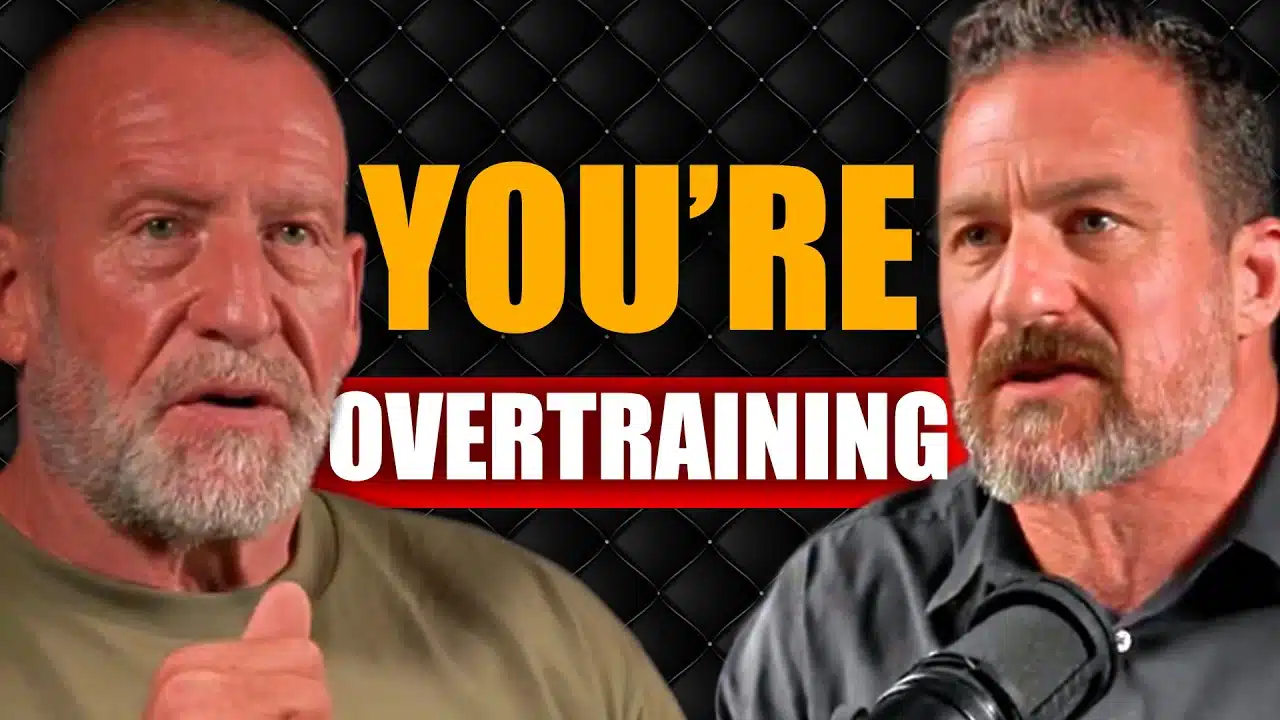
His “Blood and Guts” methodology bridged the gap between extreme high-intensity training and traditional bodybuilding—and the results speak for themselves.
In a recent conversation, Yates revealed exactly how he developed this game-changing system and why doing less might actually build more muscle.
Jump to:
- The Science Experiment That Built a Champion
- Finding the Middle Ground: Between Extremes and Excellence
- The Arnold Paradox: Why Champions Train Differently
- The Two Non-Negotiables for Muscle Growth
- The Steroid Factor Nobody Discusses
- Mind-Muscle Connection: The X-Factor
- Practical Applications for Your Training
The Science Experiment That Built a Champion
Yates didn’t stumble upon his training philosophy by accident. He meticulously documented every workout from day one, treating his bodybuilding career like a controlled scientific experiment.
His approach was rooted in the principles of Arthur Jones, creator of Nautilus machines and pioneer of high-intensity training. Jones advocated for whole-body workouts performed just twice weekly—revolutionary thinking in an era dominated by marathon gym sessions.
I read Arthur Jones’s books and I think I’m a logical thinker so it made sense to me. But if it made sense to me and it didn’t work out practically, who cares?
The real test came when Yates experimented with training volume. Working construction while pursuing bodybuilding, he found his sweet spot at three sessions weekly. When he increased frequency to four times per week, progress completely stalled for three to four weeks.
Cut back to three sessions? Growth resumed immediately.
Finding the Middle Ground: Between Extremes and Excellence
Yates’s methodology evolved further after meeting Mike Mentzer, the American champion who popularized ultra-brief, one-set-to-failure training.
Initially, Yates performed warm-up sets followed by one working set to failure, then rested 2-3 minutes before dropping weight by 10% for another failure set. Around 1991-92, Mentzer challenged him to eliminate that second set entirely.
Mike said, ‘Why don’t you try cutting back to one set to failure?’ So, I started that around 91, 92 and I feel like I got another level of growth from that.
This adaptation proved crucial. While pure high-intensity training advocates might argue Yates didn’t follow orthodox protocols, his hybrid approach acknowledged the unique demands of competitive bodybuilding versus general fitness.
Why Competitive Bodybuilders Need More Than Average Trainees
Jones’s original whole-body routine twice weekly works perfectly for someone building muscle for health and aesthetics. But competitive bodybuilding requires targeted development of specific muscle groups—side delts, rear delts, different areas that need individual attention.
Average person could do one shoulder exercise, would be enough. So you need to do a little bit more as a competitive bodybuilder.
Yates landed on brief, intense sessions that hit individual body parts with surgical precision. Less time than conventional bodybuilders, more exercises than pure HIT advocates.
The Arnold Paradox: Why Champions Train Differently
Arnold Schwarzenegger famously promoted training twice daily, six days weekly. Magazines glorified this approach, creating unrealistic expectations for aspiring bodybuilders.
Yates identified a critical flaw in copying champion protocols.
If you look at Arnold, he was probably a full size when he was 21, 22. He was huge. How did he get there? He was bench pressing 500. He was doing deadlifts. He was doing squats, whatever. He built the foundation.
Elite bodybuilders already possess massive muscle mass. Their high-volume training serves dual purposes: maintaining muscle while burning calories for contest preparation.
Yates proposed a smarter strategy: use weight training exclusively for building and maintaining muscle, then add cardio for calorie burning. This separation allows proper recovery from the intense overload necessary for growth.
The Two Non-Negotiables for Muscle Growth
According to Yates, muscle development requires two factors working in harmony.
Sufficient Intensity
Without adequate overload, muscles receive no signal to adapt and grow. Training must push past comfort zones to create the necessary stimulus.
Our objective is to get an exercise and go to real muscular failure. We’ll need to get there safely.
Yates emphasizes that reaching true muscular failure isn’t about ego—it requires proper warm-up sets and sometimes multiple attempts if the target muscle wasn’t fully engaged.
Complete Recovery
Training creates damage and stress. Growth doesn’t happen in the gym—it happens during recovery.
Yates uses a powerful analogy: knocking down a wall during home renovation. Workers need time and materials to rebuild that wall stronger than before. Return to knock it down again mid-construction, and progress halts entirely.
The idea is to not do more than is necessary because then you’re going to find it harder to recover. And the process is stimulate, right? So you got to train, you got to overload. And during this process, you’re not growing.
The Steroid Factor Nobody Discusses
Yates brings refreshing honesty to a topic many avoid: anabolic steroids dramatically affect recovery capacity.
Let’s just put it straight out there, man. You know, there’s a big difference between somebody using anabolic steroids than somebody that’s not. So, somebody that’s using can recover from that process more quickly than somebody that isn’t.
This reality makes copying champion training protocols potentially counterproductive for natural lifters. Enhanced athletes recover faster, allowing higher training frequencies that would overtrain natural athletes.
Champion bodybuilders often train for refinement and contest prep, not mass building. Their protocols reflect different goals and physiological capabilities.
Mind-Muscle Connection: The X-Factor
Experience matters significantly in high-intensity training effectiveness. Advanced lifters develop superior mind-muscle connection, allowing complete muscle fiber recruitment in fewer sets.
Beginners might need additional sets to achieve the same stimulus—not because more volume is inherently better, but because neural efficiency improves with practice.
Yates acknowledges this flexibility:
If somehow you don’t feel or I don’t feel you nailed it in that set, let’s do another one. You know, there’s no law. Can’t do a little bit more.
The principle remains constant: do enough to trigger adaptation, nothing more.
Practical Applications for Your Training
Yates’s approach offers actionable lessons regardless of experience level or goals.
- Track everything: Document workouts to identify what actually drives progress versus what feels productive
- Experiment systematically: Change one variable at a time and observe results over several weeks
- Prioritize intensity over volume: One brutal set beats three mediocre ones
- Respect recovery: Muscles grow between sessions, not during them
- Separate strength training from cardio: Use weights for muscle stimulus, cardio for calorie management
- Adjust for your situation: Natural athletes likely need less frequency than enhanced competitors
- Focus on true failure: Adequate warm-up, then push working sets to genuine muscular exhaustion
Yates meticulously recorded every training session throughout his career, creating an irrefutable log of what built one of bodybuilding’s most impressive physiques. His willingness to question conventional wisdom and trust empirical results over popular opinion separated him from competitors.
Less can absolutely be more—when executed with proper intensity and adequate recovery.










