When a lifter in the gym loads fifteen hundred pounds onto a leg press, wraps three lifting belts around his waist, and slaps himself in the face before attempting a quarter-rep, you’re witnessing something unforgettable.
You’re watching “El Campeón” — Spanish for “the champion” — a gym legend whose viral training videos blur the line between strength sports and performance art.
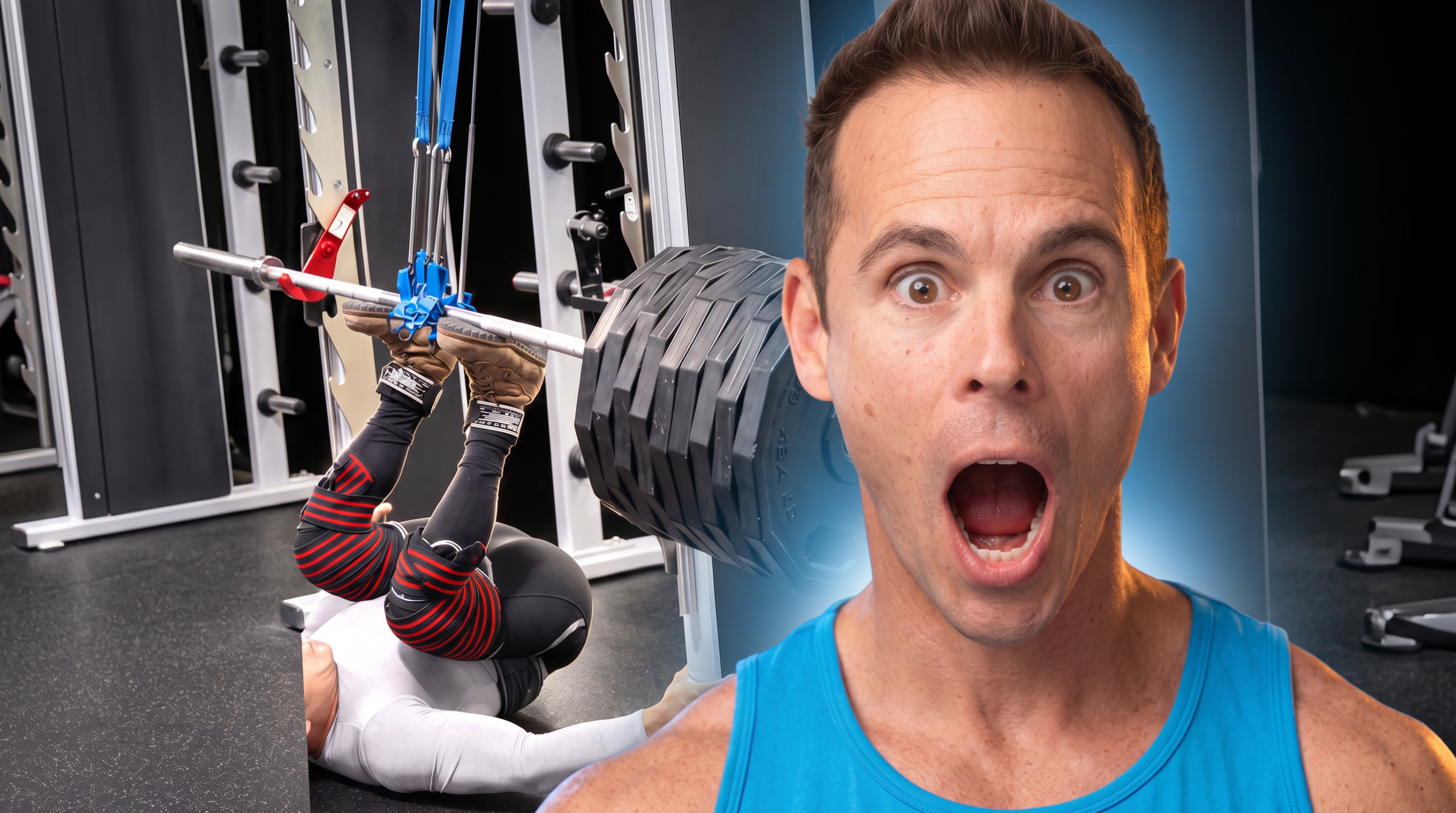
Dr. Mike Israetel, co-founder of Renaissance Periodization and respected exercise scientist, recently broke down what makes these spectacles so mesmerizing, and more importantly, what everyday lifters can actually learn from them.
The answer might surprise you: sometimes the most valuable lesson is knowing exactly what not to do.
Jump to:
- The Setup That Becomes the Workout
- The Hidden Cost of Extreme Loading
- Partial Reps: When Quarter Squats Make Sense (and When They Don’t)
- The Psychological Element: Slapping, Straps, and Mental Preparation
- Equipment Integrity: The Smith Machine Elephant in the Room
- What Everyday Lifters Should Actually Take Away
- The Entertainment Value of Strength Sports
The Setup That Becomes the Workout
Israetel’s first observation cuts straight to a practical training principle that affects everyone from beginners to elite athletes.
Watching El Campeón construct elaborate contraptions — stacking weights on makeshift towers, threading bands through Smith machines, arranging safety bars in precarious configurations — Israetel identifies a critical inefficiency.
Set up time and set up complexity and set up effort in your lifting. The ideal lifting happens that you show up, the weights magically rearrange in three-dimensional space to go onto the bar, and you got to do not except get under the bar and lift the exact weight you’re going to lift.
This isn’t just about convenience.
Every minute spent wrestling equipment into position is a minute your nervous system isn’t focused on the actual training stimulus. Mental energy drains. Physical fatigue accumulates before the working sets even begin.
Why Selectorized Machines Earn Their Place
Israetel points to selectorized machines — those with weight stacks you simply pin — as examples of setup efficiency done right.
This is the reason why selectorized machines, you just put the stack in, are so amazing cuz you can just click the thing in. You don’t have to move weights around or anything like that.
For personal trainers running back-to-back sessions, this principle becomes even more critical.
Israetel recommends prioritizing exercises with minimal setup requirements: deficit push-ups, lunges, pull-ups, dumbbell curls with pre-loaded weights, and upright rows that don’t require constant clip changes.
The Hidden Cost of Extreme Loading
When El Campeón loads nine hundred pounds onto a makeshift curl tower, the spectacle is undeniable.
But Israetel shares a personal story that illustrates the neurological shock of handling truly massive loads.
I was squatting like 500 raw at the time. I unracked 900 lbs. Here’s the thing that really tripped me out the most about it. I pressed up on that weight for literally 2 seconds and the bar didn’t move at all. It just bent and my body shrunk underneath it.
The experience left a lasting impression.
When weights reach certain thresholds, the body’s response changes fundamentally — bars bend, joints compress, and the central nervous system works overtime just to prevent collapse.
Safety Equipment: Essential vs. Theatrical
El Campeón’s signature move involves wearing multiple lifting belts simultaneously — sometimes three at once, occasionally more.
While Israetel finds humor in the approach, he emphasizes that proper belt usage matters for serious lifters.
He advocates for the Hyper Belt, which he helped design specifically for bodybuilding-style training across rep ranges from five to thirty.
The key differences? A quality hypertrophy belt should be tall to cover more of the torso, flexible to allow breathing and movement between reps, and thin enough not to interfere with exercise execution.
Three belts stacked on top of each other? That’s performance art, not performance enhancement.
Partial Reps: When Quarter Squats Make Sense (and When They Don’t)
Perhaps the most contentious element of El Campeón’s training is his range of motion — or deliberate lack thereof.
Israetel acknowledges that partial range squats and presses have legitimate applications in specific contexts.
- Olympic weightlifters performing quarter squats to strengthen the catch position
- Sprinters building explosive power in sport-specific ranges
- Powerlifters doing rack pulls or board presses to target sticking points
But for general muscle growth?
The science consistently favors full range of motion training.
The Nick Walker Standard
Israetel contrasts El Campeón’s partial leg presses with the approach of IFBB Pro Nick Walker, who built massive legs using deep, controlled repetitions on the leg press.
If you just do a couple of sets a week of really deep leg press, leg hack squat, etc., you’re going to get big muscles, strong tendons, full mobility, full movement.
The recommendation is clear: lower the back pad as far as comfortable, reduce the weight substantially, and prioritize depth over load.
Muscles grow best when trained through their full contractile range, and connective tissues adapt most effectively when exposed to varied positions under tension.
The Psychological Element: Slapping, Straps, and Mental Preparation
Before many of his lifts, El Campeón delivers hard slaps to his own face.
Israetel notes his own preference for physical stimulation before heavy attempts, though he quickly jokes about the potential for injury from overzealous training partners.
The practice touches on a real phenomenon in strength sports: psyching up.
Arousal techniques — from ammonia inhalants to music to physical stimulation — can temporarily increase motor unit recruitment and pain tolerance.
Research suggests that high-arousal strategies work best for limit strength efforts (one to three reps), while moderate arousal proves more effective for hypertrophy work (six to twenty reps).
Straps on Curls: Actually Smart
One element Israetel wholeheartedly endorses is El Campeón’s use of lifting straps during barbell curls.
Straps into curl is such a baller move, you guys. If you are not strapping into curl, then you are making a big mistake.
The logic is sound.
When training biceps for hypertrophy, forearm fatigue shouldn’t be the limiting factor. Straps allow you to push closer to true muscular failure in the target muscle group without grip strength becoming the weak link.
Equipment Integrity: The Smith Machine Elephant in the Room
Perhaps the most concerning aspect of several clips involves loading Smith machines and fixed equipment well beyond their rated capacity.
Israetel doesn’t mince words about the safety implications.
I’ll tell you guys this, that Smith machine is not rated for that much weight. There’s no Smith machine, I don’t think, that’s rated.
Commercial gym equipment typically has weight ratings clearly marked by manufacturers.
Smith machines generally max out around 600-800 pounds of total loading, including the weight of the bar carriage. Cable towers have similar limitations.
Exceeding these limits risks catastrophic equipment failure — welds breaking, guide rods bending, safety catches shearing off.
What makes compelling footage can make for genuinely life-threatening situations.
What Everyday Lifters Should Actually Take Away
Israetel’s ultimate verdict on El Campeón is one of amused respect mixed with clear caution.
The spectacle has entertainment value and even inspirational qualities — the dedication, the confidence, the sheer audacity.
But as a training template?
In real life, don’t do this kind of stuff. You’ll probably get hurt.
For practical muscle building and strength development, the evidence-based approach looks quite different.
Principles That Actually Build Muscle
- Choose exercises with minimal setup complexity to preserve mental and physical energy for training
- Prioritize full range of motion for superior muscle growth and joint health
- Use equipment as designed and within rated capacity to prevent catastrophic injury
- Implement strategic equipment like straps and belts to enhance performance, not for theater
- Train with intensity and focus, but always within the bounds of sustainable, long-term practice
Israetel points users toward structured programs like the RP Hypertrophy App, which removes uncertainty and provides precisely defined progression without requiring any quarter-rep fifteen-hundred-pound leg presses.
The Entertainment Value of Strength Sports
There’s genuine value in figures like El Campeón and Kyriakos Grizzly — another internet strength legend Israetel mentions.
They remind us that training can be joyful, creative, and larger than life.
They inspire conversations about training methods, push boundaries (sometimes literally), and create moments of shared amazement in the fitness community.
But inspiration works best when tempered with education.
Understanding why something makes compelling content versus why it makes effective training allows you to appreciate both without confusing one for the other.
El Campeón earns his title not through optimal hypertrophy programming, but through the unforgettable spectacle of human determination meeting physics in ways that defy both logic and sometimes equipment ratings.
As Israetel puts it, sometimes the rating speaks for itself.
I rate Al Campione as the champion out of 10.
For the rest of us mere mortals? Dial down the belts, increase the depth, respect the equipment ratings, and focus on progressive overload with exercises you can set up in under thirty seconds.
Your muscles will thank you, and you’ll probably avoid becoming a cautionary tale in someone else’s training video breakdown.