Research into male pattern hair loss has uncovered something surprising: one of the most powerful treatments might not be an exotic peptide or expensive therapy reserved for the elite.
It’s actually a familiar drug at an unfamiliar dose.
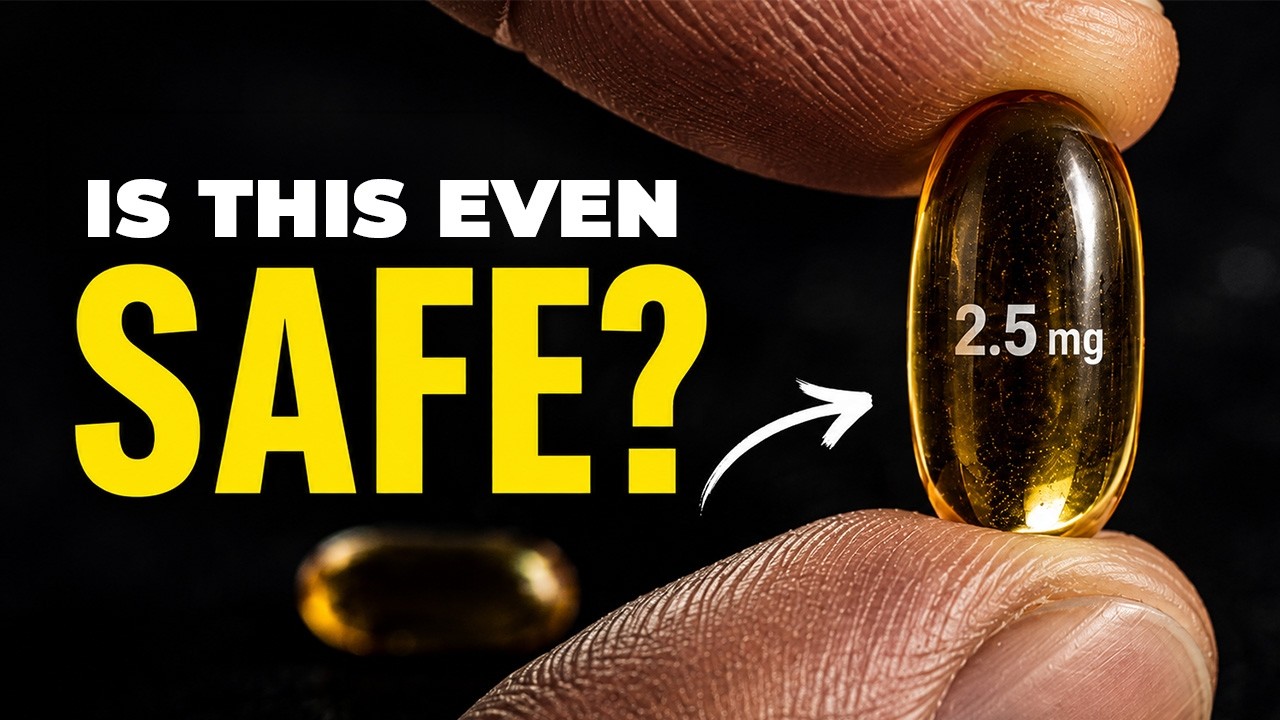
Hair loss researcher Rob English recently examined the evidence behind 2.5 milligrams of oral dutasteride daily—a dose five times higher than standard—and the results challenge conventional thinking about androgenic alopecia treatment.
English, who publishes and reviews scientific papers on hair loss disorders and serves on a dermatology journal, dove deep into why this dose produces such potent effects, whether the extra growth is cosmetically meaningful, and most importantly, whether it’s safe.
Jump to:
Understanding Dutasteride vs. Finasteride
For men fighting hair loss, finasteride has long been considered the gold standard. Daily doses of 1 to 5 milligrams reduce dihydrotestosterone (DHT)—a primary hormonal driver of androgenic alopecia—by roughly 60 to 70%.
Clinical studies spanning two years show that 80 to 90% of men using finasteride slowed, stopped, or partially reversed their hair loss.

If you want something simple that actually works, this is one of the most effective tools I’ve used to build strength, conditioning, and endurance without needing a full gym setup.
- Full-body training with one weight using swings, squats, and presses
- Solid cast iron build that feels stable and lasts for years
- Comfortable grip that makes high-rep workouts easier to handle
Dutasteride operates through similar mechanisms but with significantly greater potency. English explains that the body produces three enzymes that convert free testosterone into DHT: type 1, type 2, and type 3 5-alpha reductase.
Type 2 is most prominently implicated in androgenic alopecia development, produced at dermal papilla cell cluster sites and outer root sheaths of hair follicles. Finasteride targets type 2 effectively, but dutasteride is three times more effective at targeting type 2 and more than 100 times more effective at targeting type 1.
This allows dutasteride to suppress DHT levels throughout the body by 90% or more—a very impressive pharmaceutical achievement.
The Clinical Evidence Behind 2.5 Milligrams
English focuses heavily on Ely Olsen’s 2006 clinical trial, which enrolled 416 men ages 21 to 45 with mild to moderate androgenic alopecia. Participants were randomized to different groups: placebo, dutasteride at 0.05 mg, 0.1 mg, 0.5 mg, or 2.5 mg, plus 5 mg of finasteride as a comparator.
The study methodology was robust. Olsen’s team used the Canfield method of hair counting—clipping a one-inch circle near the vertex, marking the center with a tiny tattoo, photographing under magnification, then returning to the exact same location for each assessment.
This is known as the Canfield method of hair counting and it matters a great deal because some studies they do a terrible job at counting hairs.
After six months of daily treatment, results showed a clear dose-response relationship. The placebo group lost hair, as expected. Five milligrams of finasteride and 0.1 milligrams of dutasteride performed similarly with hair gains above baseline.
If you want something simple that actually works, this is one of the most effective tools I’ve used to build strength, conditioning, and endurance without needing a full gym setup.
- Full-body training with one weight using swings, squats, and presses
- Solid cast iron build that feels stable and lasts for years
- Comfortable grip that makes high-rep workouts easier to handle
Half-milligram dutasteride users did better than finasteride users. But the 2.5-milligram dutasteride group produced the largest hair gains—almost 110 hairs in a square inch area, statistically outperforming the 5-milligram finasteride group.
The Vellus Hair Problem
English cautions that impressive hair count numbers don’t always translate to visible improvement. In androgenic alopecia, hairs range from thick terminal hairs to nearly invisible, fully miniaturized vellus hairs that don’t grow beyond a few millimeters.
Good research groups exclude these thin, wispy hairs by choosing a “non-vellus hair thickness cutoff point”—basically, how thick must a hair be before inclusion in analysis.
Olsen’s dutasteride paper reportedly used a 30-micrometer cutoff, which English considers problematic. However, the convergence of multiple endpoints tells a different story.
Hair counts, frontal photographs, vertex photographs, investigator scores, and patient scores all pointed in the same direction across doses. This convergence is critical—it indicates that 2.5 milligrams isn’t merely producing invisible peach fuzz but generating visible, tangible results across multiple measurements.
The Mechanism Behind Superior Results
Olsen’s team measured both serum and scalp DHT levels. In blood, finasteride reduced DHT by around 70%, half-milligram dutasteride by 92%, and 2.5 milligrams by 96%.
If you want something simple that actually works, this is one of the most effective tools I’ve used to build strength, conditioning, and endurance without needing a full gym setup.
- Full-body training with one weight using swings, squats, and presses
- Solid cast iron build that feels stable and lasts for years
- Comfortable grip that makes high-rep workouts easier to handle
Moving from 92% to 96% suppression in serum seems trivial. But scalp tissue DHT levels revealed the real story.
Finasteride reduced scalp DHT by about 41%, dutasteride at half-milligram by about 51%, but at 2.5 milligrams, scalp DHT levels fell by 79%.
That is the central mechanistic finding. It’s that five times more dutasteride barely moved blood levels of DHT, but it significantly further lowered scalp levels of DHT.
This dramatic reduction in the tissue where hair follicles reside appears responsible for the superior hair growth outcomes.
Safety Concerns and Side Effect Profile
Efficacy represents only half the equation. English extensively examined safety data from Olsen’s study and additional research on higher-dose dutasteride.
In Olsen’s study, researchers found no statistically significant differences in total adverse events, serious adverse events, or withdrawals across groups. But decreased libido showed notable variation: reported in 3% of placebo, 4% of finasteride, 1% of half-milligram dutasteride, and 13% of the 2.5-milligram dutasteride group.
That jump appears concerning. However, context matters. Of the nine men on 2.5 milligrams who reported decreased libido, all continued treatment (suggesting mild effects), and four reported side effect resolution while continuing.
If you want something simple that actually works, this is one of the most effective tools I’ve used to build strength, conditioning, and endurance without needing a full gym setup.
- Full-body training with one weight using swings, squats, and presses
- Solid cast iron build that feels stable and lasts for years
- Comfortable grip that makes high-rep workouts easier to handle
This phenomenon is common with finasteride and dutasteride—mild sexual side effects in early months often resolve with continued treatment, possibly in around 50% of cases.
Additional Safety Data
English found additional studies tracking men on higher-dose dutasteride. One six-month study on nearly 400 older men with enlarged prostates tested half-milligram, 2.5-milligram, and 5-milligram doses versus placebo.
Results showed dutasteride increased sexual side effect risk versus placebo, as expected, but without a clear dose-dependent relationship. Eleven percent on half-milligram reported decreased libido, but only 7% on 2.5 milligrams.
Another 24-week randomized trial on 284 Japanese men with enlarged prostates tested 0.5 and 2.5 milligrams versus placebo. Overall adverse events didn’t climb with higher doses, nor did erectile dysfunction between the two dutasteride groups initially.
However, at the one-year mark for men who continued treatment, higher erectile dysfunction reporting emerged for the 2.5-milligram group.
The Half-Life Consideration
Dutasteride has an increasing dose-dependent half-life. Small amounts metabolize quickly, but large doses take considerable time to clear.
If you want something simple that actually works, this is one of the most effective tools I’ve used to build strength, conditioning, and endurance without needing a full gym setup.
- Full-body training with one weight using swings, squats, and presses
- Solid cast iron build that feels stable and lasts for years
- Comfortable grip that makes high-rep workouts easier to handle
In Olsen’s study, men quit at week 24. Three months later, lower doses had DHT levels returned to normal, but the half-milligram dose wasn’t yet at baseline, and the 2.5-milligram dose had barely moved from where the drug left them at month six.
It took men on 2.5 milligrams an average of 155 days to return to within 25% of baseline DHT levels.
On the positive side, this extended half-life allows pulse-dosing strategies—cycles of three or six months on and off while possibly retaining adequate scalp DHT suppression. On the downside, side effects after quitting will take longer to resolve as DHT levels gradually normalize.
Who Should Consider High-Dose Dutasteride?
English offers measured recommendations based on the evidence.
In my opinion, it would be somebody with androgenic alopecia who’s a male who has already tried standard strength oral dutasteride and has demonstrated tolerability and they want to take their hair gains to another level.
By first tolerating half-milligram dutasteride, prospective users remove significant risk from the equation. They’ve already demonstrated they can handle DHT suppression without problematic side effects.
Whether additional hair growth justifies increased exposure remains a personal decision to make with a healthcare professional, not a YouTube researcher.
If you want something simple that actually works, this is one of the most effective tools I’ve used to build strength, conditioning, and endurance without needing a full gym setup.
- Full-body training with one weight using swings, squats, and presses
- Solid cast iron build that feels stable and lasts for years
- Comfortable grip that makes high-rep workouts easier to handle
Alternative Pathways Before Escalating
Before leaning further into DHT suppression, English suggests targeting other proven treatment pathways:
- Growth stimulation: Oral or topical minoxidil
- Anti-inflammatory actions: Ketoconazole topically or as shampoo
- Combination approaches: Multiple mechanisms working synergistically
These interventions address androgenic alopecia through different mechanisms than DHT suppression alone, potentially offering meaningful improvement without escalating doses.
The Bottom Line on 2.5 Milligrams
According to head-to-head clinical data, 2.5 milligrams daily of dutasteride might be the most powerful established monotherapy for androgenic alopecia in men. Compared to finasteride and lower dutasteride doses, it produces the biggest hair gains, strongest visual improvements, and greatest scalp DHT reductions.
But most powerful doesn’t always mean most reasonable.
This higher dose carries slightly elevated sexual side effect risk. While the absolute increase is small—especially considering you’re quintupling the dose—transparency about these risks matters before anyone tries this medication.
The treatment exists. The data supports efficacy. Safety concerns appear manageable for many users. Whether 2.5 milligrams makes sense depends entirely on individual tolerance, goals, and willingness to accept extended washout periods if discontinuation becomes necessary.
If you want something simple that actually works, this is one of the most effective tools I’ve used to build strength, conditioning, and endurance without needing a full gym setup.
- Full-body training with one weight using swings, squats, and presses
- Solid cast iron build that feels stable and lasts for years
- Comfortable grip that makes high-rep workouts easier to handle
For men who’ve exhausted standard options and demonstrated tolerance to lower doses, high-dose dutasteride represents a scientifically-validated escalation strategy—not a first-line approach, but a powerful tool for those who need it.