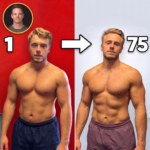
For years, the fitness world swore by the idea that gaining muscle and losing fat were mutually exclusive processes.
Build muscle in a surplus, burn fat in a deficit—that was the rule.
But recent research has flipped that assumption on its head.
Thanks to a growing body of studies—including a comprehensive review by researcher Chris Barakat—we now know that body recomposition is not only possible, but surprisingly common under the right conditions.
If you’ve been wondering whether you can simultaneously build muscle and shed fat, the answer is a resounding yes—and the roadmap might be a lot simpler (and more exciting) than you think.
Jump to:
- Yes, You Can Build Muscle and Lose Fat at the Same Time
- Caloric Deficit Is Not a Hard Requirement
- Protein: The Secret Weapon for Recomposition
- Training Matters—But You Don’t Need to Be an Athlete
- Use a Judicious Caloric Surplus
- What Happens in the Lab vs. Real Life?
- Men and Women Benefit Equally
- Practical Takeaways for Body Recomposition
- The Bottom Line
Yes, You Can Build Muscle and Lose Fat at the Same Time
Body recomposition—the process of gaining lean muscle while losing fat—was long believed to be almost impossible without extreme protocols or newbie genetics.
But more than a dozen studies now say otherwise.
According to Barakat’s review, seven out of ten studies on recomposition showed that participants gained more muscle than fat lost, suggesting a net gain in lean mass even when starting at or above maintenance calories.
This breaks the conventional thinking that you must be in a caloric deficit to lose fat and a surplus to gain muscle.
These results strongly imply that with the right type of training and nutrition—most notably a high-protein approach—you can, in fact, do both at once.
Caloric Deficit Is Not a Hard Requirement
One of the most surprising revelations from these studies is that a caloric deficit isn’t mandatory for fat loss when high-protein intake and resistance training are at play.
In fact, several participants experienced fat loss while in a slight caloric surplus, as evidenced by modest increases in body weight with simultaneous drops in fat mass.
“You can lose fat in a surplus”—that’s the weird but exciting takeaway.
Protein: The Secret Weapon for Recomposition
Across all successful recomposition case studies, one variable remained consistent: high protein intake.
Most subjects consumed somewhere between 1.0 to 1.5 grams of protein per pound of body weight.
Several studies led by Dr. Joey Antonio even had participants consume up to 2 grams per pound, simply by stacking extra protein on top of their normal diets—with astounding results.
“Nobody gains fat and some actually lose fat,” researchers explained, despite the subjects adding 80 to 100 grams of extra protein per day, often in the form of shakes, lean meats, or eggs.
This added protein appeared to have peculiar effects—subjects reported feeling warmer, sweating in their sleep, and spontaneously decreasing their intake of less nutritious calories.
Why Protein Works So Well
- High Thermic Effect: Digesting protein burns more calories than carbs or fat.
- Appetite Regulation: Protein increases satiety, curbing cravings and spontaneous over-eating.
- Muscle Preservation: Protein minimizes muscle breakdown, promoting a net gain in lean mass.
- Energy Expenditure: Extra protein may enhance both training output and non-exercise calorie burn.
Training Matters—But You Don’t Need to Be an Athlete
If you’re wondering how hard you need to train for body recomposition to happen, the answer is: train efficiently, not endlessly.
Participants in successful studies typically followed resistance training three times per week, along with cardio two to three times weekly, generally in zone 2 with some high-intensity bursts mixed in.
They performed about three to six working sets per body part, taking lifts near failure with meaningful intent—no fluff, just focused effort.
A proper warm-up and 5–10 minutes of preparation were standard, but the workouts weren’t extreme or overly long.
This approach doesn’t just work for elite athletes—it’s surprisingly ideal for everyday people committed to making a sustainable lifestyle change.
Use a Judicious Caloric Surplus
The idea isn’t to bulk recklessly.
Experts recommend a slight surplus of about 10% above maintenance—roughly 200 to 300 extra calories daily—primarily from high-quality protein sources.
That’s equal to one chicken breast and a scoop of protein powder added to your regular diet.
It’s enough to fuel training and support growth, but not so much that excess fat creeps in.
What Happens in the Lab vs. Real Life?
In a 2013 controlled feeding study by Bray et al., participants were fed escalated levels of protein inside a metabolic ward where exercise was not permitted.
The result? They gained both fat and lean mass—highlighting the importance of resistance training for positive recomposition in free-living scenarios.
In the real world, when participants consumed extra protein and lifted weights, most saw little to no fat gain and frequently more fat loss—suggesting that movement and training continue to be crucial drivers of success.
Men and Women Benefit Equally
These findings weren’t exclusive to any gender.
Both men and women experienced successful body recomposition when following a similar prescription: smart training, high protein, and controlled calories.
Effort in the gym paired with intentional nutrient intake proved more powerful than chasing a calorie deficit alone.
Practical Takeaways for Body Recomposition
- Prioritize resistance training 3–4 times per week, focusing on effort and progressive overload.
- Include 2–3 cardio sessions weekly, mixing steady-state work with the occasional sprint or interval.
- Eat at or just above maintenance, aiming for a 10% calorie surplus.
- Stack your protein intake to reach 1.0–1.5 grams per pound of body weight.
- Don’t obsess over timing—total daily intake matters more than meal distribution.
- Adjust based on feedback: If you’re gaining too much fat, scale back. If you’re stalling, consider upping training quality or protein further.
The Bottom Line
Body recomposition isn’t a myth reserved for genetic elites or beginners—it’s a practical, research-backed strategy for anyone ready to train smart, eat intentionally, and commit consistently.
A slight caloric surplus rich in high-quality protein, when combined with committed resistance training, doesn’t just maintain body composition—it can radically improve it.
As Barakat and his colleagues have shown, the rules of body transformation have changed—and they might be more flexible than we ever imagined.