It’s easy to feel discouraged when you learn how rapidly we lose muscle and strength with age.
By your 30s, you’re already losing about 3.5% to 4% each decade, and that rate spikes up to 12% by your 50s and beyond.
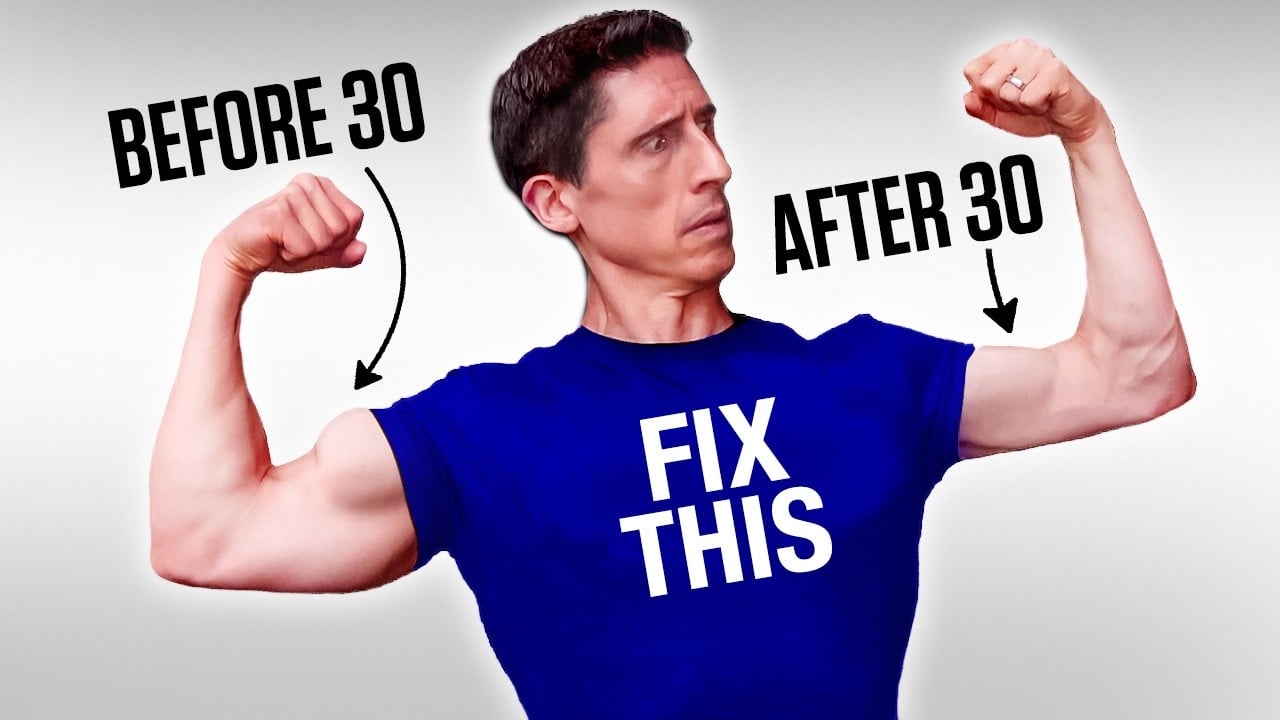
But this decline isn’t just inevitable—it’s highly manageable.
The concept of “anabolic resistance” explains why things get tougher with age—but also reveals a roadmap for how to fight back and preserve your strength.
In this article, we’ll break down the eight specific factors driving age-related muscle loss—and the simple, science-backed strategies you can implement to slow, and even reverse, the curve.
Jump to:
- 1. Age Increases Your Protein Needs—Per Meal
- 2. Leucine Becomes Even More Critical
- 3. You Must Train Hard—Not Just “Stay Active”
- 4. Satellite Cell Decline Hurts Recovery
- 5. Chronic Inflammation Increases With Age
- 6. Your Hormones Don’t Help Anymore
- 7. Blood Flow to Muscles Gets Worse
- 8. You Need to Fight Back—Deliberately
1. Age Increases Your Protein Needs—Per Meal
As you age, your muscles face something known as anabolic resistance. This blunts your body’s ability to build new muscle—even if you eat well and strength train.
One of the first victims of this process is your response to dietary protein. While a younger body can stimulate muscle protein synthesis (MPS) with just 20–25 grams per meal, older adults need more—closer to 35 to 40 grams per meal.
This change is like turning up the volume on an old stereo: what used to work with a mild turn now requires a full crank just to get the same effect. Older muscles are less sensitive, so you need more protein stimulus to get the same building response.
Aim to hit at least 1 gram of protein per pound of body weight daily, and if you train hard, consider bumping it up to 1.2 grams per pound.
Even more importantly, divide that protein intake evenly across your meals to maximize the number of times your body can stimulate new muscle growth throughout the day.
2. Leucine Becomes Even More Critical
Leucine, an essential amino acid found in high-quality proteins, plays a central role in muscle growth via the mTOR pathway, your body’s muscle-building switch.
In younger individuals, about 2–3 grams of leucine per meal is enough to trigger this pathway. But with age, your body’s mTOR signaling becomes “dimmed,” and you need more leucine to get the same effect.
How do you get there? Choose high-leucine foods like whey protein, fish, and eggs. Since leucine typically makes up 10% of total protein content in these sources, a 30-gram serving of a high-quality protein provides 3 grams of leucine.
You can also consider adding BCAA (branched-chain amino acid) supplements to ensure you’re consistently crossing the leucine threshold for muscle stimulation.
3. You Must Train Hard—Not Just “Stay Active”
Protein intake is powerful, but without training, it won’t build meaningful muscle.
Older adults often shy away from lifting heavy or pushing hard—but this is a mistake. As your body resists change more, the intensity of your workouts must go up, not down.
Focus on quality reps close to muscular failure, use heavier weights, and slow your tempo. Training slowly with control drastically reduces injury risk—even with more challenging loads.
Use “effective reps” to make your workouts more efficient: aim to reduce rest between sets slightly so that your muscles are continually pushed toward fatigue with fewer total reps.
4. Satellite Cell Decline Hurts Recovery
Think of satellite cells as your muscle’s pit crew: after a tough workout, they repair and rebuild you stronger. As you age, you have fewer satellite cells, and they respond more sluggishly.
This means slower recovery and diminished muscle growth if you don’t adapt your training volume and recovery habits accordingly.
Space your strength sessions wisely—an upper/lower split four times per week is often ideal. Prioritize deep sleep, stretching, and even “boring” corrective exercises to improve your recovery window.
Consider anti-inflammatory support like omega-3 fatty acids to boost recovery further.
5. Chronic Inflammation Increases With Age
A condition called “inflammaging” refers to a chronic, low-grade inflammation in the body that worsens with age. This state competes with muscle growth for your body’s attention and energy.
Symptoms can include poor sleep, brain fog, joint pain, and mood issues—and it contributes directly to anabolic resistance by suppressing the signals needed for muscle protein synthesis.
Combat inflammaging by sleeping 7–9 hours per night, eating an antioxidant-rich diet, and supplementing with anti-inflammatory nutrients like omega-3s. Curcumin and vitamin D are also commonly used to fight systemic inflammation.
6. Your Hormones Don’t Help Anymore
Testosterone, growth hormone, and IGF-1 all naturally decline as you age. In fact, testosterone drops about 1% per year starting as early as your 30s.
Since hormones are like the background music for muscle building, their lowered volume makes growth more difficult—unless you increase your muscle’s sensitivity to them.
The fix? Train hard. Exercise—especially resistance training—ramps up your body’s sensitivity to growth hormones even when overall levels are declining.
A strong muscle trained with intensity becomes more responsive—even amid a changing hormonal landscape.
7. Blood Flow to Muscles Gets Worse
Aging reduces the elasticity of blood vessels, restricting blood flow and slowing the delivery of nutrients to your muscles during and after training.
That means slower recovery—and slower gains.
To combat this, take advantage of the post-workout window of increased blood flow by consuming protein soon after training. It may not be essential for the young, but for older lifters, timing your nutrition can give you an edge.
Additionally, improve blood flow long-term by doing more cardio—especially zone 2 (moderate intensity) and zone 5 (short, intense intervals) workouts. These build a more efficient circulatory system to deliver more fuel, faster.
8. You Need to Fight Back—Deliberately
Yes, aging is inevitable. But that doesn’t mean decline has to be.
The real secret is not giving in, but resisting—intelligently, consistently, and patiently. Every one of these barriers to maintaining your muscle and strength can be addressed with training, nutrition, recovery, and smart supplementation.
Whether that means eating your protein more strategically, pushing yourself harder in the gym, or taking rest days more seriously than you used to—it all counts.
As Jeff Cavaliere says, “We don’t have to age gracefully. The most important thing you can do is resist.”