Three of the world’s most accomplished performance coaches sit down to discuss the invisible game that determines everything.
Bob Bowman guided Michael Phelps through two decades of Olympic dominance, George Mumford worked behind the bench during the Bulls’ championship dynasty, and Brian Johnson translates ancient wisdom for Navy SEALs and business leaders.
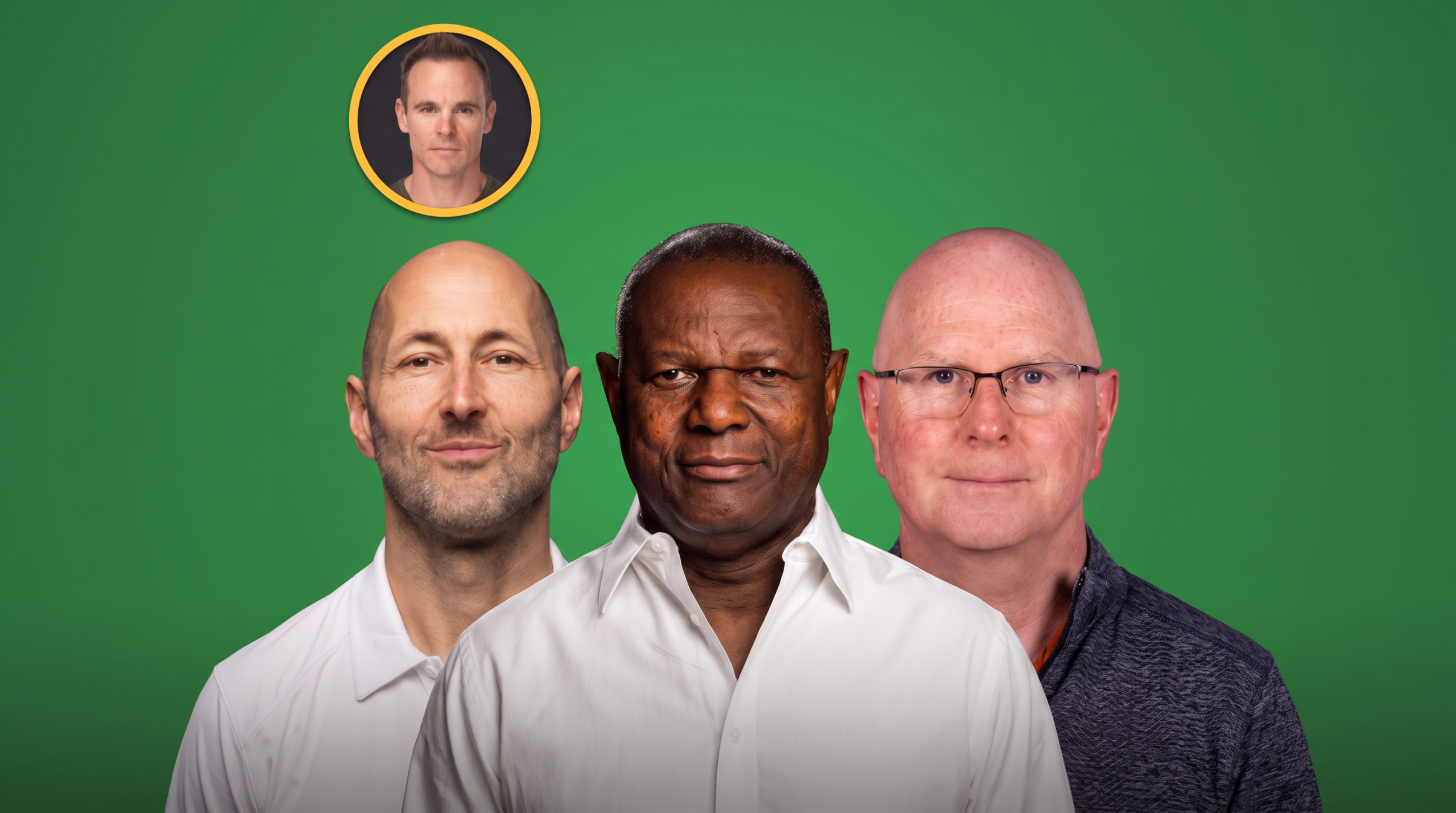
Their methods differ—preparation, awareness, practical philosophy—but they all lead to the same destination: mastery of the voice inside your head.
What emerges from their conversation isn’t just coaching theory, but a roadmap for anyone wrestling with doubt, distraction, or the gap between who they are and who they could become.
Jump to:
- The Teacher Who Said Michael Phelps Would Never Amount to Anything
- Why Failure Is Feedback, Not Defeat
- Michael Jordan’s Last Shot and the Power of Pure Performance
- The Two Wolves Fighting Inside Your Head
- Bob Bowman’s Radical Approach to Self-Talk
- The Broken Wrist That Led to Olympic Gold
- Why Visualization Isn’t What You Think It Is
- Steve Kerr, Jeff Hornacek, and the Inner Game in Action
- Churchill’s Paradox: Plans Are Useless, Planning Is Everything
- The Moment Michael Phelps Became Unbeatable
- The Game You’re Actually Playing
- Why Balance Is a Myth and What to Do Instead
- George Mumford’s Journey from Shooting Gallery to Championship Bench
- The Three Things George Mumford Knows for Sure
- Bob Bowman’s Heroes and What They Reveal
- Why Michael Jordan Never Destroyed His Own Confidence
- The Light You Already Have
- Sources
The Teacher Who Said Michael Phelps Would Never Amount to Anything
At age ten, Michael Phelps sat outside a classroom while a teacher delivered a verdict to his mother that would have crushed most kids.
Michael will never amount to anything. He can’t focus on anything.
Bob Bowman, who would coach Phelps for the next twenty years, saw something entirely different unfold.

If you want something simple that actually works, this is one of the most effective tools I’ve used to build strength, conditioning, and endurance without needing a full gym setup.
- Full-body training with one weight using swings, squats, and presses
- Solid cast iron build that feels stable and lasts for years
- Comfortable grip that makes high-rep workouts easier to handle
Guess what? The most focused person I’ve ever been around.
The transformation wasn’t magic. It was forged through relentless failure and an unusual relationship with setbacks.
Michael was never more motivated than after he had a setback.
Bowman watched this pattern repeat itself countless times. Bad race? The next six months became a masterclass in obsessive refinement.
Why Failure Is Feedback, Not Defeat
Most athletes hide from failure. The greats hunt for it.
Bowman’s philosophy cuts against everything parents and coaches typically preach about protecting young athletes from disappointment.
Everyone is going to fail. Some people think Michael Phelps never failed. He failed a million times. I saw everyone in 20 years.
The difference between champions and everyone else isn’t talent or luck—it’s how they metabolize setbacks.
Failure becomes fuel when you reframe it as information. What went wrong? Which variables need adjusting? What needs strengthening?
If you want something simple that actually works, this is one of the most effective tools I’ve used to build strength, conditioning, and endurance without needing a full gym setup.
- Full-body training with one weight using swings, squats, and presses
- Solid cast iron build that feels stable and lasts for years
- Comfortable grip that makes high-rep workouts easier to handle
Bowman teaches swimmers to strip away shame and emotion from poor performances and treat them as diagnostic tools.
When they fail, they’re ashamed, they just want to kind of get emotional about it. But in reality, that’s where the learning happens.
George Mumford frames this principle through a simple phrase he shares with athletes: “No struggle, no swag.”
Struggle isn’t the opposite of success. It’s part of the same coin.
Michael Jordan’s Last Shot and the Power of Pure Performance
Game Six of the 1998 NBA Finals. Utah Jazz leading. Championship on the line.
George Mumford sat behind the Bulls bench, surrounded by hostile fans and security guards. Then Michael Jordan did what Michael Jordan does—but not how most people remember it.
Michael runs around, comes back, he strips Kyle Malone, comes down and he makes that shot and it was like poof. The whole environment, the whole place, Utah, it was like silence.
What looked like instinct was actually intelligence. Jordan remembered what happened in the 1997 Finals—same situation, different defensive read.
If you want something simple that actually works, this is one of the most effective tools I’ve used to build strength, conditioning, and endurance without needing a full gym setup.
- Full-body training with one weight using swings, squats, and presses
- Solid cast iron build that feels stable and lasts for years
- Comfortable grip that makes high-rep workouts easier to handle
In ’97, Utah doubled Jordan and he kicked to Steve Kerr for the winning shot. In ’98, they stayed home on Kerr. Jordan read it instantly.
But there’s a detail almost no one caught.
Jordan’s shots that night had been falling short. So before releasing the championship-winning jumper, he went back to basics: elbow in, follow through.
People think he was profiling. No, all of his shots prior to that were short. So he had to go back to basic fundamentals.
This is what Mumford calls “pure performance”—being fully present, reading the situation, expressing yourself authentically without being “compelled by desire or fear.”
The Two Wolves Fighting Inside Your Head
An old Cherokee story tells of a grandfather teaching his grandson about life.
There’s this ferocious battle going on inside of me between two wolves. One wolf is fear, one wolf is love.
The grandson asks which wolf wins. The grandfather’s answer cuts through every self-help cliché:
If you want something simple that actually works, this is one of the most effective tools I’ve used to build strength, conditioning, and endurance without needing a full gym setup.
- Full-body training with one weight using swings, squats, and presses
- Solid cast iron build that feels stable and lasts for years
- Comfortable grip that makes high-rep workouts easier to handle
The one that I feed.
Mumford uses this parable to explain self-talk at the neurological level. Your nervous system operates in two modes: survival or growth.
In survival mode, your brain scans for danger. Nine out of ten thoughts will be negative. You’re in fight-flight-freeze.
In growth mode, you’re curious, creative, focused on what you can control.
The breakthrough insight? You can’t be in both modes simultaneously. On a cellular level, cells are either defending or growing—never both at once.
This aligns with research on the autonomic nervous system’s role in stress and performance, where the sympathetic (fight-or-flight) and parasympathetic (rest-and-digest) branches create fundamentally different physiological and psychological states.
If you understand you’re in survival mode and you get out of survival mode and get into growth mode, now you’re asking what’s the lesson?
The first step isn’t changing your self-talk—it’s recognizing which mode you’re in. Tight jaw? Shoulders by your ears? That’s fear talking, even when you think you’re fine.
If you want something simple that actually works, this is one of the most effective tools I’ve used to build strength, conditioning, and endurance without needing a full gym setup.
- Full-body training with one weight using swings, squats, and presses
- Solid cast iron build that feels stable and lasts for years
- Comfortable grip that makes high-rep workouts easier to handle
Bob Bowman’s Radical Approach to Self-Talk
Bowman doesn’t just coach technique. He coaches the voice that shows up in the ready room before a race.
His method starts with a question borrowed from researcher Brené Brown:
Would you ever talk to somebody you loved that way?
Athletes demolish themselves with criticism they’d never level at a friend. Bowman learned this from his own internal battles.
I’m probably my biggest critic. I would never say anything like that to my grandson. Why would you talk to yourself that way?
The principle he drills into young swimmers: what you program in is what comes out under pressure.
Be careful what you feed your mind in training, because that’s the voice that shows up when everything’s on the line.
This isn’t about toxic positivity or pretending weakness doesn’t exist. It’s about grace—giving yourself the same patience you’d extend to someone you’re trying to help grow.
If you want something simple that actually works, this is one of the most effective tools I’ve used to build strength, conditioning, and endurance without needing a full gym setup.
- Full-body training with one weight using swings, squats, and presses
- Solid cast iron build that feels stable and lasts for years
- Comfortable grip that makes high-rep workouts easier to handle
The Broken Wrist That Led to Olympic Gold
Michael Phelps broke his wrist during critical training. Most athletes would see only limitation.
Bowman saw opportunity.
Okay, we can focus on your leg strength.
For months, Phelps worked obsessively on his kick. Later, one of his Olympic gold medals came down to exactly that—superior leg strength in the final meters.
Mumford calls this “being with what is as it is and being yourself authentically.” You can’t control the broken wrist. You can control what you do next.
I got a broken wrist. What am I going to do? How can I be Michael in this situation?
Champions don’t ignore obstacles—they extract value from them.
This mindset separates those who crumble under adversity from those who use it as rocket fuel.
If you want something simple that actually works, this is one of the most effective tools I’ve used to build strength, conditioning, and endurance without needing a full gym setup.
- Full-body training with one weight using swings, squats, and presses
- Solid cast iron build that feels stable and lasts for years
- Comfortable grip that makes high-rep workouts easier to handle
Why Visualization Isn’t What You Think It Is
Most people think visualization is a cute exercise. George Mumford knows it’s happening all the time whether you realize it or not.
We’re imagining all the time. We’re just not aware of it.
Ever rehearse a difficult conversation in your head? That’s visualization. The problem? Your nervous system can’t distinguish between imagined and real experiences.
If you repeatedly imagine failure, conflict, or embarrassment, you’re training your body to respond as if it’s happening.
This aligns with well-established research on motor imagery and mental practice, where imagining movements activates similar neural pathways as physical execution, though the claim that the nervous system “can’t distinguish” is more nuanced—the patterns overlap significantly but aren’t identical.
Whatever we hold in mind manifests. If you keep thinking about trauma, your physiology—you’re actually still in it.
The solution isn’t to stop visualizing—it’s to visualize deliberately.
Mumford worked with Olympic volleyball players in Brazil, NBA champions, prisoners seeking transformation. The technique stays constant: imagine the outcome with sensory detail, then imagine who you need to become to achieve it.
If you want something simple that actually works, this is one of the most effective tools I’ve used to build strength, conditioning, and endurance without needing a full gym setup.
- Full-body training with one weight using swings, squats, and presses
- Solid cast iron build that feels stable and lasts for years
- Comfortable grip that makes high-rep workouts easier to handle
He once worked with the Bulls while Jordan was retired. Mumford visualized himself behind the bench of a championship team. It happened eight times.
Steve Kerr, Jeff Hornacek, and the Inner Game in Action
Late in his career with the Spurs, Steve Kerr felt stuck. He admired Jeff Hornacek’s creative, dynamic style but couldn’t seem to access that same fluidity in his own game.
Then Kerr returned to Tim Gallwey’s Inner Game principles. The advice was almost absurdly simple: go to practice and pretend to be Hornacek.
Kerr did it. After that practice, teammates mobbed him with high-fives.
Steve, that was the best practice of the whole year that you just showed us.
He kept it going. The Spurs won the championship. In Game Seven against the Suns, Kerr scored 18 points in the final minutes to seal the victory.
Emulation unlocks something visualization alone can’t—permission to access parts of yourself you’ve disowned.
If you want something simple that actually works, this is one of the most effective tools I’ve used to build strength, conditioning, and endurance without needing a full gym setup.
- Full-body training with one weight using swings, squats, and presses
- Solid cast iron build that feels stable and lasts for years
- Comfortable grip that makes high-rep workouts easier to handle
You’re not becoming someone else. You’re trying on aspects of excellence that already exist within you but haven’t been expressed.
Churchill’s Paradox: Plans Are Useless, Planning Is Everything
Winston Churchill said it in the context of World War II, but the principle applies to every high-pressure situation.
Planning is everything. Plans mean nothing.
Mumford experienced this teaching a class in prison. He’d prepared copious notes for an elaborate lecture. Then he discovered 28 of his 32 students spoke only Spanish.
All the preparation flew out the window. But because he’d prepared so thoroughly, he could simplify and adapt on the spot.
Bowman embodies this with his swimmers. Every detail matters in training—stroke mechanics, nutrition, sleep schedules, mental rehearsal. But race day requires letting go and making the next play.
You got to make the next play every time.
Preparation creates freedom. When you’ve done the work, you can trust yourself to respond rather than panic.
If you want something simple that actually works, this is one of the most effective tools I’ve used to build strength, conditioning, and endurance without needing a full gym setup.
- Full-body training with one weight using swings, squats, and presses
- Solid cast iron build that feels stable and lasts for years
- Comfortable grip that makes high-rep workouts easier to handle
The Moment Michael Phelps Became Unbeatable
Spain. A major international meet. Michael Phelps was sixteen and swimming in semi-finals.
The event was the 200-meter butterfly—not his strongest race at the time, but he’d been training hard. Semi-finals were run as two heats, eight swimmers each. Winners advance to finals.
Phelps was in the second heat. The first heat went off. A Russian swimmer broke the world record.
Bowman was watching from above, looking down into the ready room. Phelps looked up at him.
He just had this look kind of like, and then he looked back and I was like, my gosh, this poor kid’s going to hold a world record for one minute.
Phelps went out and destroyed the time. Bowman saw something in that moment that went beyond talent or training.
It was the look of someone living fully into the moment. No fear. No doubt. Just presence and hunger.
If you want something simple that actually works, this is one of the most effective tools I’ve used to build strength, conditioning, and endurance without needing a full gym setup.
- Full-body training with one weight using swings, squats, and presses
- Solid cast iron build that feels stable and lasts for years
- Comfortable grip that makes high-rep workouts easier to handle
Mumford describes this state as “pure performance”—when you’re not compelled by fear or desire, just expressing yourself authentically within the flow of competition.
The Game You’re Actually Playing
Brian Johnson teaches business leaders, military operators, and athletes a framework that redefines success.
Ancient Greeks had a word for the ultimate purpose of life: eudaimonia. It’s commonly translated as happiness, but it really means flourishing—living in alignment with your highest self.
The ultimate game of life is to connect with that best version of ourselves. Then you use the swimming pool, the basketball court, business as a context to play the ultimate game.
How do you achieve eudaimonia? The Greeks answered in one word: arete—excellence or virtue.
Close the gap between who you’re capable of being and who you actually are, moment to moment to moment.
When there’s a gap—when you know you could have done better and didn’t—that’s where regret, anxiety, and disillusionment breed.
If you want something simple that actually works, this is one of the most effective tools I’ve used to build strength, conditioning, and endurance without needing a full gym setup.
- Full-body training with one weight using swings, squats, and presses
- Solid cast iron build that feels stable and lasts for years
- Comfortable grip that makes high-rep workouts easier to handle
Jordan and Kobe lived this. Not sometimes. Not when it mattered most. Every single day.
MJ didn’t take a day off. He was expressing his best version of himself moment to moment to moment.
Johnson drives this home with his thirteen-year-old son, who wants to become a chess grandmaster. Before every tournament, Johnson asks the same question:
“What do you want?”
His son used to say, “I want to be a grandmaster.” Now he says, “I want to be a good person, and I want to be a grandmaster.”
Why Balance Is a Myth and What to Do Instead
The question comes up constantly: How do champions maintain relationships while pursuing excellence at that level of intensity?
Johnson’s answer cuts against the work-life balance mythology.
If you want something simple that actually works, this is one of the most effective tools I’ve used to build strength, conditioning, and endurance without needing a full gym setup.
- Full-body training with one weight using swings, squats, and presses
- Solid cast iron build that feels stable and lasts for years
- Comfortable grip that makes high-rep workouts easier to handle
It’s not about static balance. It’s like a tightrope walker. You’re never balanced statically. It’s dynamic.
You’re constantly adjusting—a little too far this way, compensate that way. The key is knowing your destination.
Freud said a good life comes down to two things: work and love. Johnson adds a third: energy.
Your self-talk is driven as much by physiology as psychology. Bad sleep? Watch your inner dialogue tank. Poor nutrition, no movement, shallow breathing? Good luck showing up as your best self.
Johnson calls it the Big Three: energy, work, love. You need all three, and when one suffers, the others feel it.
His practical tip for parents trying to be present: lock your phone in a safe when you’re with your kids.
Tal Ben-Shahar, who taught the largest class in Harvard history on happiness, uses a literal lock box. When he’s with his children, the phone goes in the safe.
If you want something simple that actually works, this is one of the most effective tools I’ve used to build strength, conditioning, and endurance without needing a full gym setup.
- Full-body training with one weight using swings, squats, and presses
- Solid cast iron build that feels stable and lasts for years
- Comfortable grip that makes high-rep workouts easier to handle
Presence isn’t about quantity of time. It’s about being fully there when you are there.
George Mumford’s Journey from Shooting Gallery to Championship Bench
Mumford doesn’t hide his past. He talks about it openly—substance abuse, desperation, hitting bottom in places most people only see in nightmares.
This is how I went from being in the crack house to being behind the bench of NBA championship team.
How?
By applying the same principles he now teaches elite athletes: taking responsibility, getting comfortable being uncomfortable, asking what needs to happen next.
My best thinking got me high and drunk. I had to behave my way into proper thinking.
You can’t think your way out of a pattern—you have to act differently until your thinking changes.
This is why Mumford’s teaching resonates beyond sports. Athletes see Jordan and Kobe and think, “I could never be like them.” But they see Mumford—someone who climbed out of hell through the same practices he’s teaching—and think, “Maybe I can do this.”
If you want something simple that actually works, this is one of the most effective tools I’ve used to build strength, conditioning, and endurance without needing a full gym setup.
- Full-body training with one weight using swings, squats, and presses
- Solid cast iron build that feels stable and lasts for years
- Comfortable grip that makes high-rep workouts easier to handle
I ain’t Michael or Kobe, but I’m just like you. You’re just a human being. So how’d you do it?
The Three Things George Mumford Knows for Sure
Mumford appeared on both Tim Ferriss’s and Lewis Howes’s podcasts. Both asked him the same question: What are the three things you know for sure?
His answer hasn’t changed:
- The only time we have is now
- The only one you can be is you
- All you need is love
Simple. Profound. Impossible to argue with. And maddeningly difficult to live.
That’s my triangle offense.
Most people spend their lives everywhere except the present. They’re reliving yesterday or rehearsing tomorrow, performing for an audience that doesn’t exist, hiding from who they actually are.
Mumford’s work is about leading people back to themselves. Not giving them something new, but helping them access what’s already there.
I’m not telling you what to do. I’m showing you who you are.
Bob Bowman’s Heroes and What They Reveal
When asked about his heroes, Bowman doesn’t name famous coaches or athletes first. He names his mother.
If you want something simple that actually works, this is one of the most effective tools I’ve used to build strength, conditioning, and endurance without needing a full gym setup.
- Full-body training with one weight using swings, squats, and presses
- Solid cast iron build that feels stable and lasts for years
- Comfortable grip that makes high-rep workouts easier to handle
She embodies everything I think a good person is. Selfless, serves others. She was a teacher for 40 years, high school teacher.
Then he talks about his high school band teacher—someone who taught him how to truly love something and opened his eyes to the world beyond Columbia, South Carolina.
Your heroes reveal your values. Bowman’s choices show someone who prioritizes character, service, passion, and the transformative power of great teaching.
He also mentions Abraham Maslow, the psychologist who studied peak performance and self-actualization—the idea that we must become what we’re capable of becoming.
Johnson teaches people to literally put pictures of their heroes on the wall and ask: What would they do in this moment?
It’s not about imitation. It’s about using someone else’s excellence as a ruler to measure yourself against.
Why Michael Jordan Never Destroyed His Own Confidence
Michael Jordan had a rule he never broke.
If you want something simple that actually works, this is one of the most effective tools I’ve used to build strength, conditioning, and endurance without needing a full gym setup.
- Full-body training with one weight using swings, squats, and presses
- Solid cast iron build that feels stable and lasts for years
- Comfortable grip that makes high-rep workouts easier to handle
I never have any self-talk that destroys my confidence.
Not once. Not ever.
This wasn’t arrogance. It was discipline. Jordan understood that confidence is a resource you either build or deplete with every thought.
Mumford sees this as the difference between survival mode and growth mode. When you’re feeding the fear wolf, you’re actively programming failure.
Champions guard their internal narrative like their lives depend on it—because their performance does.
This doesn’t mean denying reality or avoiding hard truths. It means refusing to participate in self-sabotage.
John Wooden said it differently: “Poise is being yourself.” No matter what happens, your job is to be you, expressing your highest self.
If you want something simple that actually works, this is one of the most effective tools I’ve used to build strength, conditioning, and endurance without needing a full gym setup.
- Full-body training with one weight using swings, squats, and presses
- Solid cast iron build that feels stable and lasts for years
- Comfortable grip that makes high-rep workouts easier to handle
The Light You Already Have
Mumford shares a story that sounds small but contains everything.
He traveled for work, rushed, barely made his Zoom call. He’d forgotten to pack his external light for video calls. Sitting in darkness, frustrated, he had a simple realization.
Something told me to brighten it up. And I brightened it up and it lit the whole thing up. I said, ‘Oh, that’s interesting.’ I’m thinking I need an external light when in actuality the computer—I just hit the light thing.
It became a metaphor for everything he teaches.
How often do we search outside ourselves for something we already have?
How much of what we do where we’re going out there and all we got to do is turn on the inner light to see?
Light is consciousness. The ability to see clearly. It’s already in you.
The game these three coaches play—with Olympic swimmers, NBA champions, Navy SEALs, business leaders—isn’t about adding something you don’t have.
If you want something simple that actually works, this is one of the most effective tools I’ve used to build strength, conditioning, and endurance without needing a full gym setup.
- Full-body training with one weight using swings, squats, and presses
- Solid cast iron build that feels stable and lasts for years
- Comfortable grip that makes high-rep workouts easier to handle
It’s about removing what blocks the light that’s already there.
Sources
- Research on motor imagery and mental practice (neural pathway activation during visualization)
- Studies on autonomic nervous system function in stress and performance contexts