

Training smarter isn’t just a tag line—it’s a science. But with all the chatter around injury risk, training spikes, and the hottest new wearables, it’s easy to get buried under conflicting advice.
That’s exactly why exercise physiologist Dr. Franco Impellizzeri’s insights are gaining so much traction right now.
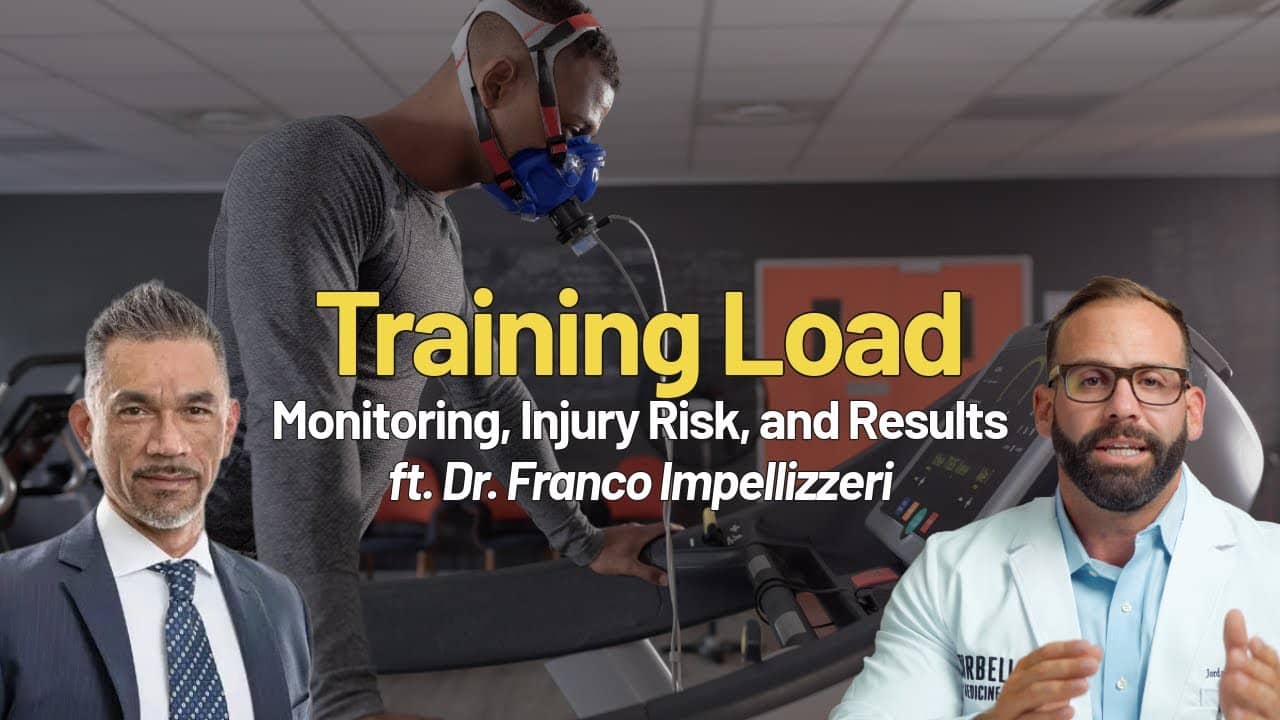
In a recent appearance on the Barbell Medicine podcast, Dr. Impellizzeri—a pioneer in training load research and evidence communication—unpacked the nuances behind why more isn’t always better…unless you know exactly what you’re doing.
Get ready to dive into what training load really is, how it can boost performance (or ruin it), and why science-based decisions aren’t just about data—they’re also about context, logic, and sometimes, a little intuition.
Jump to:
Training Load: It’s More Than Just Volume
For decades, the term “training load” has been tossed around loosely—as if it were a single, one-size-fits-all concept. But Dr. Impellizzeri, who helped formalize the terminology over 20 years ago, made it clear that the concept is anything but simplistic.
According to his model, training load can be divided into two distinct but interlinked categories:
- External load: The measurable, objective elements like reps, weight lifted, distance, or velocity used during training.
- Internal load: The individual’s physiological and psychological response to that external stressor—think heart rate, RPE (Rate of Perceived Exertion), HRV (Heart Rate Variability), and muscle soreness.
“In the end of the day,” says Dr. Impellizzeri, “it’s the internal response that determines the adaptations you’re going to get.”
Why Context Dictates Monitoring Strategy
Many coaches search for the best metric for tracking progress or injury risk, but Dr. Impellizzeri is adamant: the “best” measure depends entirely on your training goals and plan.
“Monitoring makes sense if you have a plan to begin with,” he explains. “What to monitor depends on what you’re trying to do.”
Take time-under-tension, for example. If that’s the basis of your hypertrophy program, tracking weight and reps alone might miss the point. On the other hand, if your sprint program targets maximum speed, then top-end velocity and frequency may matter far more than RPE or duration.
Bottom line: Every metric is only as useful as the training program it supports.
Internal Load: Not Just About Physiology
While it’s tempting to gravitate toward heart rate or HRV as go-to internal metrics, Dr. Impellizzeri stresses the importance of an overlooked—but highly powerful—tool: perception.
“Yes, RPE is subjective. That’s the point,” he emphasizes. “It captures psychological stress, mood, fatigue. That’s vital, especially in real-world training.”
This lens shifts how we think about effective training. If an athlete rates a session unexpectedly high in intensity on an easy day, that feedback could signal an underlying issue—such as illness, poor sleep, or burnout—long before external data flags it.
Is There a Magic Metric?
Not exactly.
While wearables and apps often report training loads using proprietary “strain” or “readiness” scores, Dr. Impellizzeri encourages skepticism. Many of these algorithms claim scientific backing, yet few are validated in a coaching or medical sense.
“If it sounds too neat, too precise—it probably is,” he warns.
Rather than chasing a perfect number, he suggests coaches and athletes focus on identifying trends over time:
- Is the internal response (RPE, HRV, soreness) matching expectations?
- Are performance markers improving, stalling, or regressing?
- Is the athlete expressing fatigue earlier than planned?
“Combining multiple data points paints a fuller picture,” he says. “No single number ever tells the whole story.”
The Fatigue Paradox: Why Risk Can’t Be Eliminated
Possibly the most profound point shared in the conversation: fatigue and injury risk aren’t enemies of performance—they’re the price of admission.
“If you want to succeed at the Olympics, you won’t get there wanting comfort,” says Dr. Impellizzeri. “There’s risk in competition, and some risk in serious training. Avoiding all risk also means avoiding all reward.”
This candid view extends to popular metrics like the acute:chronic workload ratio (ACWR). Once hailed as a predictor of injury due to sudden spikes in workload, recent, more rigorous studies have challenged its validity. In fact, in some cases, increasing training volumes appeared protective.
“You need to train hard. You just need to be smart enough to notice when things aren’t going as expected.”
Apply It Yourself: Practical Tips on Monitoring
Not sure where to start with monitoring for yourself or your athletes? Dr. Impellizzeri shared some key takeaways:
- Always begin with a plan. Decide why you’re using any metric before you collect data.
- Use multiple inputs. Combine RPE, training logs, fatigue scores, and HRV for trend recognition.
- Don’t fear fatigue. A temporary rise in internal load—if planned—may be both expected and necessary.
- Let athletes self-monitor. Asking “How do you feel today?” might provide more insight than a whole suite of sensors.
And above all—resist the urge to chase certainty.
“Coaching is full of gray zones,” says Impellizzeri. “The best metric is the one that helps you make a better decision for your environment.”
Where Science Meets Intuition
While science underpins smart training, Impellizzeri is clear that data alone won’t protect against miscommunication or poor judgement. The gap between evidence and practice? That’s where coaching lives.
“I trust a coach with a good process—even if their methods aren’t backed by perfect evidence—more than someone blindly applying a paper.”
In a landscape crowded with fancy dashboards and trends, his advice rings loud and true: Know your athletes. Know your training goals. Use data to guide, not dictate.
And above all—train hard enough to improve, but smart enough to know when to step back. Because no model, app, or wearable will ever replace the art of coaching—or the experience of the athlete.










