Gray hair turning dark again sounds like an internet myth.
Columbia University’s Dr. Martin Picard says it is real, because he watched it happen on his own head.
On the Body Tobe podcast, the mitochondria researcher explained what his lab found about reversible graying.
His explanation hinges on one surprising idea: your body runs on a strictly fixed energy budget.
Keep reading for the daily habits Picard follows himself, plus the one supplement he skips.
Jump to:
- Gray Hair Can Turn Dark Again, but Only Within a Window
- How Stress Steals From Your Energy Budget
- Four Habits Picard Links to Healthier Mitochondria
- Fasting: Ancient Practice Meets Modern Lab
- Is Aging Reversible? Biological Clocks Say Maybe
- Purpose May Show Up in Your Mitochondria
- Where Science Stops and Tradition Begins
- Rapid-Fire Takeaways
Gray Hair Can Turn Dark Again, but Only Within a Window
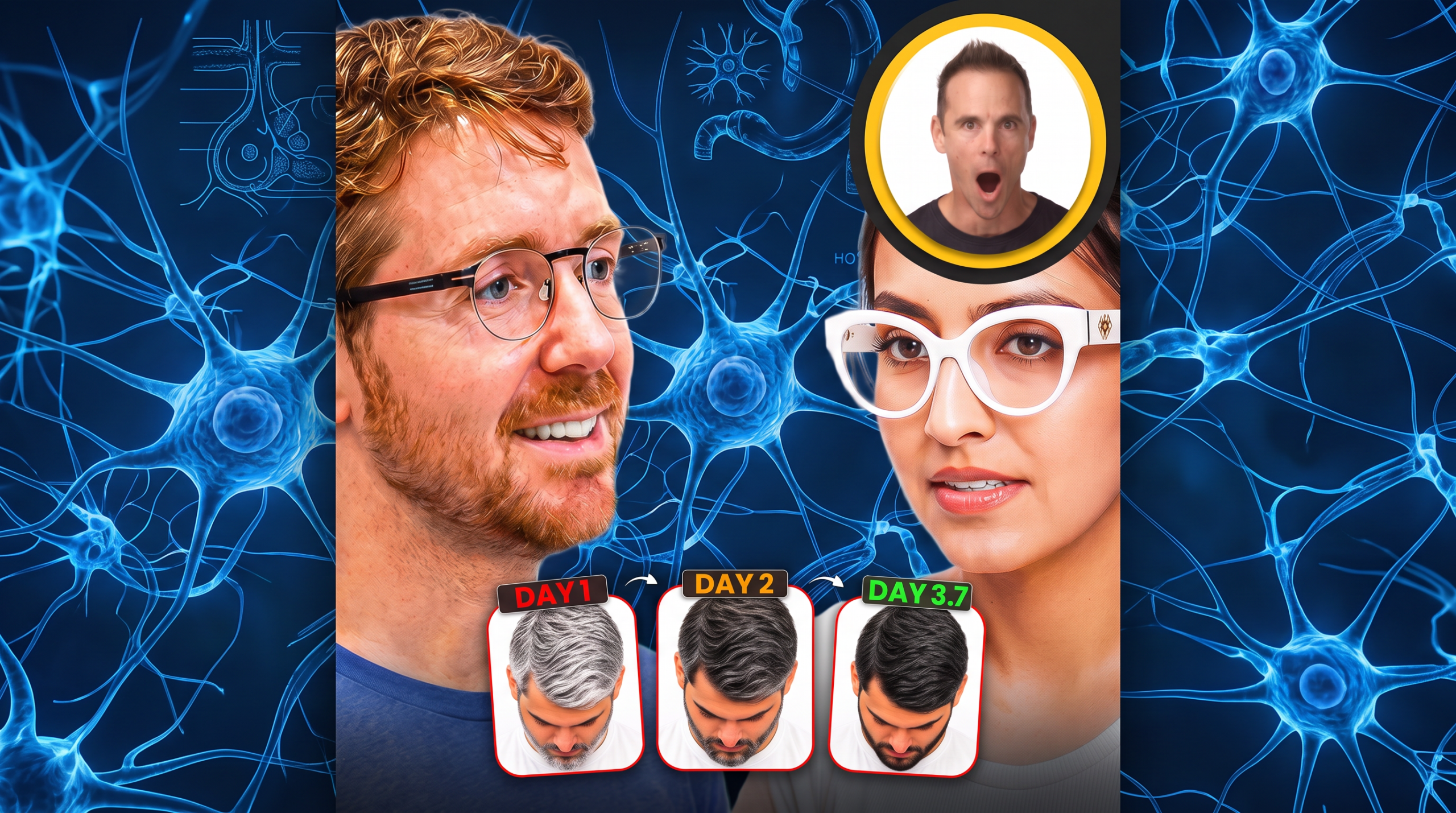
Picard leads the mitochondria psychobiology group at Columbia and co-directs its science of health program. His team reported that some gray hairs regain pigment in as little as 3.7 days.

If you want something simple that actually works, this is one of the most effective tools I’ve used to build strength, conditioning, and endurance without needing a full gym setup.
- Full-body training with one weight using swings, squats, and presses
- Solid cast iron build that feels stable and lasts for years
- Comfortable grip that makes high-rep workouts easier to handle
We discovered hair growing is reversible. And I was really skeptical until I saw it on my own head.
After a week-long beach vacation, Picard noticed five formerly white hairs had darkened again.
Skepticism faded when his team collected hair samples from around the world. One pubic hair had a white tip and a dark regrowth, and Picard thought, this has to be real.
Why Your Hair Loses Color
Each hair follicle works like a tiny U-shaped organ. Inside sit melanocytes, cells that make pigment and burn energy doing it.
When a follicle runs low on fuel, Picard believes it makes a decision. Color production gets cut first, and the hair turns gray or white.
Molecular analysis of dark, white and re-darkened hairs showed the strongest signal was a difference in mitochondria. That challenges the long-held scientific view that graying is a one-way street.
The Catch: A Narrow Window
It seems like there’s a window of potential. There’s a window of reversibility.
A hair that recently turned gray may still bounce back. A strand gray for 20 years likely will not, and a vacation will not change that.
If you want something simple that actually works, this is one of the most effective tools I’ve used to build strength, conditioning, and endurance without needing a full gym setup.
- Full-body training with one weight using swings, squats, and presses
- Solid cast iron build that feels stable and lasts for years
- Comfortable grip that makes high-rep workouts easier to handle
How Stress Steals From Your Energy Budget
Picard’s central model is simple. Imagine 100 units of daily energy, with roughly half reserved for vital jobs like heartbeat, brain function and immunity.
Worry, anxiety and chronic stress spend units from what remains. Those units come out of growth, maintenance and repair, which he abbreviates as GMR.
That’s probably why stress can accelerate hair graying because stress will steal energy away from things that are really dispensable like having color.
Survival always wins the tug-of-war. Healing waits until the threat passes.
Note the hedge: Picard frames this as what his data “suggests,” a working model rather than settled fact.
Four Habits Picard Links to Healthier Mitochondria
- Do not overeat. More food does not mean more energy.
- Move until you breathe harder. Exercise signals cells to build more healthy mitochondria.
- Rest deliberately. Meditation, yoga and downtime lower stress responses.
- Cultivate purpose and connection. Isolation and depression appear to carry an energetic toll.
Picard is candid that none of this is a guaranteed hair fix. On whether fasting could reverse graying, he said it could help, then added:
We don’t know that for sure.
Fasting: Ancient Practice Meets Modern Lab
Picard says hunger activates quality control inside cells. Old mitochondria die off faster, and fresh ones replace them.
If you want something simple that actually works, this is one of the most effective tools I’ve used to build strength, conditioning, and endurance without needing a full gym setup.
- Full-body training with one weight using swings, squats, and presses
- Solid cast iron build that feels stable and lasts for years
- Comfortable grip that makes high-rep workouts easier to handle
His own routine: skip breakfast, eat around 11 a.m. or noon, and stop by 7 p.m.
I wouldn’t be surprised if, you know, in 20 years, maybe hopefully earlier, like in 10, 15 years, modern western medicine considers fasting as a medical intervention.
How much is “too much”? Picard says no universal number exists. Science relies on averages, yet “nobody is the average.”
His yardstick is subjective: learn to feel when you are full. Distracted eating and highly palatable food make that harder.
The Cancer Hypothesis
Picard also discussed cancer, arguing that mutations are not the only driver and that metabolic shifts matter too. His idea is that fasting forces cells back onto mitochondria, which could restore normal behavior.
His own words matter here: “So that’s the theory.” This remains a hypothesis under investigation, not an established treatment, so medical guidance still comes first.
Is Aging Reversible? Biological Clocks Say Maybe
No single agreed method measures biological age. Researchers use “clocks” built on blood proteins, DNA methylation, gene expression and metabolites.
If you want something simple that actually works, this is one of the most effective tools I’ve used to build strength, conditioning, and endurance without needing a full gym setup.
- Full-body training with one weight using swings, squats, and presses
- Solid cast iron build that feels stable and lasts for years
- Comfortable grip that makes high-rep workouts easier to handle
Picard pointed to a Harvard group whose clocks showed faster aging during pregnancy, surgery and infection. Afterward, biological age dropped again.
So we have evidence now from a number of different areas which demonstrates the plasticity or the malleability of the aging process.
Purpose May Show Up in Your Mitochondria
Post-mortem brain studies found stronger energy transformation in the frontal brain of people who reported a purposeful life. Picard is now developing MRI techniques that could profile mitochondria in living people without harming them.
That paper remains under review, so treat it as early-stage work.
Mitoception: The Energy Sense
Picard describes “mitoception,” the ability to sense energy flow. A protein called GDF-15 travels to the brain and signals that energy is not flowing well, producing fatigue or nausea.
His quick test: exhale, hold your breath, and notice where discomfort lands. As oxygen drops, mitochondria lose their electron flow, which he suggests explains the panic.
Where Science Stops and Tradition Begins
The host raised yogic ideas: breath counts that predict lifespan, and masters who live well past 100. Picard did not endorse those claims.
If you want something simple that actually works, this is one of the most effective tools I’ve used to build strength, conditioning, and endurance without needing a full gym setup.
- Full-body training with one weight using swings, squats, and presses
- Solid cast iron build that feels stable and lasts for years
- Comfortable grip that makes high-rep workouts easier to handle
I’m not sure that just by slowing your breath you’re going to live longer. I don’t think that we have research that supports this.
Animals with slower heart rates, like whales and turtles, do tend to live longer. Slowing your own breath is a different question with no supporting evidence.
We don’t have a scientific framework for this.
On extreme longevity stories, he urged curiosity over dismissal. Without tools to measure something, he said, fear becomes the default reaction.
Rapid-Fire Takeaways
- Daily habit for mitochondria: sleeping enough
- Biggest energy drain: chronic stress
- Afternoon crash fix: not eating too much
- Longevity supplement? He would not take one
- Meditation or exercise? Meditation, if forced to choose
- Biggest longevity myth: that aging is a disease to eradicate
Keeping your energy flowing by having periods of high intensity, high resistance, but also periods of low intensity and low resistance.
His closing principle echoes nature: the sun rises, the sun sets. Push hard, then genuinely recover.