Building an impressive chest requires more than just showing up and benching heavy weight.
According to John Meadows of J3 University, who coaches top IFBB pros and transformed his own lagging chest into a standout feature, most lifters are sabotaging their progress with three critical mistakes.
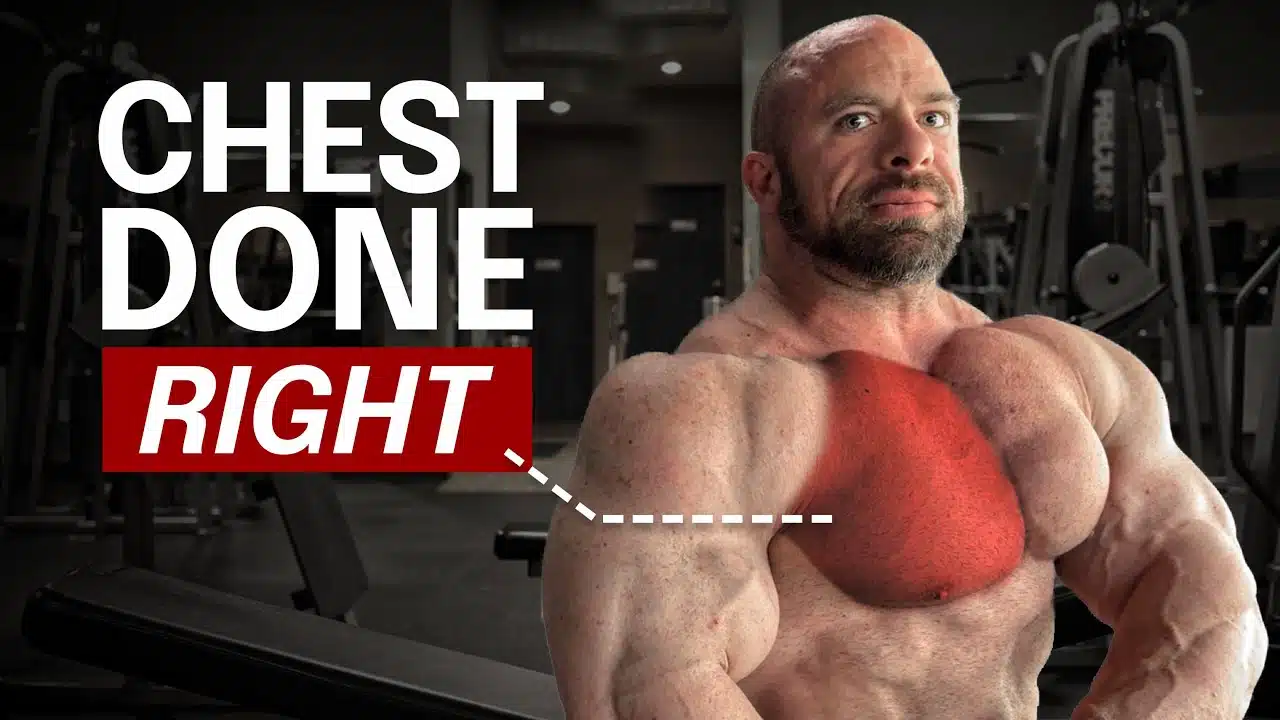
In his comprehensive breakdown of chest training, he reveals exactly why generic programs fail and how understanding your unique biomechanics can unlock serious growth.
The insights might completely change how you approach every pressing and fly movement.
Jump to:
- Understanding Chest Anatomy Changes Everything
- Mistake #1: Converting Your Press Into a Front Delt Exercise
- Mistake #2: Poor Grip Width and Arm Path Destroy Chest Activation
- Mistake #3: Letting Shoulders Rise Kills Chest Tension
- Top Exercise Selections for Maximum Chest Development
- Programming Strategy for Lagging Chest Development
Understanding Chest Anatomy Changes Everything
Pectoral muscles divide into three distinct regions: clavicular (upper), sternal (mid), and costal (lower). Each section has specific fiber directions that determine which exercises actually target them effectively.
Upper pec fibers pull the arm from low to high. Mid pec fibers move the arm directly across the body. Lower pec fibers work from high to low positions.
Despite three anatomical regions, John simplifies the approach into two practical training zones: mid-to-lower and mid-to-upper. This means just two well-selected exercises can comprehensively develop the entire chest—one fly variation and one pressing variation for each zone.
Mistake #1: Converting Your Press Into a Front Delt Exercise
Most lifters unknowingly transform their chest presses into shoulder-dominant movements by selecting the wrong bench angles.
John recommends a simple self-assessment before touching any equipment. Place hands in front of your body and squeeze the pecs together. Gradually raise your arms while maintaining that squeeze, paying close attention to where tension shifts.
Starting low activates lower-to-mid pec fibers. Continuing upward moves tension progressively higher through the chest. Eventually, you’ll reach a point where the pec disengages and front delts take over.
For me that’s right here. So this torso angle that you’re seeing that would be more of my upper pec pressing movement.
For most people, the optimal working range falls between -15 to +15 degrees. That flat-to-slight-incline zone keeps maximal tension on chest fibers rather than shoulders.
Arch Position Matters More Than You Think
Creating a proper arch by lifting the traps off the bench elevates the chest, effectively changing torso angle. This technique shifts emphasis toward lower pec fibers even on a flat bench.
Conversely, staying completely flat-backed redirects work toward upper fibers. The critical takeaway: lock in your torso position throughout every rep. Allowing the chest to drop or torso to shift during pressing bleeds tension from target muscles.
Mistake #2: Poor Grip Width and Arm Path Destroy Chest Activation
Grip selection dramatically impacts which muscles dominate pressing movements.
Ultra-wide grips severely limit range of motion. Excessively narrow grips transform the movement into a tricep-focused exercise. Neither maximizes chest development.
At the bottom position of any press, wrists should stack directly over elbows. Elbows should position at 45 degrees from the torso—not flared out to 90 degrees.
That wider 90-degree flare aligns with shoulder fibers rather than chest. The 45-degree path creates optimal mechanical advantage for pectoral muscles to perform their primary function.
Scapular Movement: The Game-Changing Detail
Traditional powerlifting coaching emphasizes pinning shoulder blades back throughout pressing movements. While this creates stability for maximal loads, it severely compromises chest development.
I was always told like pin them back in your press, but really we know from a 3D view of the pec that it also functions to not just bring the arm across the body, but it does move the shoulder forward and back.
Pectoral muscles don’t just move the arm across the body—they also protract the shoulder forward and back. Keeping scapulas rigidly pinned limits this natural movement pattern.
Better cue: keep shoulder blades down and neutral. Allow them to move naturally around the ribcage during pressing. This permits full pectoral engagement through complete range of motion while building triceps and delts becomes secondary.
Mistake #3: Letting Shoulders Rise Kills Chest Tension
Shoulder elevation during presses and flies shifts mechanical advantage away from chest and toward front deltoids.
Common powerlifting cue of squeezing traps together and digging them into the bench inadvertently elevates shoulders. This repositioning places front delts in optimal position to dominate arm movement across the body.
Solution: actively cue shoulders down throughout every rep. This adjustment realigns the upper arm directly across pectoral fibers rather than shoulder muscles.
From a side view during video analysis, shoulders rising above chest level indicates suboptimal positioning. Proper form shows chest elevated above the line of the upper arm, with front delts remaining neutral rather than forward.
Top Exercise Selections for Maximum Chest Development
Exercise selection doesn’t require overcomplicated movements. Strategic use of proven exercises with proper execution delivers superior results.
Pec Deck Fly: Versatile Isolation Perfection
Pec deck machines allow targeting both lower and upper fibers through simple positioning adjustments.
For lower-to-mid pec emphasis, push hips forward to create the torso angle identified during the self-assessment. This positions upper arms moving across lower pectoral fibers.
For mid-to-upper pec focus, pull hips back and adjust grip higher. Upper arms now move closer to midline, engaging sternal and clavicular fibers more directly.
The fan-shaped structure of pectoral muscles means all regions contribute to some degree at every angle. These adjustments simply shift emphasis rather than creating complete isolation.
Cable Flies: Ultimate Versatility
Cable stations provide unmatched flexibility for chest training through adjustable cable height and bench position.
- Cable position low-to-high: Targets mid-to-upper pec fibers
- Cable position high-to-low: Emphasizes mid-to-lower pec fibers
- Bench farther back: Loads pecs in lengthened position (ideal for early-session movements)
- Bench aligned with cables: Loads pecs in shortened position (better for later-session work)
This versatility allows complete pectoral development while manipulating resistance profiles throughout training sessions.
Smith Machine Press: Stability Meets Adjustability
Smith machines rank as top pressing options because they accommodate all necessary angles while providing stability.
The fixed bar path reduces stabilization demands, allowing greater focus on chest contraction. Adjustable bench positions enable targeting upper, mid, and lower regions effectively.
One limitation: the straight vertical path doesn’t match the natural arc-like movement of pectoral function. This creates excellent bottom-to-mid-range chest activation but often becomes tricep-dominant near lockout.
Don’t think because you’re not locking out or you’re doing partials that you’re doing the movement wrong.
Alternative Pressing Options
Converging chest press machines allow handles to move together during pressing, better matching natural pec function. However, fixed machine paths don’t accommodate everyone’s biomechanics. Individual experimentation determines effectiveness.
Dumbbell presses offer maximum freedom of movement with excellent bottom-range pec activation. Joint stacking at the top often shifts tension toward triceps. Solution: stop pressing before tension leaves the chest rather than forcing full lockout.
Single-arm pressing provides a workaround when bilateral machines don’t fit properly. This allows leaning into the movement and positioning upper arms closer to the body for superior pec alignment.
Don’t Overlook Dips
Chest dips effectively target costal fibers through high-to-low arm movement patterns. Maintaining a forward torso lean keeps emphasis on pectorals rather than triceps and delts.
Many lifters unconsciously adopt upright positioning that defeats chest-focused execution. Hooking feet onto something behind creates forced forward lean, or simply maintaining conscious awareness of torso angle prevents this common error.
Programming Strategy for Lagging Chest Development
Strategic programming transforms exercise selection into measurable progress.
Training frequency: Hit chest twice weekly with complementary movement patterns.
Day 1 structure: Low-to-high fly movement paired with high-to-low press (example: flat press + incline fly)
Day 2 structure: High-to-low fly movement paired with low-to-high press (example: flat fly + incline press)
This approach ensures comprehensive fiber recruitment across both training sessions without redundancy.
Volume and Intensity Guidelines
Start with six total sets per session—three sets for fly movements and three sets for pressing movements. Adjust volume based on individual recovery capacity and progress tracking.
Rep ranges between 6-12 repetitions occupy the hypertrophy sweet spot. Higher reps require extended bracing before reaching stimulating reps. Lower reps increase connective tissue stress and become difficult to sustain.
Select rep ranges matching exercise selection and joint tolerance. Sustainability matters more than dogmatic adherence to specific numbers.
Range of Motion Reality Check
Forced range of motion causes more problems than partial reps.
Stop pressing depth at your natural active range of motion—don’t force bars to touch your chest if biomechanics don’t allow it comfortably. External load can push joints beyond safe ranges, creating shoulder issues without additional chest stimulus.
Similarly, stopping before lockout when tension leaves target muscles isn’t “cheating.” It’s intelligent training that keeps mechanical tension where it belongs.
Sometimes you have to get unconventional to make weak muscles respond. Prioritizing chest contraction over ego-driven numbers separates those who build impressive pecs from those who simply move weight.