Longevity isn’t just about living longer—it’s about maintaining explosive power well into your later years.
Pavel Tsatsouline, the Russian strength coach who introduced kettlebells to Western audiences and trained elite special forces units, believes most people have aging completely backward.
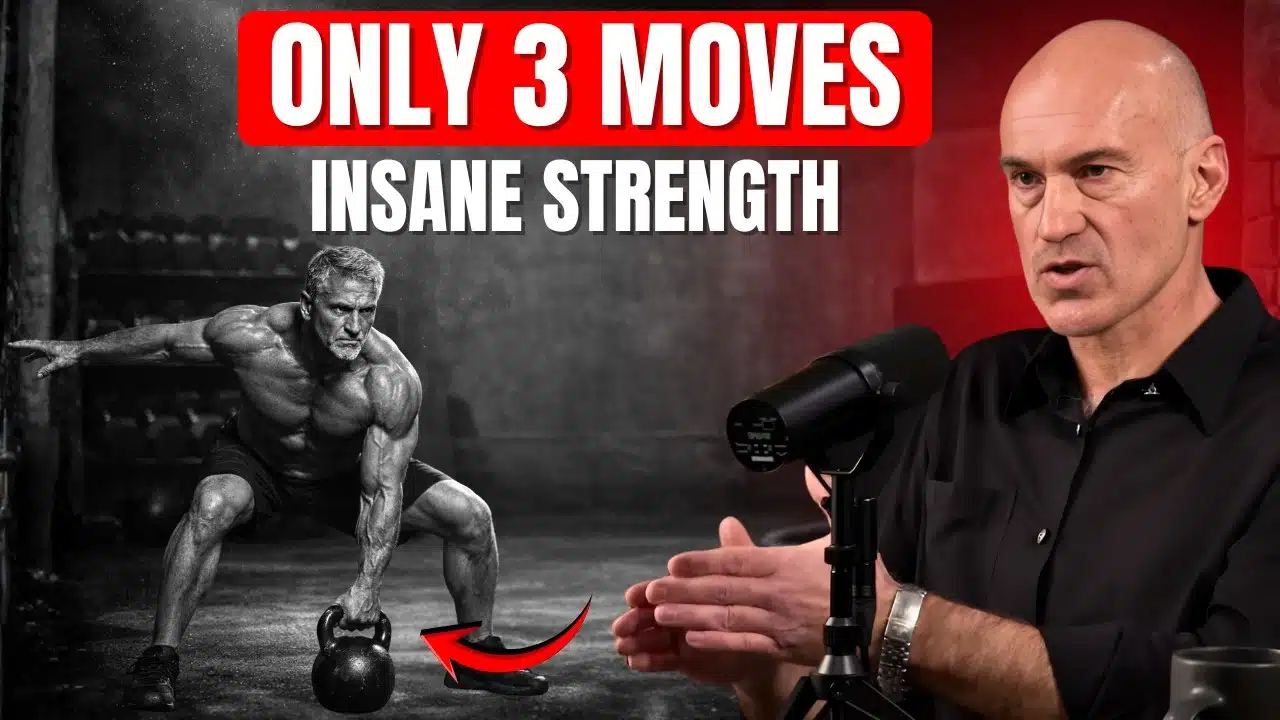
While conventional wisdom suggests strength inevitably declines with age, Pavel argues that strength is a skill that can be mastered at any stage of life with proper training tools.
His solution? Three specific kettlebell exercises that unlock what he calls the “what the hell effect”—unexpected strength gains that transfer to movements you’ve never even practiced.
Jump to:
The Overspeed Eccentric Swing: Building Bulletproof Tissues
Most people treat kettlebell swings like a lazy pendulum motion, passively letting gravity bring the bell back down. Pavel teaches something radically different: the overspeed eccentric swing.
Before mastering this technique, you must first eliminate the most common mistake that leads to lower back pain and glute injuries. People instinctively try lifting the kettlebell with their arms or back rather than understanding the fundamental movement pattern.
You have to hip hinge, not lift with your back.
Mastering the Hip Hinge
Pavel uses a brilliant analogy: imagine your hands are full of groceries and you need to close your car door using only your butt. You push your hips straight back while maintaining a neutral spine.
Your body should move like scissors—with all power generated from the hinge in the middle (your hips)—not like paper folding in half. Once you’ve mastered this pattern without weight and progressed through sumo deadlifts, you’re ready for Pavel’s overspeed secret.
The Overspeed Secret
In traditional swings, you explosively snap your hips forward to propel the bell upward, then passively wait for gravity to return it. Pavel sees this waiting as a missed opportunity for building strength.
Instead of waiting, you attack the floor. Think of a professional baseball pitcher who doesn’t just release the ball but actively accelerates it toward the target with every muscle fiber.
You’re throwing the kettlebell back down between your legs as explosively as possible. Research using force plates revealed something remarkable: when instructors spike a 53-pound kettlebell downward, the force at the bottom effectively makes that bell weigh 500 pounds.
This is the revelation. You don’t need dangerous 500-pound barbells to achieve elite-level adaptations. By using speed—what Pavel calls overspeed eccentrics—you teach tendons and ligaments to handle massive loads in fractions of a second, transforming your body into a high-performance machine and making your tissues bulletproof against injury.
The “What the Hell” Effect
Pavel discovered something strange happening with his kettlebell trainees. After months of focused swing practice, people reported improvements in activities they weren’t even training.
Golfers found their drives suddenly traveling 30 yards farther. Martial artists discovered their punches doubled in speed. Sixty-year-olds realized they could hop over fences without hesitation.
What the hell happened? I only did swings.
Pavel explains these as collateral benefits—totally unexpected adaptations because the swing simultaneously trains power, endurance, and full-body coordination. It systematically cleans up your entire physical system, building foundational resilience that spills into every aspect of life.
Pavel describes these effects as youth-promoting. The swing doesn’t just build strength in isolation—it restores qualities people assume they’ve lost to aging.
The One-Legged Kettlebell Deadlift: Your Injury Insurance Policy
While explosive power matters, resilience determines longevity. Pavel’s second essential exercise addresses exactly that: the one-legged kettlebell deadlift.
Pavel shares stories from tactical teams—elite military and police units constantly dealing with torn hamstrings during high-stress operations. Hamstring tears are devastating: painful, slow to heal, and career-threatening.
When these teams incorporated one-legged deadlifts into training protocols, hamstring injuries virtually stopped. The exercise teaches your body to become a sturdy bridge.
Waking Up Your Stabilizers
Standing on one leg while holding a kettlebell in the opposite hand creates an intense stabilization challenge. As you hinge forward, your body fights to maintain balance, forcing dozens of small stabilizer muscles around hips, knees, and ankles to activate and coordinate.
Most injuries occur because major muscle groups are strong while tiny balancing muscles remain dormant. The one-legged deadlift is like a roll call for your entire system, demanding every muscle wake up and contribute to structural integrity.
For adults at any age, this becomes the ultimate tool for preventing falls and maintaining joint mobility. Success isn’t measured by weight lifted but by control over your own frame.
The Kettlebell Snatch: The Czar of Exercises
If the swing builds foundation, the snatch constructs the skyscraper. In one fluid explosive motion, the kettlebell travels from between your legs to a locked-out position overhead.
The snatch is a less democratic exercise.
Pavel means it’s a high-level skill. Like parallel bar dips, if you possess sufficient strength and shoulder mobility, it’s perhaps the best exercise in existence. Without that foundation, you must earn the right through patient progression.
Three Massive Benefits in One Movement
- Explosive Power: Moving the bell fast enough to make it fly upward trains your nervous system to stay young and reactive
- Cardiovascular Endurance: High-rep snatches burn more calories than almost any exercise—Pavel calls it “sprinting without running,” giving you a marathoner’s heart with a sprinter’s power
- Shoulder and Spine Mobility: Safely holding weight overhead requires thoracic spine mobility
Pavel points to Dr. Fred Hatfield and other researchers who perform beautiful mobile movements at 70 years old that men in their twenties cannot replicate. The snatch and variations like the bent press keep bodies open and strong rather than hunched and stiff.
Pavel’s Path: Patience Over Intensity
How do you implement these three exercises safely? Follow Pavel’s rule of patience.
You don’t begin by attempting heavy snatches. Start with the hip hinge—practice that car door movement until your lower back feels completely safe. Progress to deadlifts to learn proper loading mechanics. Only then advance to swings, and eventually earn the snatch.
Pavel often references Soviet biochemist Nikolai Yakovlev, who emphasized the importance of sprint training for both teenagers and elderly populations. Kettlebell swings and snatches function as your sprints—providing youth-promoting benefits without the high hamstring-tear risk of track sprinting.
He didn’t stop because he got old. He stayed young because he didn’t stop.
Pavel mentions friends still playing baseball in their sixties thanks to kettlebell habits started twenty years earlier. They discovered the secret: consistency beats intensity when measured across decades.
The Language of Power
Kettlebells teach you the language of power—a fundamental skill set that transfers to every physical demand life presents.
Whether your goals involve fat loss, eliminating back pain, or becoming the strongest version of yourself at eighty, Pavel’s Big Three provide a proven roadmap:
- The overspeed eccentric swing
- The one-legged deadlift
- The snatch
You don’t need expensive equipment filling an entire room. Just one bell, one properly executed hinge, and discipline to practice consistently.
As Pavel would say: enjoy the struggle.