Shoulder clicks during overhead presses. Progress stalls. Rest doesn’t help—it makes things worse.
What if the solution wasn’t rest at all, but a specific type of loading that makes tendons resilient and strong?
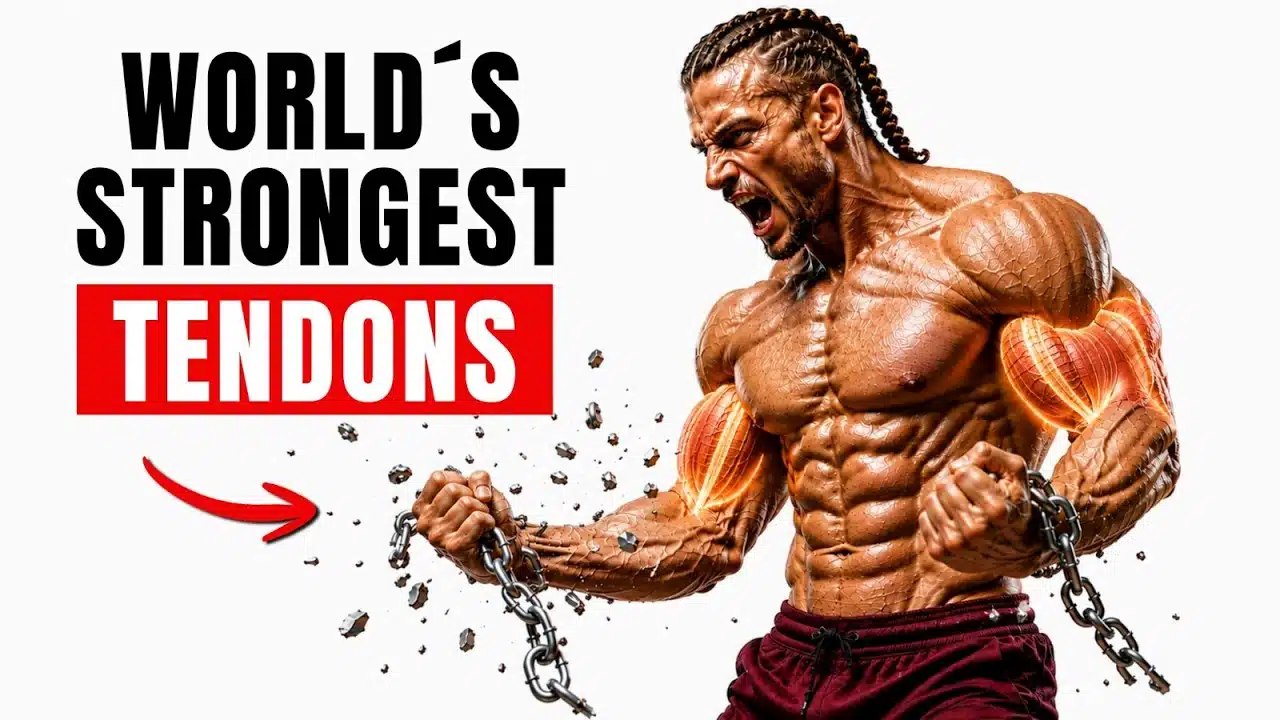
A 12-week study found that patients holding one position at maximum effort saw their damaged tendons become over 20% stiffer while gaining significant strength. The method challenges everything most people believe about tendon recovery.
If joints click or ache, it’s not damage—it’s a gap between muscle strength and tendon capacity, and that gap is exactly where pain begins.
Jump to:
Why Tendons Fall Behind Muscle
Two factors create this mismatch between muscle and tendon strength.
First, tendons receive minimal blood flow compared to muscle tissue. Muscles repair quickly because blood constantly delivers nutrients. Tendons heal slowly because they barely receive that supply.

If you want something simple that actually works, this is one of the most effective tools I’ve used to build strength, conditioning, and endurance without needing a full gym setup.
- Full-body training with one weight using swings, squats, and presses
- Solid cast iron build that feels stable and lasts for years
- Comfortable grip that makes high-rep workouts easier to handle
Think of muscle as a phone on a fast charger. Tendons are stuck on a trickle charger across the room.
This isn’t a small difference. A 2015 meta-analysis by Bohm and colleagues revealed that tendons need loads above roughly 70% of maximum effort to adapt. Below that threshold, minimal change occurs.
Second, tendon tissue thickens far slower than muscle grows. Research by Mersmann and colleagues in 2014 studied young athletes over time and found muscle strength consistently outpaced tendon development during intense training periods.
Muscles grew rapidly. Tendons never caught up. Performance spiked temporarily, then tendons started tearing.
Sports statisticians could later identify steroid users from injury patterns alone—that’s how predictable this imbalance becomes. Programs focused solely on reps, pump, and muscle growth only widen this gap further.
The Warning Sign Most People Miss
When tendons get irritated, they swell slightly and thicken. In tight spaces like shoulder joints, that small swelling matters enough to make tendons pop or roll during movement.
If you want something simple that actually works, this is one of the most effective tools I’ve used to build strength, conditioning, and endurance without needing a full gym setup.
- Full-body training with one weight using swings, squats, and presses
- Solid cast iron build that feels stable and lasts for years
- Comfortable grip that makes high-rep workouts easier to handle
Clicking alone isn’t automatically damage. Clicking accompanied by genuine pain is the real warning sign.
Neural Priming: The Forgotten Layer
During World War I, Russian strongman Alexander Zass was captured and shackled in solid iron chains. He started pulling against those chains with maximum effort.
He emerged from that cell stronger than when he entered. He later ripped an iron bar from his window and escaped.
After the war, his strength became legendary. He bent steel bars with bare hands, carried horses across his shoulders, and caught cannonballs fired at him. Zass became known as the father of isometrics, believing real strength lived in tendons, not muscles.
The method he discovered by accident is called overcoming isometrics—pushing against something immovable with maximum effort for just a few seconds.
How to Break Through Plateaus
If bench press progress has stalled, press against a wall as hard as possible for 3 to 5 seconds. Repeat this two to four times, approximately 3 to 10 minutes before working sets.
If you want something simple that actually works, this is one of the most effective tools I’ve used to build strength, conditioning, and endurance without needing a full gym setup.
- Full-body training with one weight using swings, squats, and presses
- Solid cast iron build that feels stable and lasts for years
- Comfortable grip that makes high-rep workouts easier to handle
This preload increases neural drive at the exact point where failure typically occurs. It may take months, but this approach can demolish plateaus.
A 2011 study by Seformes and colleagues found that among all contraction types tested, only isometric contractions produced this effect. The benefit appeared roughly 3 to 10 minutes later—the window where fatigue clears but the nervous system remains activated.
A brief maximum contraction fires nearly every muscle fiber simultaneously. Rest 3 to 10 minutes, then perform normal lifts with enhanced neural drive and no additional joint wear from grinding heavy singles.
Joint angle can be matched to specific goals. Throwers might hold tension at release point. Combat athletes might hold punch positions against walls. Training exact positions hardens strength precisely where needed.
The Two Mistakes Damaging Tendons
Mistake one: sudden training load jumps. New programs or sports spike volume quickly. It feels manageable for weeks, then something starts nagging.
Tendons didn’t have time to adapt. Research consistently links sudden training jumps to higher injury risk. The safe threshold varies individually, but the pattern holds everywhere—spike it fast, get punished.
If you want something simple that actually works, this is one of the most effective tools I’ve used to build strength, conditioning, and endurance without needing a full gym setup.
- Full-body training with one weight using swings, squats, and presses
- Solid cast iron build that feels stable and lasts for years
- Comfortable grip that makes high-rep workouts easier to handle
One athlete tested this by training one side of his body with heavy weights and low reps while training the other side with lighter weights and higher reps. Within weeks, the heavy side developed elbow and knee pain. Heavy weight wasn’t the problem—his tendons weren’t ready for that specific demand yet.
Mistake two: momentum. Bouncing bars off chests, bouncing out of squats, swinging into serves without control—momentum strips tension from muscles and dumps load directly onto tendons.
That’s exactly the type of load tendons handle worst. Controlling tempo protects tissue that keeps failing.
Killing Two Dangerous Myths
Myth one: rest fixes tendon pain. Not by itself. Tendons need appropriate mechanical load to stimulate collagen production and remodeling.
Remove load completely and tissue gradually loses strength. Pain fades because nothing stresses it—not because it healed. The moment training resumes, pain returns. This cycle repeats for years in people who only rest.
Loading, not resting, actually closes the gap.
If you want something simple that actually works, this is one of the most effective tools I’ve used to build strength, conditioning, and endurance without needing a full gym setup.
- Full-body training with one weight using swings, squats, and presses
- Solid cast iron build that feels stable and lasts for years
- Comfortable grip that makes high-rep workouts easier to handle
Myth two: more training volume automatically builds stronger tendons. Often the opposite proves true. Keith Barr’s lab at UC Davis studies this using engineered ligaments.
His 2017 research found tendon cells stop responding to load quickly—after roughly 10 minutes of loading. Extra sets past that point add wear without additional repair signals.
It’s not about doing more. It’s about loading correctly, then allowing actual adaptation.
The Fix: Isometric Loading Protocol
The most proven fix for tendon pain is a static hold—an isometric contraction where force is applied but nothing moves.
When tension is held without movement, load spreads evenly through tendons, including damaged sections. Dynamic movements tend to skip weak spots, loading only the strongest fibers instead. Held contractions can’t skip anything—every fiber shares the work.
That shared load triggers fresh collagen production. Over time, collagen aligns with pulling forces. That’s the definition of a stronger tendon—not bigger, but more organized.
If you want something simple that actually works, this is one of the most effective tools I’ve used to build strength, conditioning, and endurance without needing a full gym setup.
- Full-body training with one weight using swings, squats, and presses
- Solid cast iron build that feels stable and lasts for years
- Comfortable grip that makes high-rep workouts easier to handle
The 12-Week Study Results
In 2022, researchers led by Radovanovic studied chronic Achilles tendon pain. Patients performed 12 weeks of high-effort isometric holds—roughly 3 seconds of near-maximum effort, 4 days weekly.
After 12 weeks:
- Tendon stiffness improved by just over 20%
- Cross-sectional area increased by nearly 9%
- Strength in affected legs increased over 7%
- Results beat classic slow eccentric protocols for rebuilding tendon structure
This was tested in people with existing chronic tendon pain, not healthy tissue—crucial for those managing symptoms currently.
How to Apply It
Pick the motion that bothers you most—elbow, shoulder, knee. Load that joint around the halfway point of movement. Push or hold against something immovable: a rack, wall, or machine set heavier than you can budge.
Hold at least 70% of maximum effort for 30 seconds. Rest briefly. Repeat for several sets. Spread 10 to 15 sets throughout the day—not all at once. Do this five to six days weekly, not just once.
Safety note: Some discomfort during holds is normal. Mild pain up to three or four out of 10 is acceptable. If it feels worse the next day, reduce effort. Start with weights or angles you can control safely. Add difficulty only once current levels feel easy.
If you want something simple that actually works, this is one of the most effective tools I’ve used to build strength, conditioning, and endurance without needing a full gym setup.
- Full-body training with one weight using swings, squats, and presses
- Solid cast iron build that feels stable and lasts for years
- Comfortable grip that makes high-rep workouts easier to handle
A separate 2015 study by Rio and colleagues found something remarkable: a single isometric hold reduced tendon pain almost immediately. Strength jumped by close to 19% right after the set.
This isn’t only a long-term fix—it works the same day.
No Equipment Needed
A door frame, squat rack, or loaded barbell that won’t budge is genuinely enough to start. No special equipment required.
Tendons don’t need more rest or more reps. They need the right load, held long enough, often enough.
Start with one joint tonight—the one bothering you longest. Pick a position, push into it hard, hold, repeat for a few sets.
Twelve weeks feels long on day one. It won’t feel long once clicking stops. This problem wasn’t built overnight, so give the fix a real chance.
If you want something simple that actually works, this is one of the most effective tools I’ve used to build strength, conditioning, and endurance without needing a full gym setup.
- Full-body training with one weight using swings, squats, and presses
- Solid cast iron build that feels stable and lasts for years
- Comfortable grip that makes high-rep workouts easier to handle
Consistency beats intensity here, every single time. Keep loading correctly. Tendons will finally catch up to the rest of you.