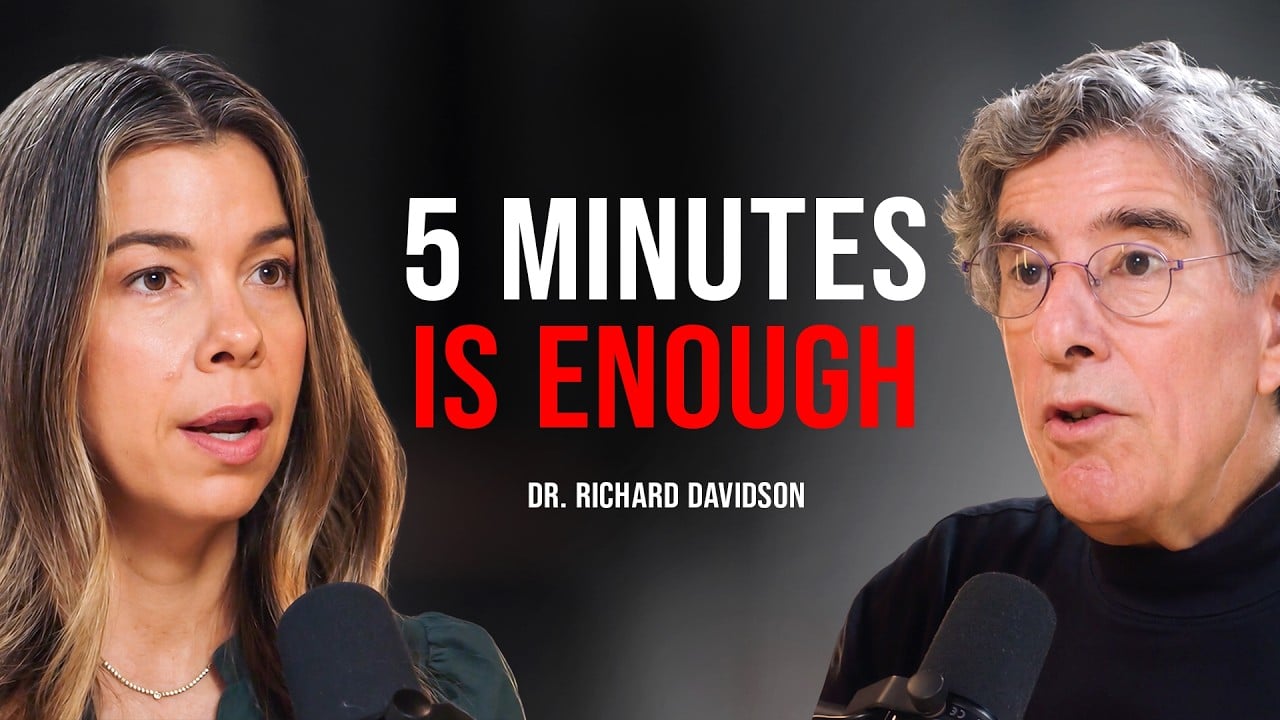
In a fascinating conversation, Dr. Richard Davidson challenges a question many health-conscious individuals grapple with: why meditate when you could exercise instead?
His answer is refreshingly simple.
You don’t have to choose.
The renowned neuroscientist reveals how combining physical activity with intentional mental training creates a powerful synergy that transforms both body and mind in ways neither practice can achieve alone.
Jump to:
- The Neuroplasticity Paradox
- Contemplative Aerobics: The Ultimate Combination
- Five Minutes That Change Your Biology
- The Gut-Brain Connection Runs Deep
- Loneliness: A Greater Killer Than Smoking
- Four Pillars of Flourishing
- The Strength Training Revelation
- Children and the Prefrontal Cortex Advantage
- The Most Important Thing Parents Can Do
- Mindset Changes Biology
- Accessible Practices for Daily Life
- The Attention Crisis
- Witting Versus Unwitting Neuroplasticity
- The Gym Nightmare
- Flourishing Is Contagious
The Neuroplasticity Paradox
Vigorous aerobic exercise stands as the most empirically validated strategy for increasing neuroplasticity, the brain’s ability to adapt and change.
But here’s the catch: neuroplasticity itself is completely neutral.

If you want something simple that actually works, this is one of the most effective tools I’ve used to build strength, conditioning, and endurance without needing a full gym setup.
- Full-body training with one weight using swings, squats, and presses
- Solid cast iron build that feels stable and lasts for years
- Comfortable grip that makes high-rep workouts easier to handle
If you increase neuroplasticity and you’re thinking a lot of unwholesome thoughts, toxic thoughts, if you’re in an environment which is stressful, you will increase the likelihood of being stressed and of being challenged because the increase in neuroplasticity is increasing the extent to which those negative thoughts are being encoded.
This revelation reframes everything we think we know about brain health. Simply boosting neuroplasticity through exercise isn’t enough—we must simultaneously cultivate positive mental states.
Otherwise, we’re essentially reinforcing whatever toxic thought patterns happen to dominate our minds during that neuroplastic window.
Contemplative Aerobics: The Ultimate Combination
Dr. Davidson introduces a practice he calls “contemplative aerobics”—a deceptively simple approach that requires zero extra time.
The technique involves reflecting on how your exercise benefits not just yourself, but everyone you interact with directly or indirectly.
It’s a radical act of generosity for you to be improving your health. It’s not just something good for you but it’s something good for the entire social network that you interact with.
This mindset shift—from self-focused to altruistic—activates brain regions associated with positive emotion far more powerfully than exercising solely for personal benefit.
Starting while putting on your sneakers or during the first few minutes of activity, this practice transforms routine workouts into profound acts of connection.
If you want something simple that actually works, this is one of the most effective tools I’ve used to build strength, conditioning, and endurance without needing a full gym setup.
- Full-body training with one weight using swings, squats, and presses
- Solid cast iron build that feels stable and lasts for years
- Comfortable grip that makes high-rep workouts easier to handle
Five Minutes That Change Your Biology
Dr. Davidson’s research delivers stunning evidence that minimal meditation practice produces measurable biological changes.
In a large randomized controlled trial, participants who meditated just five minutes daily for 28 days experienced remarkable transformations.
- Significant decrease in IL-6, a pro-inflammatory cytokine
- More robust immune response to flu vaccines
- Microbiome changes, particularly in butyrate-producing bacteria
- Effects persisting at six-month follow-up
The microbiome findings prove especially intriguing. Butyrate-producing bacteria play crucial roles in sealing the gut lining, preventing permeability linked to depression, inflammation, cardiovascular disease, and Alzheimer’s.
Exercise also increases these beneficial bacteria, suggesting a powerful complementary effect.
The Gut-Brain Connection Runs Deep
Two hundred million neurons reside in the gut, constantly feeding information to the brain.
It’s not just the mind influencing the body, it’s also the body influencing the mind.
This bidirectional communication highway explains why mental training produces physical health benefits and vice versa. Dr. Davidson’s asthma research beautifully illustrates this connection.
If you want something simple that actually works, this is one of the most effective tools I’ve used to build strength, conditioning, and endurance without needing a full gym setup.
- Full-body training with one weight using swings, squats, and presses
- Solid cast iron build that feels stable and lasts for years
- Comfortable grip that makes high-rep workouts easier to handle
His team discovered that the insula—a brain region containing a “map” of autonomic organs—powerfully modulates lung inflammation in asthmatics, responding dramatically to psychosocial stress.
More alarmingly, chronic lung inflammation appears to drive neuroinflammation, potentially explaining why asthmatics show significantly higher rates of premature dementia and Alzheimer’s disease.
Loneliness: A Greater Killer Than Smoking
The 2023 Surgeon General’s health advisory on loneliness revealed a shocking statistic: loneliness poses a greater risk for premature mortality than smoking 15 cigarettes daily.
Even more striking, loneliness carries more than twice the mortality risk of obesity.
Social connection literally gets under our skin, changing our biology in profound ways. Dr. Davidson’s research demonstrates that practices cultivating connection—like reflecting on how your health improvements benefit others—produce anti-inflammatory effects and alter altruistic behavior in measurable ways.
Randomized controlled trials show these changes don’t require extensive practice, just consistency.
If you want something simple that actually works, this is one of the most effective tools I’ve used to build strength, conditioning, and endurance without needing a full gym setup.
- Full-body training with one weight using swings, squats, and presses
- Solid cast iron build that feels stable and lasts for years
- Comfortable grip that makes high-rep workouts easier to handle
Four Pillars of Flourishing
Dr. Davidson’s new book, Born to Flourish, introduces four innate qualities every human possesses that serve as keys to well-being.
Awareness: Knowing What Your Mind Is Doing
Awareness encompasses presence, mindfulness, and meta-awareness—the crucial ability to recognize what your mind is doing. That moment when you realize you’ve read three pages without comprehension? That’s meta-awareness awakening.
Training this skill requires intentionally adopting supports for awareness, like focusing on bodily sensations during exercise rather than letting your mind wander to past or future concerns.
Connection: The Antidote to Self-Absorption
Connection involves qualities essential for healthy relationships: appreciation, gratitude, kindness, and compassion.
Excessive self-focus—the “me, my, I” syndrome—ranks among the most significant causes of psychological suffering and associated biological harm.
Connection practices shift attention outward, activating reward pathways in the brain far more powerfully than self-focused activities.
If you want something simple that actually works, this is one of the most effective tools I’ve used to build strength, conditioning, and endurance without needing a full gym setup.
- Full-body training with one weight using swings, squats, and presses
- Solid cast iron build that feels stable and lasts for years
- Comfortable grip that makes high-rep workouts easier to handle
Insight: Changing Your Relationship to Your Narrative
Everyone carries an internal narrative—beliefs and expectations about themselves that filter worldview.
Insight doesn’t require changing this narrative, but rather transforming your relationship to it. Recognizing these stories as simply constellations of thoughts, not absolute truths, creates psychological flexibility.
For pessimists, this means approaching thoughts with curiosity: Is all of me pessimistic? Can I find even a smidgen that’s not?
Purpose: Finding Meaning in Everything
Purpose doesn’t require grand gestures. Dr. Davidson transforms scooping cat litter into a meaningful ritual by reflecting on how this simple act benefits his wife, his cat, and anyone entering the room.
I actually look forward to doing the cat litter every day. And it’s a task that most people would think of as not so nice, but you can turn it into a little ritual and have it imbued with some purpose.
Among people 70 and older, having a strong sense of purpose stands as probably the single most important psychological predictor of longevity.
The Strength Training Revelation
Heavy resistance training naturally cultivates awareness in ways steady-state cardio often doesn’t.
If you want something simple that actually works, this is one of the most effective tools I’ve used to build strength, conditioning, and endurance without needing a full gym setup.
- Full-body training with one weight using swings, squats, and presses
- Solid cast iron build that feels stable and lasts for years
- Comfortable grip that makes high-rep workouts easier to handle
Lifting barbells demands complete presence—awareness of burning quads, controlled breathing, proper form. The mind cannot wander when supporting significant load.
This focused attention on bodily sensations during challenging physical tasks simultaneously builds resilience. Exposure to moderate adversity—whether mental or physical—strengthens our capacity to recover from stress.
Research shows individuals who engage in deliberately difficult practices, from cold exposure to demanding workouts, demonstrate improved stress management throughout their day.
Children and the Prefrontal Cortex Advantage
Children bounce back from adversity more readily than adults, but not necessarily because of greater neuroplasticity.
Their secret? A less mature prefrontal cortex.
This brain region enables characteristically human abilities like mental time travel—anticipating futures and reflecting on pasts. While advantageous in many ways, it also fuels worry about tomorrow and rumination about yesterday.
If you want something simple that actually works, this is one of the most effective tools I’ve used to build strength, conditioning, and endurance without needing a full gym setup.
- Full-body training with one weight using swings, squats, and presses
- Solid cast iron build that feels stable and lasts for years
- Comfortable grip that makes high-rep workouts easier to handle
Children naturally inhabit the present moment more fully because they lack the developed neural machinery for extensive time travel.
Adults can reclaim this advantage through awareness practices.
The Most Important Thing Parents Can Do
Dr. Davidson’s advice for parents seeking to cultivate well-being in their children might surprise many.
The most important thing that we adults can do for our kids is to do these practices ourselves. To be an embodied exemplar for our children of what calm, resilient persons could be.
Children don’t just observe parental behavior—they osmotically absorb it, encoding stress or calm at deep cellular levels through neuroplastic processes.
Being fully present with children, radiating love without checking phones, models well-being more powerfully than any formal instruction.
Mindset Changes Biology
In a rigorous randomized controlled trial, Dr. Davidson created a control group receiving only mindset training—zero meditation practice.
If you want something simple that actually works, this is one of the most effective tools I’ve used to build strength, conditioning, and endurance without needing a full gym setup.
- Full-body training with one weight using swings, squats, and presses
- Solid cast iron build that feels stable and lasts for years
- Comfortable grip that makes high-rep workouts easier to handle
Participants learned concepts like innate kindness and looking for good in people, spending approximately five minutes daily for 28 days.
Results showed mindset training alone produced significant improvements in both behavioral and biological measures compared to untreated controls. While meditation plus mindset proved superior, mindset training by itself generated substantial benefits.
This underscores a critical truth: believing you’re resilient, focusing on positive aspects of experiences, and deliberately cultivating optimistic perspectives actively reshape your physiology.
Accessible Practices for Daily Life
Meditation doesn’t require special postures, quiet mountaintops, or dedicated time blocks.
Dr. Davidson’s Healthy Minds Program app teaches the four pillars through practices designed for activities of daily living—commuting, walking, exercising, even doing laundry.
The app offers both formal meditation options and active practices integrated into regular routines. Data shows no statistical difference in benefits between approaches, removing the friction that prevents many from establishing consistent practice.
If you want something simple that actually works, this is one of the most effective tools I’ve used to build strength, conditioning, and endurance without needing a full gym setup.
- Full-body training with one weight using swings, squats, and presses
- Solid cast iron build that feels stable and lasts for years
- Comfortable grip that makes high-rep workouts easier to handle
Simple gratitude practices before meals provide another accessible entry point. Reflecting on the farmers who grew your food, people who prepared it, and countless individuals whose labor enabled your meal cultivates appreciation while fostering a sense of interdependence.
The Attention Crisis
Modern technology has created an unprecedented challenge: most Americans struggle to simply sit with their own minds.
Research shows male college students prefer receiving electric shocks over sitting quietly doing nothing.
When people begin meditation practice, anxiety often initially increases as they recognize how chaotic their minds have become. Dr. Davidson’s team tells new practitioners this anxiety is exactly what should happen—they’re doing it right.
After about one week, anxiety begins declining, eventually dropping below baseline levels.
Witting Versus Unwitting Neuroplasticity
Neuroplasticity occurs constantly, whether we recognize it or not. Our brains continuously reshape themselves in response to experience.
If you want something simple that actually works, this is one of the most effective tools I’ve used to build strength, conditioning, and endurance without needing a full gym setup.
- Full-body training with one weight using swings, squats, and presses
- Solid cast iron build that feels stable and lasts for years
- Comfortable grip that makes high-rep workouts easier to handle
Most of the time, this happens unwittingly—we remain barely aware of forces molding our neural architecture.
Dr. Davidson’s work represents an invitation to take responsibility for our brains, intentionally directing neuroplastic changes rather than passively accepting whatever environmental influences happen to dominate.
Combining exercise-induced neuroplasticity with deliberate mental cultivation creates witting neuroplasticity—conscious, purposeful brain training aligned with flourishing.
The Gym Nightmare
Dr. Davidson confesses to cringing when observing typical gym behavior: people working out while watching “gunk on television.”
That’s a prescription for disaster. They’re increasing neuroplasticity and they’re filling their minds with crap. That will make things worse.
Watching negative news, anxiety-provoking social media, or emotionally toxic content while exercising facilitates the encoding of precisely those unwholesome mental states into newly plastic neural networks.
This explains partially why despite widespread exercise, many people still struggle with well-being—they’re inadvertently reinforcing negativity during their most neuroplastically receptive moments.
If you want something simple that actually works, this is one of the most effective tools I’ve used to build strength, conditioning, and endurance without needing a full gym setup.
- Full-body training with one weight using swings, squats, and presses
- Solid cast iron build that feels stable and lasts for years
- Comfortable grip that makes high-rep workouts easier to handle
Flourishing Is Contagious
Born to Flourish rests on three key insights: flourishing is a skill, it’s easier than you think, and it’s contagious.
Just as stress spreads through social networks, well-being radiates outward from flourishing individuals.
This contagion effect multiplies the impact of individual practice. When you cultivate your own well-being, you simultaneously create conditions for others’ flourishing—family members, colleagues, even strangers you encounter.
The qualities underlying flourishing aren’t foreign imports requiring years to develop. They’re innate human capacities simply needing nourishment to fully express themselves.
Like brushing teeth—an evolutionarily novel practice now universally adopted—spending a few minutes daily nourishing our minds could transform individual lives and collective well-being.
The research is clear: combining physical exercise with intentional mental training creates synergistic benefits neither practice achieves alone. Five minutes daily, practiced consistently, produces measurable biological changes persisting months later.
If you want something simple that actually works, this is one of the most effective tools I’ve used to build strength, conditioning, and endurance without needing a full gym setup.
- Full-body training with one weight using swings, squats, and presses
- Solid cast iron build that feels stable and lasts for years
- Comfortable grip that makes high-rep workouts easier to handle
You don’t need to choose between exercise and meditation. You need to unite them.