Forearms don’t get the spotlight biceps command, yet their size and strength quietly dictate your performance in the gym and beyond.
From crushing a deadlift personal record to simply carrying groceries without your grip giving out, these muscles matter more than most realize.
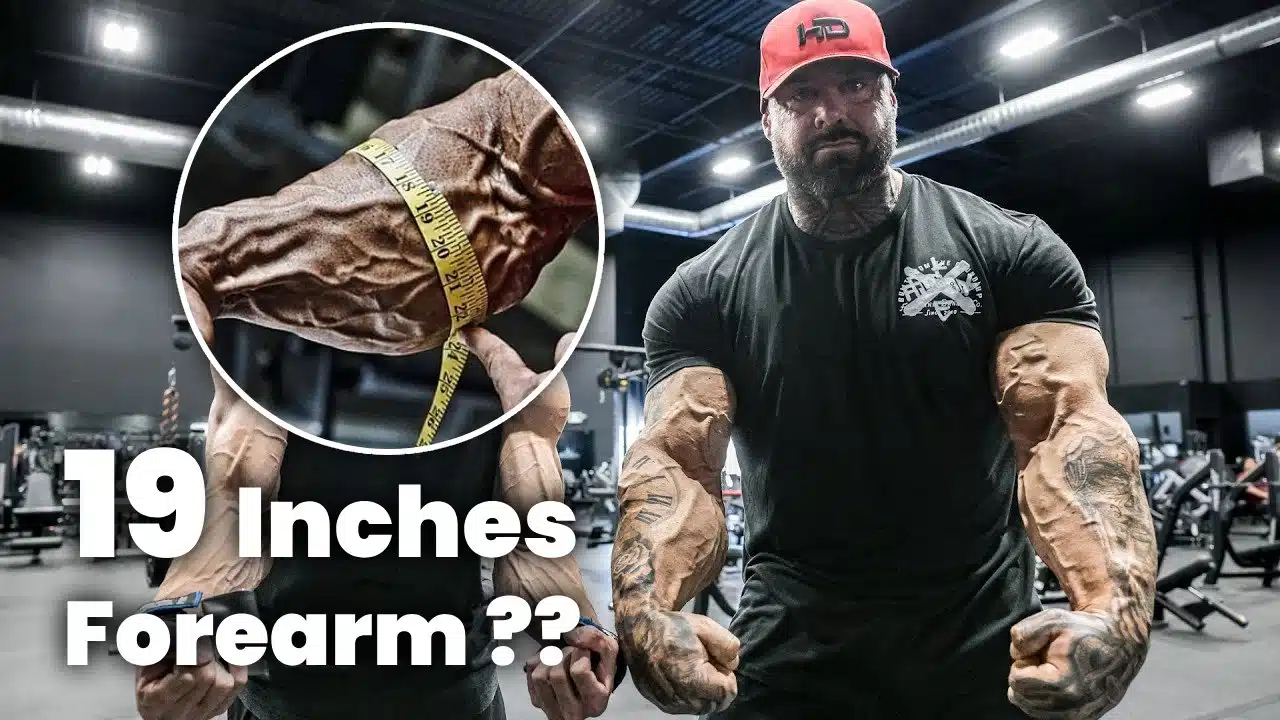
But what actually counts as “big” forearms, and where do you stack up against the average?
The data reveals surprising patterns across percentiles, showing that forearm development varies dramatically based on factors most people overlook.
Jump to:
- What Are Considered Big Forearms?
- Factors Influencing Size
- A Word on Forearm Anatomy
- The Importance of Size and Strength
- Average Forearm Size For Men
- Average Forearm Size For Women
- Can You Increase Forearm Size?
- How To Measure Your Forearm Circumference Correctly
- How to Get Bigger Forearms
- FAQs on Forearm Size
- Sources
What Are Considered Big Forearms?
For men, a forearm circumference exceeding 14 inches typically enters big territory, while the average sits at 12.2 inches.
Women with forearms measuring over 10.5 inches fall into the same category, compared to an average of 10.3 inches.
These measurements aren’t carved in stone. Height, body composition, and overall muscular development all shift the goalposts.
A 5’6″ man with 13-inch forearms might look remarkably developed, while the same measurement on a 6’4″ frame appears proportionally smaller.
Factors Influencing Size
Genetics lay the foundation, determining muscle fiber composition and growth potential from birth.
Some athletes are simply born with more fast-twitch fibers or a bone structure that allows greater muscle mass development. But genes aren’t destiny.
Regular strength training and targeted forearm exercises can dramatically override your genetic starting point. Progressive overload forces adaptation, triggering muscle growth even in those without natural gifts.
Conversely, a sedentary lifestyle leaves potential untapped, resulting in underdeveloped forearms regardless of genetic blueprint.
Nutrition fuels the entire process. Adequate protein intake supports muscle repair and growth, while overall caloric balance determines whether you’re building or maintaining mass.
A Word on Forearm Anatomy
Two primary bones form the skeletal structure: the radius and ulna.
These support an intricate network of muscles divided into flexors and extensors.
Flexors reside on the palm side, responsible for curling fingers and bending the wrist toward your body. They’re the muscles that fire when you grip a barbell or squeeze a stress ball.
Extensors occupy the back of the forearm, facilitating finger straightening and wrist extension. These often-neglected muscles play a crucial role in wrist stability and injury prevention.
This musculoskeletal symphony allows an array of movements, from gripping heavy weights to executing precise finger movements during rock climbing.
Understanding this anatomy proves crucial for targeted training and avoiding imbalances that lead to injury.
The Importance of Size and Strength
Strong forearms enhance grip strength, which forms the foundation of nearly every pulling exercise.
A firm grip translates to better control and efficiency in deadlifts, rows, pull-ups, and kettlebell swings. When your grip fails, your entire workout suffers.
Forearm strength also contributes to wrist stability and health. Weak forearms place excessive stress on wrist joints, increasing injury risk during pressing movements and daily activities.
Beyond the gym, forearm development impacts everyday life. Opening stubborn jars, carrying luggage, and maintaining proper posture during computer work all depend on these muscles.
Neglecting forearm development creates imbalances that ripple throughout your kinetic chain, potentially leading to elbow tendonitis, wrist pain, and compromised performance in compound lifts.
Average Forearm Size For Men
Comprehensive data spanning the 1st through 99th percentile reveals how forearm sizes distribute across male populations.
The 1st to 5th percentile (26.3 cm – 27.5 cm / 10.35 inches – 10.83 inches) represents significantly smaller than average forearms. Men in this range typically have naturally slender builds or minimal training history.
The 10th to 25th percentile (28.3 cm – 29.5 cm / 11.14 inches – 11.61 inches) indicates below-average sizes. These measurements suggest either genetic limitations or insufficient direct forearm training.
The 30th to 50th percentile (29.8 cm – 31 cm / 11.73 inches – 12.2 inches) captures the middle range. The median of 31 cm (12.2 inches) represents the true average, where half of men measure smaller and half larger.
The 55th to 75th percentile (31.2 cm – 32.4 cm / 12.28 inches – 12.76 inches) shows slightly above-average development. Men here typically engage in regular resistance training or physically demanding work.
The 80th to 95th percentile (32.8 cm – 34.8 cm / 12.91 inches – 13.7 inches) represents notably larger forearms. This range suggests dedicated training and strong genetic potential.
The 97th to 99th percentile (35.4 cm – 36.5 cm / 13.94 inches – 14.37 inches) occupies the extreme upper range. Achieving these measurements naturally requires years of focused training and favorable genetics.
Average Forearm Size For Women
Female forearm distribution follows similar patterns with proportionally smaller measurements.
The 1st to 5th percentile (22.5 cm – 23.5 cm / 8.86 inches – 9.25 inches) represents the smallest measurements, typically seen in women with naturally petite frames or minimal muscle development.
The 10th to 25th percentile (24.1 cm – 25.1 cm / 9.49 inches – 9.88 inches) indicates below-average forearm sizes. Many women in this range focus on cardiovascular exercise rather than resistance training.
The 30th to 50th percentile (25.4 cm – 26.3 cm / 10 inches – 10.35 inches) captures the mid-range. The median of 26.3 cm (10.35 inches) marks the average female forearm circumference.
The 55th to 75th percentile (26.5 cm – 27.6 cm / 10.43 inches – 10.87 inches) shows above-average development. Women here often participate in CrossFit, climbing, or regular weightlifting.
The 80th to 95th percentile (27.9 cm – 29.6 cm / 10.98 inches – 11.65 inches) represents noticeably larger forearms, typically achieved through consistent grip-intensive training.
The 97th to 99th percentile (30.3 cm – 31.3 cm / 11.93 inches – 12.32 inches) occupies the extreme upper range, often seen in competitive athletes or those with exceptional genetic gifts.
Can You Increase Forearm Size?
Absolutely. Forearm muscles respond to resistance training just like any other muscle group.
Multiple studies confirm targeted exercises stimulate measurable growth and strength gains.
Research published in Applied Sciences demonstrated that high-intensity training, including bench press and various forearm flexion-extension exercises, produced large effects in increasing upper extremity muscle size. Isometric ulnar deviation training specifically increased the flexor carpi ulnaris and radialis muscle size significantly.
Another study in Experimental Gerontology found that blood flow restricted exercise at low intensities increased forearm girth in older adults, suggesting this approach works across age groups.
Even research on patients with chronic renal failure, published in the American Journal of Kidney Diseases, showed isometric exercise increased forearm vein size, indicating improved muscular development.
The science is clear: consistent, progressive training produces results.
How To Measure Your Forearm Circumference Correctly
Accurate measurement requires proper technique and consistency.
Start with a flexible tape measure, the kind used for sewing or bodybuilding assessments. Stand with your arm extended and palm facing upward, muscles relaxed.
Identify the widest part of your forearm, typically about halfway between elbow and wrist. This is usually where the muscle belly reaches maximum thickness.
Wrap the tape measure around this point without pulling tight or leaving it loose. The tape should contact your skin all around without compressing the tissue.
Record the measurement to the nearest quarter inch. For consistency, always measure at the same time of day, as muscles swell slightly during and after training.
Measure both forearms, as most people have slight asymmetry between dominant and non-dominant sides.
How to Get Bigger Forearms
Building substantial forearm mass requires a multi-faceted approach beyond simply performing wrist curls.
First, increase workout intensity through progressive overload. This means gradually adding weight, increasing repetitions or sets, or decreasing rest intervals between exercises.
Eccentric training proves remarkably effective. Emphasizing the lowering phase of exercises creates greater muscle damage, triggering more robust growth responses.
For example, take three to five seconds to lower the weight during wrist curls rather than letting it drop quickly.
Specific Exercises Targeting Forearms
Hammer curls hit the brachioradialis, a major forearm muscle visible on the thumb side of your arm.
Wrist curls and reverse wrist curls directly target flexors and extensors. Perform both variations to ensure balanced development and reduce injury risk.
Farmer’s walks combine grip strength with functional movement patterns. Simply grab heavy dumbbells or kettlebells and walk for distance or time.
Grip strengtheners or thick bar attachments significantly challenge forearm muscles. Fat Gripz or similar tools force your hands to work harder during any pulling exercise.
Dead hangs from a pull-up bar build incredible grip endurance. Start with 20-30 second holds and gradually increase duration.
Enhancing Your Arm Definition
Visible forearm definition requires both muscle growth and reduced body fat covering those muscles.
Combine hypertrophy training (moderate weight, 8-12 reps) with endurance work (lighter weight, 15-20 reps). This dual approach builds size while enhancing muscular detail.
Don’t neglect overall arm strength. Exercises working biceps and triceps indirectly benefit forearm development through compound movement patterns.
Consistency matters more than perfection. Training forearms twice per week with dedicated exercises produces better results than occasional attention.
Increase Forearm Vascularity
Prominent veins require low body fat combined with increased muscle mass and blood flow.
High-repetition exercises like wrist curls and reverse curls promote blood flow to forearms. Aim for 15-25 reps per set when vascularity is your goal.
Hydration plays a crucial role. Well-hydrated veins appear more prominent beneath the skin. Paradoxically, chronic dehydration causes water retention that obscures vascularity.
Temporary vascularity increases with heat exposure or exercises that temporarily elevate blood pressure to the arms. This explains the “pump” you see immediately post-workout.
Cardio Workouts and Their Impact on Arm Size
While cardio won’t build mass like resistance training, certain activities engage forearms significantly.
Rowing machines work forearm flexors and grip strength with every stroke. Boxing and heavy bag work demand sustained grip tension while throwing punches.
Cardiovascular exercise enhances vascular health, improving blood flow and nutrient delivery to working muscles. This supports better performance during strength training sessions.
Balance remains key. Excessive cardio without adequate nutrition can actually impair muscle growth by creating too large a caloric deficit.
FAQs on Forearm Size
How Do I Make My Forearms Bigger?
Focus on exercises specifically targeting forearm muscles: wrist curls, reverse wrist curls, hammer curls, and grip exercises.
Progressively increase weight and intensity over time. Complement training with adequate protein intake (0.7-1 gram per pound of body weight) and sufficient rest for recovery.
What is the Number 1 Forearm Exercise?
Wrist curls directly target forearm flexors with measurable results.
Sit with forearms resting on your knees or a flat surface, palms facing up. Curl the weight toward your body by flexing at the wrist only.
Balance this with reverse wrist curls for complete development. Neglecting extensors creates imbalances that increase injury risk.
How Do You Fully Train Forearms?
Comprehensive training addresses all forearm muscle groups: flexors, extensors, and brachioradialis.
A complete routine includes:
- Wrist curls for flexors
- Reverse wrist curls for extensors
- Hammer curls for brachioradialis
- Farmer’s walks for grip strength
- Dead hangs for endurance
Train forearms 2-3 times weekly, allowing at least 48 hours recovery between sessions.
Can I Strengthen My Forearm?
Absolutely. Forearm strength improves with consistent, targeted exercises.
Incorporate weight lifting, gripping exercises, and flexibility routines. Pay attention to overall nutrition, ensuring adequate protein and calories support muscle adaptation.
Progress takes time. Expect noticeable strength gains within 6-8 weeks and visible size increases within 3-6 months of consistent training.
Sources
- Yagiz et al., 2022, Applied Sciences: https://www.mdpi.com/2076-3417/12/3/1593
- Kim et al., 2017, Experimental Gerontology: https://www.sciencedirect.com/science/article/abs/pii/S0531556517301961
- Leaf et al., 2003, American Journal of Kidney Diseases: https://linkinghub.elsevier.com/retrieve/pii/S0002962915343093