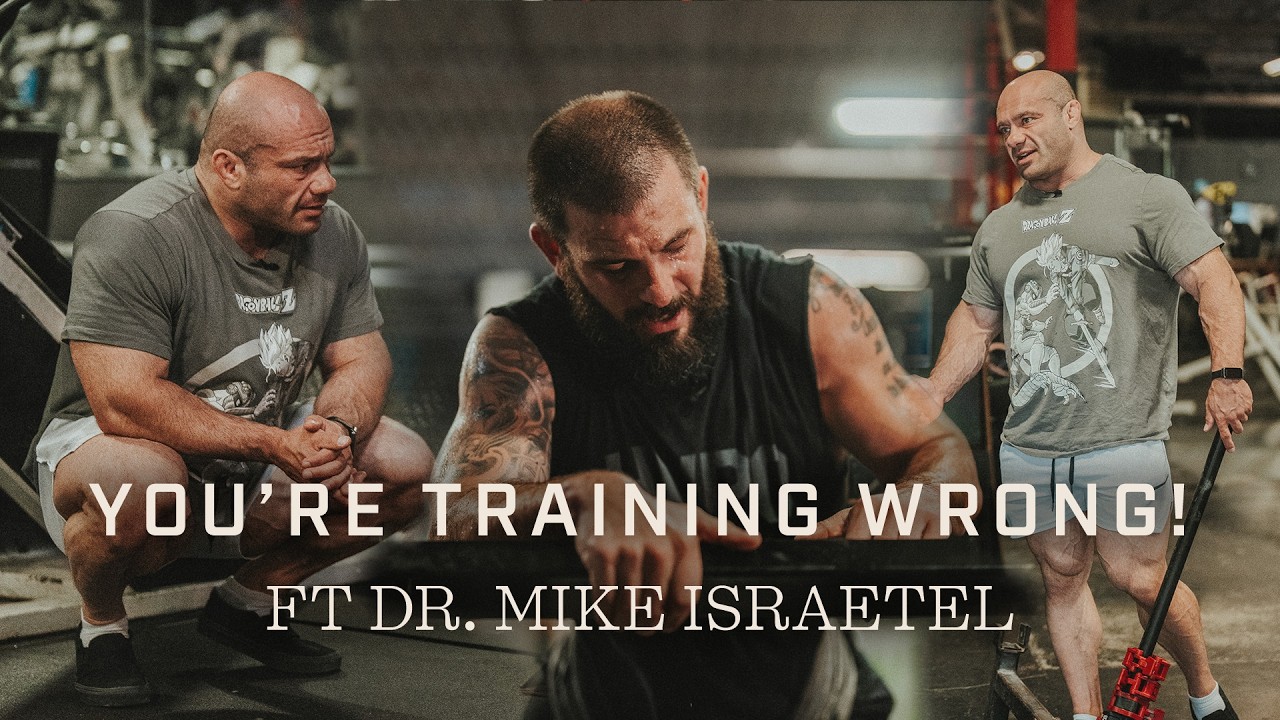
In a recent YouTube video, five-time Fittest Man on Earth Mat Fraser joined Dr. Mike Israetel for a back-and-biceps session that doubled as a masterclass in smarter training.
Why does piling on volume so often backfire?
Which warning signs reveal that your body is quietly waving a white flag?
Both men also unpacked a counterintuitive time-off strategy that champions swear by.
Stick around for a specialization plan that could unlock years of growth.
Jump to:
The Core Lesson: More Is Not Better
Fraser named volume as the biggest mistake he sees, especially in CrossFit. Athletes watch winners, then simply do more of whatever those winners do.

If you want something simple that actually works, this is one of the most effective tools I’ve used to build strength, conditioning, and endurance without needing a full gym setup.
- Full-body training with one weight using swings, squats, and presses
- Solid cast iron build that feels stable and lasts for years
- Comfortable grip that makes high-rep workouts easier to handle
He admitted falling into that trap himself around 2014 and 2015. His verdict: it went atrociously.
Every workout you should be able to say like what is the purpose of this workout? What is the goal? What am I targeting?
Fraser borrowed a concept from his track coach, Henshaw, who called purposeless sessions fluff training. Every session, he argued, needs a specific target, ideally a weakness.
Why Your Body Has a Ceiling
Israetel compared the body to a hydraulic press. Strong, yes. Unbreakable, no.
Your body is a physical system and like all physical systems has a limit.
Cross your maximum recoverable volume (MRV) and trouble follows:
- Strength regresses instead of climbing
- Injury risk rises as fatigue accumulates
- Sleep deteriorates while resting heart rate stays elevated
- Progress stalls, sometimes completely
One caveat: MRV is a practical coaching framework from Israetel’s own training model, not a fixed physiological number. Your personal ceiling shifts with sleep, stress, nutrition, and training history, so treat any set count as a starting estimate.
The trick is to give your body enough of a challenge to grow from, but enough of a recovery bandwidth on top of that to actually recover from.
Copy Elements, Not Entire Programs
Israetel sees the same pattern in bodybuilding, where lifters clone champions’ routines verbatim. His take is nuanced.
If you want something simple that actually works, this is one of the most effective tools I’ve used to build strength, conditioning, and endurance without needing a full gym setup.
- Full-body training with one weight using swings, squats, and presses
- Solid cast iron build that feels stable and lasts for years
- Comfortable grip that makes high-rep workouts easier to handle
The best have unbelievable amount of wisdom and copying elements, trying them in your program is great.
Borrow ideas. Skip wholesale program theft.
The Impatience Trap
Israetel recalled a lifter who messaged him, frustrated about not gaining weight despite eating enormous amounts. Follow-up questions revealed he was gaining about half a pound per week, a perfectly reasonable pace.
His complaint boiled down to wanting success yesterday. Fraser connected it to Olympic weightlifting, where elite lifters might train twice daily for a year hoping to add 2.5 kilos to each lift.
Progress from year one to year two flattens dramatically. As Israetel put it, it still goes up, just really slowly.
Rushing applies to performance-enhancing drugs too, according to Israetel, who warned that jumping straight to pro-level doses invites serious long-term cardiovascular consequences. His blunt summary: shortcuts exist, and you will pay for them dearly.
Four Signs You Are Overreaching
Fraser described overtraining vividly. After the 2015 Games, where extreme heat left much of the field with heat stroke, he and fellow competitors all felt off for months.
If you want something simple that actually works, this is one of the most effective tools I’ve used to build strength, conditioning, and endurance without needing a full gym setup.
- Full-body training with one weight using swings, squats, and presses
- Solid cast iron build that feels stable and lasts for years
- Comfortable grip that makes high-rep workouts easier to handle
I feel like a shell of myself.
Both men shared personal early-warning checks:
- Grip in the morning: Clench your hands or feet after waking. Feeling hollow means throttle back. Israetel calls this his pillow grip test.
- Flexibility: Israetel tries a stiff-legged deadlift pattern. Feeling bound up signals accumulated fatigue.
- Desire to train: Watching an inspiring squat video and thinking thank goodness that is not me right now suggests a deload is due.
- Mental imagery: Picture yourself invincible, shrugging off a semi-truck. If your brain flinches instead, your body may be asking for rest.
These are experience-based gut checks rather than clinically validated tests. Still, they offer free, daily feedback that costs nothing to track.
Training Versus Practice
Israetel drew a sharp line. Practice rehearses the actual competition, including pacing, transitions, and mentality. Training builds the underlying systems.
Bodybuilders practice posing but train with hack squats. Weightlifters practice snatches yet train with front squats and push presses.
There’s a brutality to training cuz it’s not the glorious thing that you want to be doing, but it makes the glorious thing better.
Fraser applied this to pull-ups. In training, he went strict to build capacity. In competition, butterfly kipping was a necessary evil for speed.
The Power of Strategic Time Off
Israetel admitted he hates this advice personally. After a week and a half away from the gym, he said, he has an existential crisis.
If you want something simple that actually works, this is one of the most effective tools I’ve used to build strength, conditioning, and endurance without needing a full gym setup.
- Full-body training with one weight using swings, squats, and presses
- Solid cast iron build that feels stable and lasts for years
- Comfortable grip that makes high-rep workouts easier to handle
Yet after two weeks off, he feels like he has a new body, with happier joints and a surging drive to train. His recommendation: at least two weeks fully off, once or twice yearly, with one break potentially stretching to a month.
When you think of yourself taking two weeks off or even a month off, think of it as a strategic long view, calculated retreat.
Fraser built that into his championship years. After winning, he took a full month off, ate whatever he wanted, and stayed up late.
I never committed to the next season until after that month off.
The break also fueled hard weeks. Knowing rest was coming, he said, he could push harder.
Win the Hours Outside the Gym
A coach once told Fraser he was not special, since everyone does heavy squats and hard rowing intervals. The edge lives in sleep, nutrition, and recovery.
Fraser took that seriously, shipping a vacuum-sealed mattress to his hotel every Games week. His logic: why change the most important recovery variable during the most important week?
Fixing Restless Nights
- Leave bed after about 15 minutes if sleep is not coming, since lying there frustrated backfires.
- Eat something if hunger is involved and it fits your plan.
- Consume deliberately boring content, such as Israetel’s favorite, audio lectures on the history of price theory.
- Familiar shows worked for Fraser, helping him escape spiraling thoughts.
Israetel also offered a sleep-debt rule: heavy volume is fine if you eat, rest, and sleep well that night. Training hard on poor sleep, then failing to sleep again, creates a blender effect.
If you want something simple that actually works, this is one of the most effective tools I’ve used to build strength, conditioning, and endurance without needing a full gym setup.
- Full-body training with one weight using swings, squats, and presses
- Solid cast iron build that feels stable and lasts for years
- Comfortable grip that makes high-rep workouts easier to handle
The Specialization Plan for Stalled Gains
Feeling stuck? Israetel’s first suggestion: two full weeks off, then rebuild gradually from lower volume.
His second: stop pushing the whole physique at once. Prioritize some muscles while others coast.
Take your legs, your chest, and your triceps. Put them on maintenance volume, which is like a third of the volume you typically do.
His example: a muscle normally trained with 18 weekly sets drops to roughly six. Meanwhile, back, biceps, and other priorities climb in volume for about 12 to 16 weeks, then roles swap after a deload.
The logic: a single muscle’s recoverable volume exceeds what it gets when every muscle trains hard simultaneously. Biceps might thrive on 25 to 35 weekly sets, but no full-body program has room for that.
Those numbers come from Israetel’s coaching experience, so adjust to your recovery. Maintenance, he stressed, preserves gains rather than losing them.
Your Takeaway
- Give every session a purpose.
- Track morning grip, mobility, and motivation as recovery signals.
- Schedule rest before your body schedules it for you.
- Rotate priorities rather than chasing everything at once.