Gemma Atkinson has returned to the gym after a forced break, sharing a powerful lower-body workout that helped her hit a new personal best.
The former Women’s Health cover star and Just As Well co-host revealed she’d been sidelined for two and a half weeks with a sinus infection.
But the break turned out to be exactly what her body needed.
In an Instagram post, Atkinson opened up about the unexpected benefits of rest, showing how sometimes our bodies force us to slow down for good reason.
Jump to:
When Rest Becomes Your Secret Weapon
Atkinson didn’t hold back about her reluctance to take time off.
I was doing a lot and constantly moaning about needing rest without actually taking a rest until I had no choice.
Her experience highlights something many fitness enthusiasts struggle with: recognizing when pushing through becomes counterproductive.
The 41-year-old made sleep and nutrition her top priorities during recovery, shifting focus from training volume to foundational wellness habits that support long-term performance.
Her return to the gym proved the strategy worked.
I even hit a new PB on my hip thrust. Sometimes a rest and reset pays off and clearly I needed one.
Strategic rest periods can actually enhance strength gains by allowing muscles to fully recover and adapt, reducing accumulated fatigue that can suppress performance.
The Lower-Body Session That Built Atkinson’s Strength
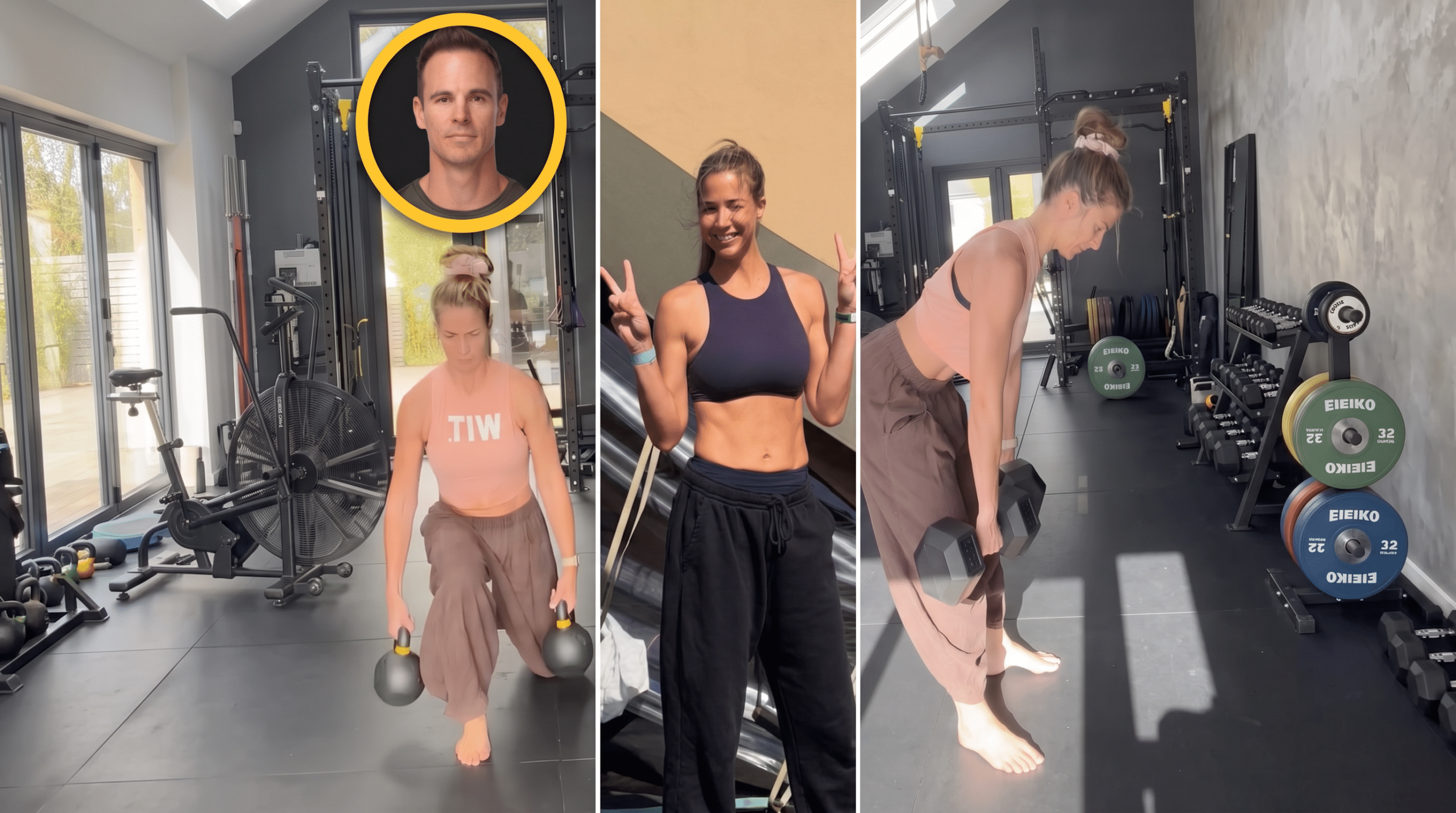
After warming up with cossack squats, cobra poses and downward-facing dogs, Atkinson dove into a compound-movement focused workout targeting her glutes, hamstrings and quads.
She also wove in skipping intervals between sets to elevate her heart rate and add cardiovascular conditioning to the strength session.
The workout featured four core exercises designed to build functional lower-body power.
Hip Thrusts for Glute Power
Atkinson positioned herself with shoulder blades against a bench, balancing a loaded barbell across her hips.
The movement requires pushing through the feet to lift the glutes off the floor, rolling onto the back of the shoulders while keeping the chin tucked. At the top position, shoulders, hips and knees form a straight line parallel to the floor.
Hip thrusts are one of the most effective exercises for building glute strength and size, targeting the gluteus maximus more directly than squats or deadlifts in many cases.
The key is squeezing the glutes hard at the top without hyperextending the lower back, then lowering with control.
Romanian Deadlifts for Posterior Chain Development
Standing with feet hip-width apart, Atkinson held dumbbells close to her thighs, maintaining a flat back with shoulder blades squeezed together.
The movement hinges at the hips, sending the bum backward while keeping bodyweight evenly distributed through the feet. She lowered the weights until feeling a solid hamstring stretch, keeping dumbbells close to her legs throughout.
Romanian deadlifts create significant tension in the hamstrings and glutes through the eccentric (lowering) phase, which is particularly effective for building muscle and improving hip hinge mechanics.
Driving back to standing by squeezing the glutes completes the movement, locking out the hips without leaning back.
Walking Lunges for Unilateral Strength
Holding kettlebells at her sides, Atkinson stepped forward about two feet with one leg, distributing weight evenly through the front foot.
She bent the front knee to 90 degrees with the thigh parallel to the floor, while the back knee hovered just off the ground. Pressing through the front foot to stand, she brought the back foot forward to meet the front, then repeated on the opposite side.
Walking lunges challenge balance, coordination and single-leg strength simultaneously, making them excellent for identifying and correcting strength imbalances between legs.
They also mimic functional movement patterns used in daily life and sports.
Plank Lateral Walks with Weighted Vest
Wearing a weighted vest, Atkinson started in a high plank with hands directly under shoulders and body in a straight line from head to heels.
She simultaneously stepped her left hand and foot to the left, then followed with her right hand and foot to return to plank position. After covering the desired distance sideways, she held a stable high plank.
This movement challenges core stability while shoulders and arms work to maintain position, making it a demanding finisher that builds anti-rotation strength and shoulder endurance.
Why Compound Movements Matter for Lower-Body Strength
Atkinson’s exercise selection focused entirely on compound movements—exercises that work multiple muscle groups and joints simultaneously.
This approach delivers several advantages over isolation exercises:
- Greater muscle recruitment: Working multiple muscles at once creates a stronger metabolic and hormonal response
- Improved functional strength: Movement patterns translate directly to real-world activities
- Time efficiency: Training multiple muscle groups simultaneously reduces workout duration
- Enhanced coordination: Complex movements improve neuromuscular control and body awareness
For women particularly, lower-body compound exercises offer unique benefits for bone density, metabolic health and functional independence as we age.
The Mind-Body Connection Atkinson Emphasizes
Beyond the specific exercises, Atkinson’s reflection on her forced break reveals an important truth about sustainable fitness.
The body is always communicating with us. Physical tension, stress, gut health, inflammation, or in my case the infection.
Learning to recognize these signals before they become injuries or illness is a skill that develops with experience.
Atkinson acknowledged that although the rest period felt frustrating in the moment, she clearly benefited from it both mentally and physically.
Her new hip thrust personal best proved that adequate recovery can actually accelerate progress rather than hinder it.
This perspective shift—viewing rest as a training tool rather than time lost—separates sustainable long-term fitness approaches from burnout-prone ones.
Building Your Own Lower-Body Routine
Atkinson’s workout provides a solid template for anyone looking to develop lower-body strength.
For beginners, start with bodyweight or light resistance, focusing on movement quality before adding load. Master the hip hinge pattern in Romanian deadlifts before progressing to heavier weights.
Intermediate lifters can follow Atkinson’s structure more closely:
- Warm up thoroughly with dynamic stretches and mobility work
- Perform 3-4 sets of 8-12 reps for each main lift
- Rest 2-3 minutes between compound exercise sets
- Include brief cardio intervals (like skipping) between exercises if desired
- Finish with a core-focused movement like plank variations
Advanced trainees can increase volume, add tempo variations, or incorporate pause reps to increase time under tension.
Progressive overload remains the key driver of continued strength gains—gradually increasing weight, reps, or sets over time.
Recovery: The Missing Piece Most People Ignore
Atkinson’s experience reinforces what research consistently shows: adaptation happens during recovery, not during training itself.
Training creates the stimulus for change by breaking down muscle tissue and stressing physiological systems. Recovery provides the opportunity for those systems to rebuild stronger.
Sleep quality and duration play crucial roles in this process, affecting hormone production, muscle protein synthesis and central nervous system recovery.
Nutrition timing and quality matter too, particularly protein intake to support muscle repair and carbohydrates to replenish glycogen stores.
But perhaps most importantly, listening to your body’s signals—fatigue, persistent soreness, mood changes, sleep disruption—helps prevent the accumulation of stress that can lead to overtraining, injury or illness.
Atkinson’s honest admission that she was “constantly moaning about needing rest without actually taking a rest” will resonate with anyone who’s pushed through when they should have backed off.
Sometimes the most productive training decision is choosing not to train.
Sources
No external research sources were provided for verification in this article.