Glen Powell didn’t just play a Top Gun pilot—he trained like one too.
From intense deadlifts to grueling ring pushups, Powell prepared for his role in Top Gun: Maverick with a workout tailored for action, aesthetics, and durability.
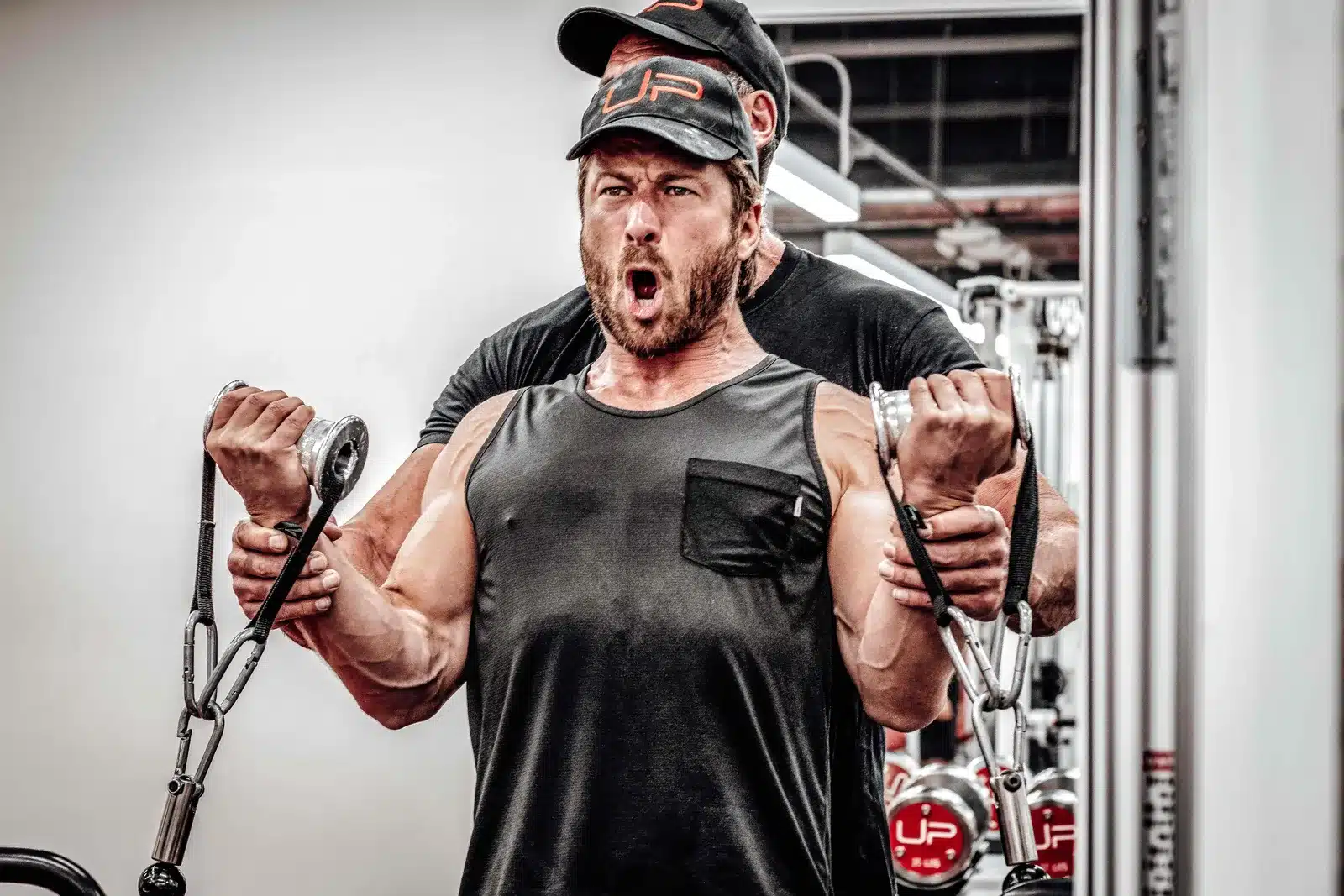
The heart-pounding football montage wasn’t just movie magic; it was the result of months of deliberate, high-performance training.
Under the guidance of elite trainer Eddie at Ultimate Performance, Powell pushed his limits to look the part and survive the G-force-inducing demands of real-life fighter jet sequences.
Here’s how Powell got shredded, stayed functional, and trained like the best of the best.
Jump to:
- Powell’s Training Priorities: Strength, Core Stability, and Injury Prevention
- Deadlifts: Powell’s Foundation Exercise
- Progressive Overload with Weighted Pulls
- Ring Pushups: Core Crushing Intensity
- Abs to Match the Montage: Hanging Knee Raises
- Rows for Muscle Balance and Posterior Strength
- The Brutal Finisher: Sled Push-Pull Superset
- Training Lessons from Top Gun Camp
- Becoming Top Gun Ready
Powell’s Training Priorities: Strength, Core Stability, and Injury Prevention
While Powell knew he had to look good on screen, he also had to perform in real fighter jets pulling up to 7.5-Gs—a force capable of knocking someone unconscious.
“You have to have a certain amount of core strength,” Powell said. “Everything we’re doing here is strength based but also functional, so I don’t get hurt on set while doing stunts with Tom Cruise.”
To handle the physical strain of stunt work and keep his physique photo-ready, his training was built around compound lifts, stabilizing movements, and high-effort finishers.
Each workout balanced aesthetics with functional strength. Nothing fancy—just brutal efficiency.
Deadlifts: Powell’s Foundation Exercise
Powell’s workout always began with deadlifts—a full-body movement essential for building posterior chain strength and resilience.
“Deadlifts are gonna work my hips and back, and for me, that’s the most crucial part of not getting hurt,” Powell said. “It works everything so your foundation is strong.”
His Routine:
- Deadlifts with dumbbells up to 100 lbs in each hand
- Low reps: 6-8 reps per set
- Three working sets
This heavy lifting demanded proper technique. “If you do heavy weight, you can’t just muscle it up. Otherwise, you’ll get hurt,” he warned.
Progressive Overload with Weighted Pulls
Once Powell established his base with deadlifts, the next focus was building pull strength and endurance.
“We put some weights on my waist,” he said, referring to weighted pull-ups. “That’s gonna work the back and lats. It makes it extra hard to get a full workout, and, you know, just to show off a little bit.”
These were often trained to failure, driving hypertrophy and upper body strength under load.
Ring Pushups: Core Crushing Intensity
The true challenge came next: ring pushups with weight on his back—designed to fire up every stabilizing muscle in the body.
“You have to maintain a plank with weight on your back. These things [rings] are moving, and you’re trying to keep them stable,” Powell explained.
Benefits of Ring Pushups:
- Targets chest, shoulders, arms, and especially the core
- Improves muscle control and balance
- Enhances real-world strength under instability
Though brutal, Powell claimed they were “one of the most impactful things if you’re trying to rip up the top half of your body.”
Abs to Match the Montage: Hanging Knee Raises
To prep for the now-iconic beach football scene, Powell needed six-pack abs worthy of a Top Gun highlight reel.
His go-to ab destroyer? Hanging knee raises.
“This is where you’ll really start seeing the abs pop,” he said. “It doesn’t feel good, but it’s the quickest way to dust off some abs that have been hiding from you for most of COVID and quarantine.”
Form Tips:
- Engage core throughout—avoid swinging
- Pull knees to chest with control
- Breathe out during contraction
Rows for Muscle Balance and Posterior Strength
Powell’s trainer ensured his physique remained well-rounded by adding rows into the mix—key for developing a strong, balanced upper back.
“You don’t want to strengthen one side or the other. You want to make sure it’s complete,” Powell said. “The key with that one is not going up, it’s going back.”
Proper execution kept his shoulders healthy and posture tight—critical for both performance and camera angles.
The Brutal Finisher: Sled Push-Pull Superset
The final segment in Powell’s regime was less about reps, more about pure grit—a sled push-pull superset designed to empty the tank each workout.
“That is the most brutal of all,” he admitted. “Push and pull a sled as hard as you can…think about everybody who’s wronged you in your whole life.”
The intense finish capped off training sessions by combining strength, speed, and raw intensity—and served as a mental toughness builder.
Training Lessons from Top Gun Camp
Powell’s transformation wasn’t just physical—it rewired his mindset. His workouts mirrored the discipline needed to fly jets, handle choreography, and thrive under G-forces.
Here’s what anyone can take from his Top Gun prep:
- Lifting heavy requires precision, not ego. It’s about building strength—not chasing numbers.
- Train for function, not just looks. Stability and mobility matter as much as muscle size.
- Balance aesthetics with durability. For every push, include a pull. For every flex, build a foundation.
- Progress slowly, compete with yourself first. “Don’t try to be a high school hero right off the bat,” Powell said. “Build up to it.”
Becoming Top Gun Ready
Glen Powell’s training proves that looking like a fighter pilot means training like one—smart, hard, and consistent.
With strength-based circuits, functional movement, and relentless core work, his routine built a body that looked camera-ready while staying stunt-ready.
“If you wanna be the best of the best,” he said, “you’ve gotta put in the work.”
And whether you’re chasing your own montage moment or just want to train smarter, there’s plenty to borrow from this Hollywood-hardcore regimen.