In 1978, Grete Waitz lined up at the start of the New York City Marathon with little fanfare.
She was a 25-year-old schoolteacher from Norway, a former middle-distance track athlete with zero marathon experience. Her longest training run had only been 12 miles.
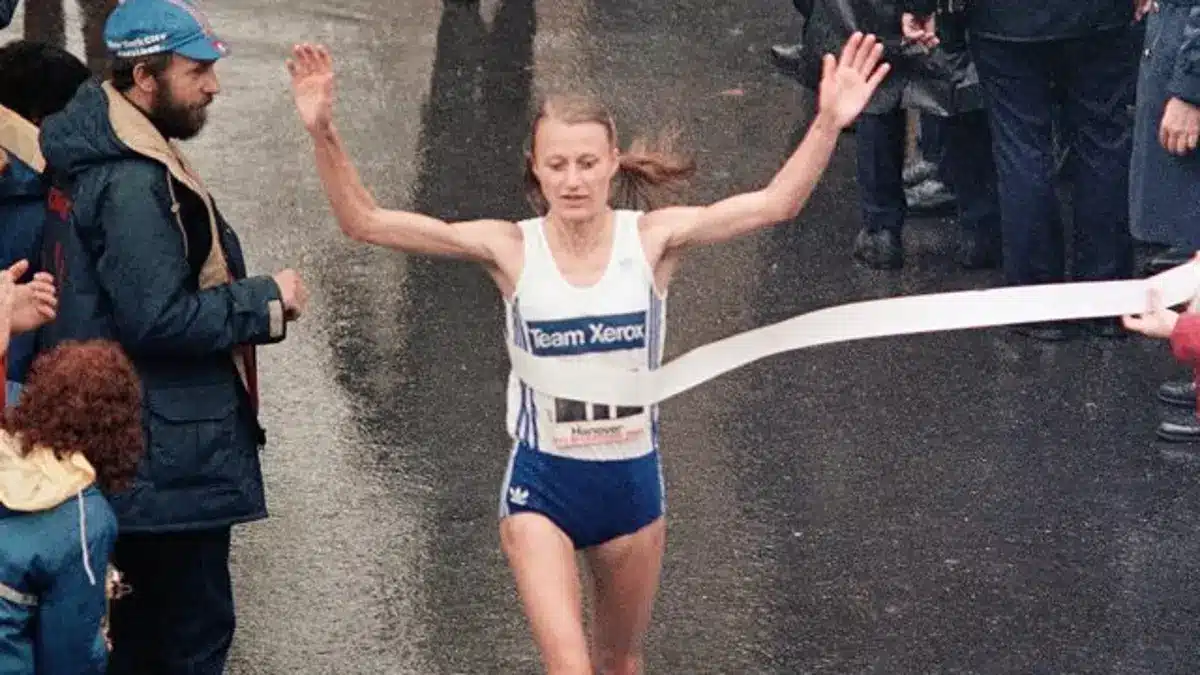
But when she crossed the finish line in 2:32:30—smashing the existing world record—she didn’t just win a race. She ignited a revolution in women’s distance running.
Waitz’s performance didn’t come with protest signs or press conferences. It came through relentless pace and quiet grit. She didn’t need to say women belonged in the marathon.
She proved it—with every mile she ran.
Jump to:
The Race That Changed Everything
The 1978 New York City Marathon was supposed to be a one-time experiment for Waitz. Persuaded by her husband and coach, Jack Waitz, she entered the race mostly out of curiosity.
What followed was nothing short of historic.
Waitz crossed the line nearly two minutes faster than the previous world record, and she did it with minimal preparation. She was so unfamiliar with marathon racing that she collapsed at the finish line, thinking she had failed. Race director Fred Lebow famously had to reassure her of her accomplishment.
“I had no idea what I was doing,” Waitz later admitted. “But that race changed my life.”
It also changed the world of sport. Her debut wasn’t just a victory—it was a direct challenge to the long-held myth that women weren’t physically capable of running long distances.
A Decade of Dominance in New York
What began as a trial became a legacy. Over the next decade, Waitz returned to New York City again and again—winning nine marathons between 1978 and 1988, a record still untouched by any athlete, male or female.
Each year, she pushed the limits further. In 1979, she ran 2:27:33—the first time a woman broke the 2:30 barrier in New York. She went on to break her own world record three times during this period.
But these races were more than victories. They were mile-by-mile demonstrations that women had the stamina, mental toughness, and physiological capability to thrive in marathon competition.
As she once said, “The difference between winning and losing is often not quitting.”
From World Championships to Olympic Silver
Waitz wasn’t just dominant in New York. In 1983, she won the inaugural women’s marathon at the IAAF World Championships in Helsinki, solidifying her place as the greatest distance runner of her era.
The following year, history caught up to her.
At the 1984 Los Angeles Olympics, the women’s marathon made its debut. Just standing on that starting line was a triumph of decades-long advocacy and athletic defiance.
Waitz won silver behind American Joan Benoit, finishing in 2:26:18. While some expected her to be disappointed, her reflections told another story:
“Just being there was a victory.”
Indeed, her presence helped validate an entire generation of female runners.
A Lifelong Commitment to Progress
After retiring from elite competition, Waitz channeled her energy into giving back. Diagnosed with cancer in 2005, she didn’t retreat from public life. Instead, she used her platform to raise funds and awareness for cancer research.
She co-founded “Aktiv mot kreft” (Active Against Cancer), an organization that promotes physical activity as part of cancer treatment. She also became a global ambassador for the sport, helping mentor runners like Liz McColgan and leading charity runs worldwide.
“She led not by shouting,” one friend said, “but by showing.”
Even while fighting her own health battles, Waitz maintained her trademark humility and strength. She used her journey not to seek sympathy, but to inspire resilience.
“In terms of battling cancer, exercise helped me stay strong—physically and mentally,” she said.
Honored Across the Globe
Grete Waitz was never in it for the accolades—but they came, nonetheless.
She received Norway’s highest honor, the Royal Norwegian Order of St. Olav, in 2008. Statues of her stand at the Bislett Stadium in Oslo and Disney’s EPCOT in Florida. The Grete Waitz Run, launched in Oslo in the 1980s, continues to attract thousands of women each year.
In 2011, Norway held a state funeral in her honor—an exceedingly rare tribute for an athlete.
From postage stamps to Adidas campaigns to airplane tail art, her image continues to inspire.
Her Impact Runs On
Waitz didn’t just change the game. She changed what women believed was possible.
She erased the myth that female bodies couldn’t handle 26.2 miles. She proved, time and time again, that grit knows no gender.
Today, millions of women lace up their shoes for races that once excluded them—not because the world changed on its own, but because pioneers like Waitz refused to slow down.
Grete Waitz didn’t shout for change. She ran for it.
And with every stride, she brought the world closer to equality—one mile at a time.