Scientists are standing at the threshold of something extraordinary.
You could be among the last generation to live a normal lifespan—or one of the first to shatter the 122-year maximum.
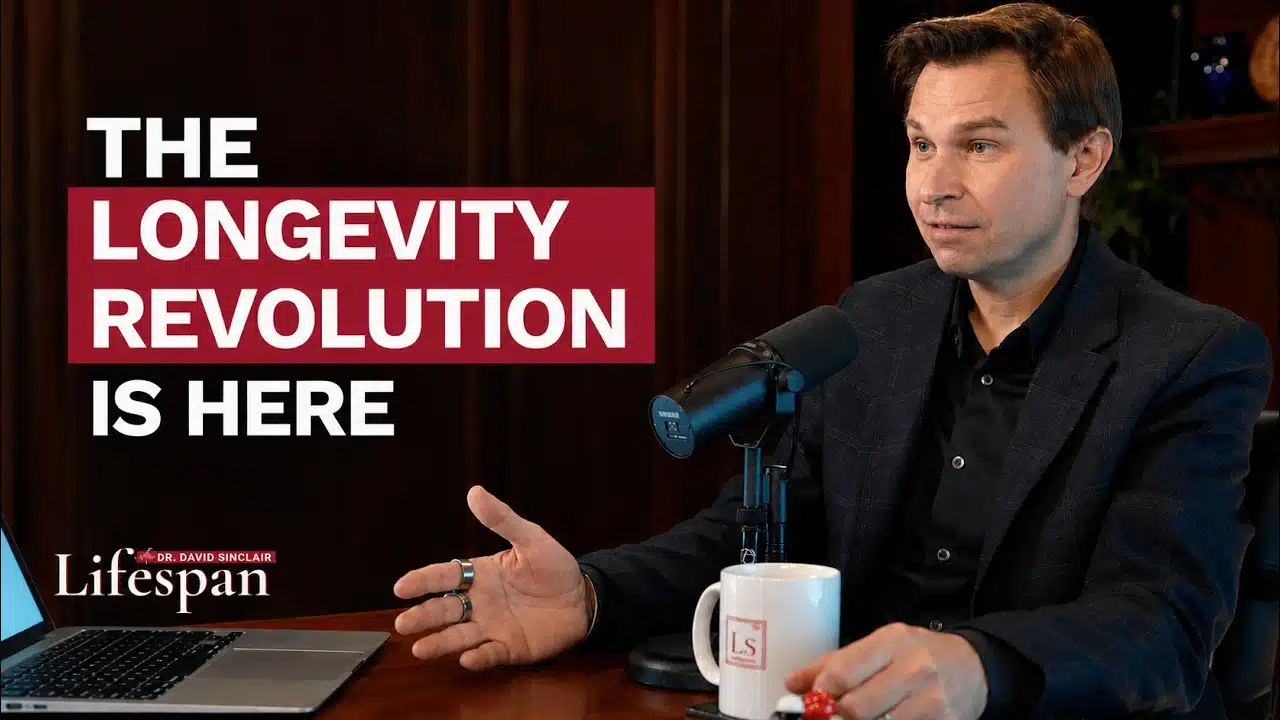
In a recent episode of his Lifespan podcast, Harvard professor and longevity researcher David Sinclair revealed that the technology to reverse aging isn’t coming—it’s already here.
And it’s now being tested in humans for the very first time.
Jump to:
The First Age-Reversal Therapy Just Got FDA Clearance
In January 2026, a drug called ER100 became the world’s first epigenetic reprogramming therapy cleared by the FDA for human clinical trials.
It’s the same technology that cured blindness in mice—and now it’s moving into people.

If you want something simple that actually works, this is one of the most effective tools I’ve used to build strength, conditioning, and endurance without needing a full gym setup.
- Full-body training with one weight using swings, squats, and presses
- Solid cast iron build that feels stable and lasts for years
- Comfortable grip that makes high-rep workouts easier to handle
People that have been treated, if all goes well, will be able to see again. So, cross your fingers that that works.
ER100 is a gene therapy developed from research conducted in Sinclair’s lab at Harvard. It targets damaged retinal nerve cells in patients with glaucoma and stroke-related vision loss—conditions previously considered irreversible.
Unlike traditional treatments that merely slow disease progression, ER100 aims to rejuvenate aged cells so they function like younger versions of themselves.
What Makes This Different From Everything Else?
Most anti-aging research focuses on damage control: mopping up free radicals, repairing DNA, or replacing dying cells.
Sinclair’s approach is radically different.
He believes aging isn’t caused by wear and tear—it’s caused by lost information.
Aging is not fundamentally caused by mutations or some other type of damage or disrepair. It is a loss of information.
This framework is called the Information Theory of Aging (IToA), and it flips decades of scientific thinking on its head.
If you want something simple that actually works, this is one of the most effective tools I’ve used to build strength, conditioning, and endurance without needing a full gym setup.
- Full-body training with one weight using swings, squats, and presses
- Solid cast iron build that feels stable and lasts for years
- Comfortable grip that makes high-rep workouts easier to handle
Two Types of Information in Every Cell
Your DNA is like a hard drive—stable, digital, nearly indestructible. It can last hundreds of thousands of years.
But there’s another layer: the epigenome.
Think of it as your cell’s operating system. It tells genes when to turn on or off, what type of cell to be, and how to behave.
Unlike DNA, the epigenome is analog—dynamic, fragile, prone to errors over time.
As you age, chemical tags on your DNA shift out of place. Genes that should stay silent start firing. Cells forget their identity.
A nerve cell starts acting like a liver cell. Muscle weakens. Vision fades. Disease takes hold.
If you want something simple that actually works, this is one of the most effective tools I’ve used to build strength, conditioning, and endurance without needing a full gym setup.
- Full-body training with one weight using swings, squats, and presses
- Solid cast iron build that feels stable and lasts for years
- Comfortable grip that makes high-rep workouts easier to handle
We start to lose our hearing, our eyesight, and our muscles shrink, our bones weaken, and then diseases take hold.
The Breakthrough That Changed Everything
In 2006, Japanese scientist Shinya Yamanaka discovered that turning on four genes—Oct4, Sox2, Klf4, and c-Myc (collectively called OSKM)—could reprogram adult cells back into stem cells.
He won the Nobel Prize for it.
But there was a problem: fully reprogrammed cells lose their identity and often become cancerous.
In animals, activating all four factors caused lethal tumors within days.
Sinclair’s student, Lu Wang Cheng, spent three years trying different combinations. He was ready to quit.
Then Sinclair convinced him to try one more experiment: leave out the cancer-causing gene, Myc.
If you want something simple that actually works, this is one of the most effective tools I’ve used to build strength, conditioning, and endurance without needing a full gym setup.
- Full-body training with one weight using swings, squats, and presses
- Solid cast iron build that feels stable and lasts for years
- Comfortable grip that makes high-rep workouts easier to handle
That day in 2017, I’ll never forget. It was a momentous one.
Using just OSK (three factors instead of four), Lu reset the epigenetic clock of human cells by up to 75%—without causing cancer.
They Made Blind Mice See Again
The team tested OSK in aged mice with damaged optic nerves—a condition that mirrors glaucoma in humans.
Normally, once these nerves are damaged, they don’t regenerate. Vision loss is permanent.
But after OSK treatment, something remarkable happened.
On June 28th, 2018, Lu sent Sinclair a series of late-night texts showing images of regenerated optic nerves stretching across the field of view.
I know my hands are shaking. Let’s prepare for the worst and hope for the best.
The damaged nerves had regrown. The mice regained their vision.
If you want something simple that actually works, this is one of the most effective tools I’ve used to build strength, conditioning, and endurance without needing a full gym setup.
- Full-body training with one weight using swings, squats, and presses
- Solid cast iron build that feels stable and lasts for years
- Comfortable grip that makes high-rep workouts easier to handle
They published the findings on the cover of Nature in 2020, showing for the first time that a gene therapy had reversed both aging and vision loss.
What Happens Next Could Change Medicine Forever
ER100 is now in Phase 1 clinical trials at three U.S. sites, including one run by Sinclair’s colleague Dr. Joe Rizzo at Harvard.
Eighteen patients with glaucoma or stroke-related vision loss will receive the gene therapy via a quick injection into the eye.
The genes travel through the fluid, reach the damaged retinal nerves at the back of the eye, and—if all goes well—rejuvenate them over six weeks.
The primary goal is safety. But researchers will also watch for signs of restored vision.
Because there’s currently no treatment that reverses blindness, ER100 could be fast-tracked if it shows promise.
If you want something simple that actually works, this is one of the most effective tools I’ve used to build strength, conditioning, and endurance without needing a full gym setup.
- Full-body training with one weight using swings, squats, and presses
- Solid cast iron build that feels stable and lasts for years
- Comfortable grip that makes high-rep workouts easier to handle
Beyond Vision: The Bigger Picture
If ER100 works in the eye, the implications extend far beyond vision.
Sinclair’s team has shown OSK can reverse aging markers in muscle, kidney, liver, and skin.
- Neurological conditions: Alzheimer’s, Parkinson’s, spinal injuries
- Sensory loss: Hearing restoration
- Organ rejuvenation: Heart, liver, kidneys
- Cosmetic aging: Skin and tissue repair
From there, just pick your organ of interest. Ear, kidney, heart, liver, skin, the possibilities are just too numerous to list.
Living to 122—Or Beyond
The longest verified human lifespan belongs to Jeanne Calment of France, who lived to 122 years and 164 days.
She was born in 1875, watched the Eiffel Tower being built, and lived through two world wars and the invention of the internet.
I only have one wrinkle and I’m sitting on it.
Calment’s record proves exceptional longevity is biologically possible. The question now is how to make it common—and healthier.
Sinclair believes that with the right interventions, living to 100 in excellent health is not a fantasy—it’s achievable.
If you want something simple that actually works, this is one of the most effective tools I’ve used to build strength, conditioning, and endurance without needing a full gym setup.
- Full-body training with one weight using swings, squats, and presses
- Solid cast iron build that feels stable and lasts for years
- Comfortable grip that makes high-rep workouts easier to handle
His own father, now 86, follows longevity practices discussed on the podcast and remains as energetic and healthy as someone decades younger.
AI, Genomics, and Personalized Longevity
Artificial intelligence is accelerating discoveries in aging research.
AI systems are now uncovering invisible aging biomarkers, identifying drug targets, and suggesting compounds that rewind cellular age.
Sinclair’s lab is using AI to analyze data and optimize interventions in ways that were impossible just years ago.
Meanwhile, the cost of genome sequencing has plummeted. In early 2026, the $100 genome was announced—a breakthrough that will enable personalized longevity guidance, early cancer detection, and biological age estimation.
This means you have a choice. Be a bystander or be literate in what comes next.
What You Can Do Right Now
While cutting-edge therapies like ER100 move through trials, there’s plenty you can do today to protect your epigenome and extend healthspan.
If you want something simple that actually works, this is one of the most effective tools I’ve used to build strength, conditioning, and endurance without needing a full gym setup.
- Full-body training with one weight using swings, squats, and presses
- Solid cast iron build that feels stable and lasts for years
- Comfortable grip that makes high-rep workouts easier to handle
Sinclair emphasizes practices supported by science:
- Exercise regularly—especially strength and endurance training
- Practice intermittent fasting or time-restricted eating
- Consider evidence-based supplements (more details in future episodes)
- Track your biomarkers with wearables and regular testing
- Stay mentally engaged with complex, lifelong learning
These aren’t magic bullets. But they lay the foundation for a longer, healthier life—and position you to benefit from emerging therapies as they become available.
The Future Is Now
For decades, aging was seen as inevitable—something to manage, never change.
That view is crumbling.
Epigenetic reprogramming has moved from theory to FDA-cleared trials. Gene therapies are restoring vision in mice and monkeys. AI is unlocking biological secrets at breathtaking speed.
We are no longer just slowing aging. We are learning to reverse it.
If you want something simple that actually works, this is one of the most effective tools I’ve used to build strength, conditioning, and endurance without needing a full gym setup.
- Full-body training with one weight using swings, squats, and presses
- Solid cast iron build that feels stable and lasts for years
- Comfortable grip that makes high-rep workouts easier to handle
What used to be science fiction just 10 years ago is now coming to reality.
Sinclair and his team have spent decades in the lab, chasing a vision most dismissed as impossible. Now, that work is reaching patients—and the rest of us may not be far behind.
Whether you’re 30, 50, or 80, the message is clear: the boundaries of human lifespan are being rewritten. The question isn’t whether it’s possible—it’s whether you’ll be ready when it arrives.