Ever celebrated a lift that wasn’t even close to your personal best?
For most lifters, a 265-kilogram deadlift might not seem worth popping champagne over, especially when you’ve previously pulled 310 kg.
But context changes everything, and in a recent training session, strength coach and lifter Mitch shared why hitting 265 kg meant more to him than chasing vanity numbers.
His approach to rehabilitating a serious disc injury while maintaining strength offers a masterclass in intelligent training that prioritizes longevity over ego.
Jump to:
- The Reality of Training Through Injury
- Using Hook Grip as a Built-In Safety Mechanism
- When Business Stress Meets Heavy Training
- The Complete Posterior Chain Session Breakdown
- Why This Exercise Selection Isn’t Redundant
- The Lat Engagement Secret for Deadlifts
- The Two-Set Revolution: Does Low Volume Really Work?
- Rest Periods: Why Five Minutes Isn’t Excessive
- Hamstring Anatomy and Complete Development
- The Posterior Chain: True Sign of Strength
- Key Takeaways for Building Bulletproof Posterior Strength
The Reality of Training Through Injury
Three to four months ago, Mitch suffered a significant disc injury that left him unable to stand for more than a minute without severe leg pain.
The culprit? Aggressive stretching, not heavy lifting.
I damaged my disc pretty damn badly probably about three or four months ago now. For the first 3 to 4 weeks, I did absolutely no spine loading because I couldn’t. I was in too much pain.
His rehabilitation strategy demonstrates a crucial principle: gradual exposure to heavy weights is the key to coming back stronger.
Rather than rushing back to his previous 310 kg deadlift, Mitch implemented deliberate constraints to limit how much weight he could handle.
Using Hook Grip as a Built-In Safety Mechanism
One of Mitch’s most clever rehabilitation tactics involves grip selection.
I’ve taken on hook grip. So, hook grip is harder for me, obviously. So, that’s going to be my limiting factor. If I did a mixed grip, I’d be able to go heavier, but I just don’t trust my back with heavier weights at the moment.
By deliberately choosing a grip style that limits his lifting capacity, he’s created a natural ceiling that protects his recovering spine while still providing training stimulus.
This approach shows exceptional training maturity.
When Business Stress Meets Heavy Training
Mitch also addressed something many lifters experience but few discuss openly: the mental interference between work stress and heavy lifting.
When you’re focusing on work and you try and lift heavy, it kind of I don’t know. For me, it just doesn’t work that well. So, when I train, I really need to try and separate it as much as I can.
His solution? Creating boundaries around training time by silencing his phone and telling people not to disturb him.
Mental presence matters just as much as physical preparation when attempting challenging lifts.
The Complete Posterior Chain Session Breakdown
Mitch’s training session provides a template for building comprehensive posterior chain strength while respecting recovery limitations.
Exercise 1: Conventional Deadlift (Skill Work)
- Working set: 265 kg × 1 rep with hook grip
- Purpose: Develop hook grip strength and practice deadlift technique
- Key technical focus: Maintaining lat engagement to prevent bar drift
Exercise 2: Pause Deficit Deadlifts
- Working sets: 2 sets × 5 reps at 200 kg
- Setup: Standing on elevated platform, using straps, no belt
- Purpose: Correct early hip rise and improve leg drive
The pause deficit deadlift serves multiple purposes in Mitch’s program.
The whole idea here of a pause deficit deadlift is to teach myself to maintain tension and take the slack out of the bar without ripping it off the ground.
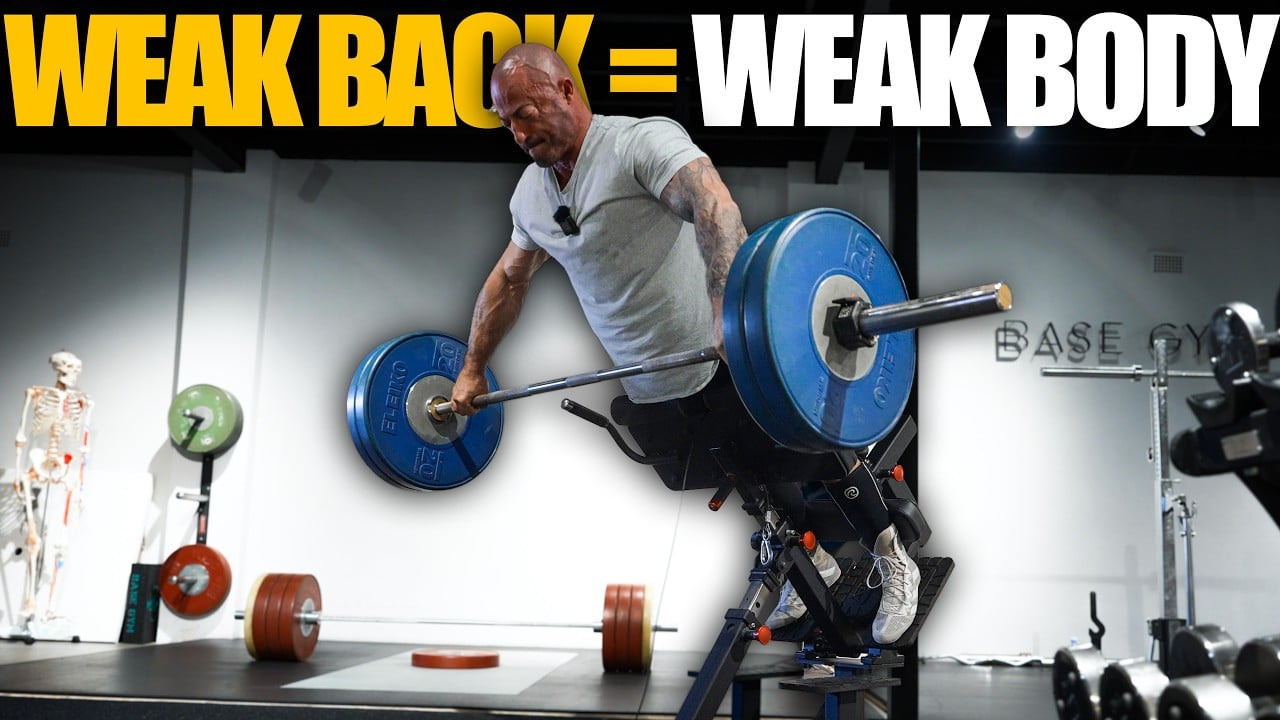
Exercise 3: Snatch Grip Back Extensions
- Working sets: 2 sets × 8 reps at 100 kg
- Equipment: 45-degree back extension bench
- Primary benefit: Upper back and lat strengthening with deadlift carryover
This exercise targets glutes in the shortened position while heavily challenging upper back strength.
Exercise 4: Hip Thrusts
- Working sets: 2 sets to failure (approximately 15-20 reps)
- Technical cue: Chin tucked, spine rigid throughout movement
- Purpose: Isolated glute work in shortened position
Exercise 5: Lying Hamstring Curls
- Working sets: 2 sets to failure
- Foot position: Toes pointed down for comfort
- Purpose: Target all four hamstring heads through knee flexion
Why This Exercise Selection Isn’t Redundant
At first glance, doing both back extensions and hip thrusts might seem unnecessary since both target glutes in the shortened position.
But Mitch explains the logic behind apparent exercise redundancy.
When I do my snatch grip back extensions, I’m going to be doing a pretty heavy weight. Even though the glutes are the prime movers in hip extension, I typically walk away from that exercise with my glutes not the limiting factor of the movement.
The determining factor is what muscle limits the exercise.
Since upper back strength limits the back extensions before glutes reach failure, adding dedicated glute work ensures complete posterior chain development.
The Lat Engagement Secret for Deadlifts
One of the most valuable technical insights Mitch shares involves proper lat activation during deadlifts.
Many lifters mistakenly retract their shoulder blades, which actually shortens arm length and reduces mechanical efficiency.
A lot of people say, you know, retract the scapula. The problem is when you retract the scapula, look at my arm length. I’m shortening my arms. I want to shorten my arms in a bench press. But, for a deadlift you want long arms.
The correct cue? Reach down and pull back.
This shoulder extension action engages lats properly while maintaining maximum arm length and keeping the bar close to your center of mass.
The Two-Set Revolution: Does Low Volume Really Work?
Mitch performs only two working sets per exercise, aligning with current training trends emphasizing quality over quantity.
But he adds crucial context that many beginners miss.
Two top sets per exercise. It’s kind of been something that I’ve been doing for a while. But typically I only preach it for people at a higher level because people at a high level know how to work hard.
He references a conversation between bodybuilding legend Dorian Yates and Dr. Andrew Huberman, where Yates explained that experienced lifters with strong mind-muscle connection can thoroughly stimulate muscles in just one or two brutal sets.
Beginners haven’t developed the neurological capacity to generate this level of intensity, so they benefit from additional volume to compensate for lower per-set quality.
Rest Periods: Why Five Minutes Isn’t Excessive
Between accessory exercises, Mitch takes five to six minutes of rest. For main lifts, he extends this to eight minutes or more.
A lot of people do things like 1 to 2 minute rest between sets. And I look at that and it’s like 1 to 2 minutes, if you’re strong enough, I don’t care who you are, that’s not adequate recovery.
The stronger you are, the more neural fatigue each set generates, requiring longer recovery to maintain set quality.
Shorter rest periods might work for beginners or during higher-rep accessory work, but not for advanced lifters performing challenging compound movements.
Hamstring Anatomy and Complete Development
Mitch provides an anatomy lesson that explains why hamstring curls remain essential even when doing heavy hip extension work.
The hamstrings consist of four heads across three muscles: semimembranosus, semitendinosus, and biceps femoris (which has two heads).
Of those hamstrings, three of the four heads cross the hip joint. So, whenever I do my hip extension exercises, three heads are on, but the short head of the biceps femoris doesn’t cross the hip joint.
To fully develop hamstrings, you need both hip extension exercises and knee flexion movements like hamstring curls, Nordic curls, or glute-ham raises.
The Posterior Chain: True Sign of Strength
Mitch’s training philosophy has evolved dramatically since his early beach-going days of wanting bigger pecs, abs, and biceps.
If I saw them turn around and saw weak erector spinae, and weak traps, and weak glutes, I’d look at them and go, “Ah, that guy’s weak.” Now that’s what I consider to be the true sign of strength is the posterior muscles.
This perspective shift reflects training maturity.
While mirror muscles create aesthetic appeal, posterior chain development determines actual functional strength and athletic performance.
Key Takeaways for Building Bulletproof Posterior Strength
- Intelligent load management: Use grip variations or other constraints to limit loads during injury rehabilitation
- Gradual progression: Small jumps maintain training stimulus while respecting recovery needs
- Exercise pairing logic: Understand limiting factors to avoid true redundancy while ensuring complete muscle stimulation
- Technical mastery: Reach down and pull back for optimal lat engagement in deadlifts
- Volume appropriateness: Two quality sets work for advanced lifters; beginners need more practice volume
- Adequate rest: Five to eight minutes between challenging sets preserves quality
- Complete hamstring development: Include both hip extension and knee flexion movements
Mitch’s session totaled just 11 working sets across five exercises, proving that intelligent program design beats random high-volume training every time.