Tackling a HYROX race requires more than just raw fitness.
Strategy, pacing, and proper technique can mean the difference between crossing the finish line strong or crawling across completely buried.
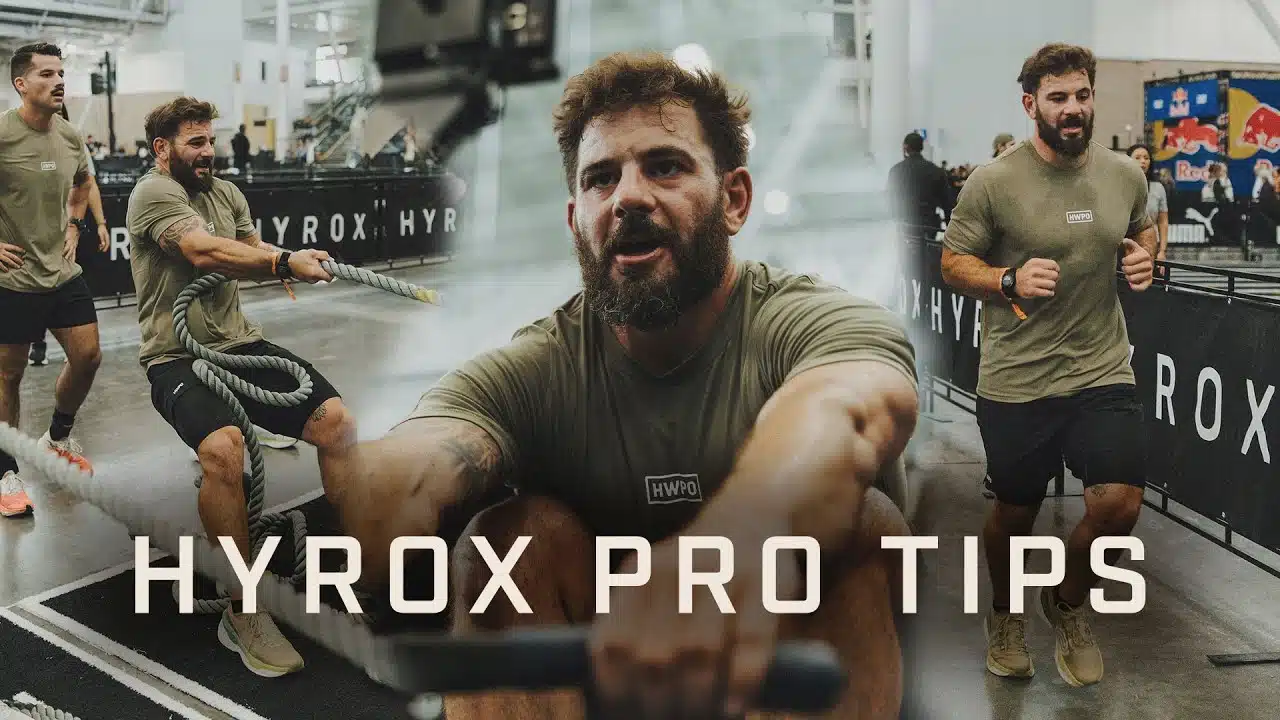
In a recent video, competitive athlete and coach breaks down essential tips for mastering HYROX’s most challenging stations—from the dreaded sled push to the deceptively difficult burpee broad jumps.
Whether tackling your first race or chasing a personal record, these insights could shave minutes off your time while keeping your heart rate manageable.
Jump to:
The Sled Push: HYROX’s Most Feared Station
Nine out of ten first-time HYROX athletes cite sled push as the hardest station. The weight is substantial, though consistent turf conditions across all lanes help level the playing field.
Technique matters more than brute strength here.
Optimal Hand Positioning and Body Mechanics
Avoid gripping at the very top of the handles, which can cause the sled to tip forward at the start. Instead, position hands slightly lower on the poles and bring shoulders into contact with the vertical bars.
I go with a pretty standard grip. I’m not grabbing right at the very top just to try to prevent like that 3, two, one, go and tipping the sled. So, I come down a little bit.
Start each push by leaning into the sled and driving with both legs simultaneously to overcome initial resistance. Then transition to short, choppy steps rather than long strides.
Unless you possess exceptionally strong legs, those quick steps will prove more sustainable across all four lengths.
Strategic Position Changes
Don’t stay locked in one position. Varying your approach distributes fatigue across different muscle groups.
- Standard position: Shoulders against poles, bent at hips
- Straight-arm push: Arms extended, engaging different muscles
- Shoulders-only technique: Used by many pros, minimizing grip involvement
Changing back angle shifts demand between quads, hamstrings, and glutes. Elite athletes often push with loose grips or just shoulder contact, conserving upper body energy.
Pacing Strategy That Actually Works
Here’s the counterintuitive truth: finishing each individual length first doesn’t matter. Getting back to running first does.
Keep in mind when you take off on your first push and you’re next to somebody in your other lane, it doesn’t matter who finishes the first length first or the second length first. It matters who’s back running first.
Consider breaking each length into smaller intervals—resting mid-length rather than grinding through to the end. Eight short, controlled intervals often beat four longer, slower ones.
Because sled push comes early in the race, conservative pacing pays dividends. Start cautiously even if planning to go unbroken. You can always accelerate if feeling fresh, but recovering from going too hard proves nearly impossible.
Team Division Tactics
Teams push the same total distance but can strategize transitions. Alternating full lengths allows each partner to push harder with extended rest between efforts.
The tradeoff? The resting partner must maintain quick feet while chasing the sled back, similar to running at high cadence on a rowing machine.
Determine switching points beforehand and assign the stronger runner to push first—they’ll arrive more recovered and set a solid pace.
Sled Pull: Three Techniques for Different Strengths
Same sled, same turf, different challenge. Sled pull confines athletes to roughly a five-by-five-foot box while hauling the weight via rope.
Arm-Over-Arm Pull
This technique suits those with developed upper bodies and typically produces the fastest consistent times. Hinge at hips, position feet wide, and pull with alternating arms using a palms-up grip.
This is like a stationary rope climb. So all we’re doing is pulling our elbow to our hip and then our hand to our shoulder. So biceps and lats.
Allow good swing between pulls to stretch lats and maximize each contraction. One advanced tip: vary grip length periodically to prevent rope oscillation, which creates unnecessary resistance.
Hip-Powered Double Overhand
This method generates more power by incorporating hip drive. Assume a hinged position, sit hips down, then explosively pop them forward while pulling.
The advantage? Significantly stronger pulls. The disadvantage? Heavy demand on hips and legs that may be needed for subsequent running.
Consider combining techniques—start with arm-over-arm to preserve legs, then switch to hip-powered pulls for the final 10-15 feet when grip and biceps fatigue.
Walk-Back Method (Emergency Only)
Since the box extends over five feet deep, you can grip the rope, walk it backward a few steps, return forward, and repeat.
This allows pulling maximum weight but sacrifices speed dramatically. Reserve this technique for desperation moments or when the load approaches your one-rep maximum capacity.
Farmer Carry: Speed Over Time Under Tension
Unlike training sessions focused on control and time under tension, HYROX rewards speed. The weights feel more manageable than sled stations, especially using kettlebells rather than dumbbells.
Grip and Posture Optimization
Avoid death-gripping handles. Instead, use a fishhook grip—letting kettlebells hang low in fingers where calluses form, similar to how gymnastics grips distribute load.
Position bells slightly forward so they don’t knock against hips with each step. Walk a tightrope line rather than taking wide steps, keeping shoulders remarkably still throughout.
There’s a difference between doing farmer carries in training where you’re looking for time under tension and control. Whereas in the race, it’s a farmer carry, not a farmer walk.
Team Strategy for Maximum Efficiency
Teams face no transition penalties, creating opportunities for frequent switches. Don’t feel obligated to complete full lengths—transition every 20 feet if beneficial.
The resting partner should stay immediately behind the carrier, communicating clearly. Develop cue words like shouting “five” to indicate five feet remaining before the switch.
If weights feel light, run with them. Making up seconds here compounds across the entire race.
Burpee Broad Jumps: The Sneakiest Heart Rate Spike
Don’t underestimate this station. While 20-30 burpees might sound manageable, adding explosive broad jumps transforms the equation entirely.
Volume Over Distance
Counterintuitively, more reps with smaller jumps beats fewer reps with maximum-distance jumps. Explosive movements spike heart rate dramatically as athletes clench, hold breath, and exert maximum force.
I’m going to take 15 burpees with a small jump over 10 burpees with a maximum jump. They’re not going to be that much different in time. But the big thing is how you feel at the end of it.
Moderate jumps maintain sustainable rhythm and allow immediate return to running. Maximum-distance attempts leave athletes gasping and useless for half the next lap.
Movement Efficiency Breakdown
After landing from your jump, place hands near feet and kick both feet back simultaneously. As you descend into the bottom position, don’t perform a controlled negative pushup—simply drop with enough control to avoid injury while staying relatively limp.
Coming up, step out rather than jumping both feet forward. Only elite athletes benefit from the explosive double-foot jump; for most competitors, the energy cost outweighs marginal time savings.
Execute the movement sequence as: come up like a seal, step one foot forward, then immediately step and jump with the second foot, using that momentum and stretch reflex.
Strategic Rest Points
If rest is needed, take it immediately after landing, not mid-movement. Land, pause for breath, then execute the entire burpee-to-jump sequence with controlled intensity.
The rhythm should be: Land → breathe → controlled drop → minimal effort to ground → step up → explosive jump with momentum.
Race Day: Warm-Up and Pacing Wisdom
HYROX processes hundreds of athletes daily, making warm-up areas crowded but friendly. Don’t feel pressure to practice every station—prioritize getting genuinely warm.
Effective Warm-Up Protocol
- Spend several minutes on runner or bike
- Touch each machine briefly to activate movement patterns
- Stop once healthy sweat develops or heart rate elevates noticeably
- Practice heavier-loaded movements like sled push and farmer carries
Here’s a crucial trick: immediately before your heat is called, perform one 20-30 second all-out sprint on a bike or runner. This intentionally spikes heart rate before the waiting period.
I think a lot of anxiety in the first round of a workout isn’t necessarily from having a high heart rate, but it’s your heart rate climbing. So, I think it’s your body’s natural warning like, hey, our heart rate’s climbing a lot, but if I’ve already touched that heart rate as it’s climbing back up, I’ve already been there.
First Lap Strategy
Resist the urge to charge out with the pack. Expect to be near the back after lap one—and embrace it completely. Eight stations and 15 more laps remain.
Starting conservatively eliminates anxiety, allows familiarization with the track, and prevents early burnout that sabotages later performance.
Transition Awareness
Many athletes run hard on track but automatically walk during interior transitions to stations. These transition distances can span several hundred yards—walking all of them adds minutes to total time.
Instead, use specific transitions strategically. Set markers like “walk these 40 meters to the exit, then resume pace” or “recovery pace until first corner, then regular tempo.”
Station Pacing Philosophy
No station requires unbroken completion. Taking a five-second break early might save ten seconds later by preventing extended recovery needs.
Calculate whether brief early rests preserve capacity for stronger finishing efforts across all movements.
Mental Game and Flow State
The race’s first half feels interminable compared to the second. After completing two laps and the first station, seven remaining stations seem overwhelming.
But rhythm builds quickly. By station four, you’ve hit the halfway mark, established cadence, recognized familiar faces, and developed track positioning instincts.
Conservative early rounds establish flow state foundation. Once there, the race becomes about maintaining momentum and honestly enjoying the challenge.
For those seeking structured preparation, dedicated HYROX training programs provide periodized guidance leading into race day. Whether competing individually or as a team, focus on making yourself proud through smart pacing, efficient technique, and relentless forward progress.
The finish line rewards strategy as much as strength.