A medical educator and team of researchers believe they’ve uncovered why sunlight—specifically its infrared wavelengths—may be essential for human health in ways science hasn’t fully appreciated.
The hypothesis challenges how we design hospitals, offices, and homes.
It suggests that modern indoor environments, with their LED lighting and low-E glass windows, may be starving our cells of a critical energy signal.
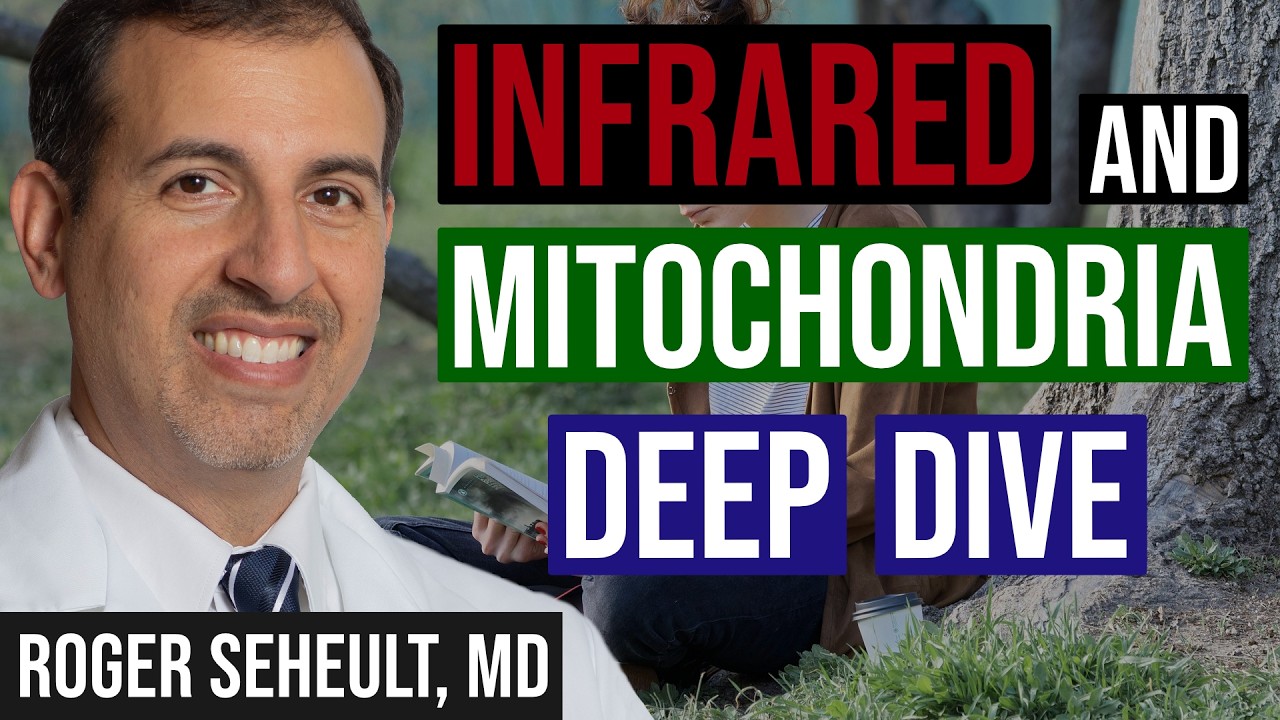
Dr. Roger Seheult, co-founder of MedCram, recently unveiled a preprint paper titled “Metabolism in the Solar Photon Field” that proposes a new mechanism for how infrared light from the sun directly modulates mitochondrial function—the powerhouses inside nearly every cell in your body.
Jump to:
- The Core Hypothesis: Light as a Metabolic Switch
- Why Sunlight May Be Irreplaceable
- Marcus Electron Transfer Theory: The Missing Link
- Why Some Wavelengths Inhibit, Others Accelerate
- Deep-Sea Yeast and the Power of Infrared
- Broad Spectrum Beats Monochromatic Light
- Implications for Human Health
- Clinical Evidence: ICU Patients and Photobiomodulation
- Modern Indoor Environments May Be Metabolically Starving Us
- What Makes This Hypothesis Novel?
- Practical Takeaways
- The Bigger Picture
- Sources
The Core Hypothesis: Light as a Metabolic Switch
Seheult and his collaborators—astrophysicist Dr. Robert Fosbury, neuroscientist Professor Glenn Jeffery, and optical engineer Scott Zimmerman—argue that infrared photons don’t just warm tissue. They actively influence how efficiently electrons move through the mitochondrial electron transport chain.
Electrons move best when the surrounding molecules are arranged just right. Infrared light causes those molecules to vibrate, changing how often the mitochondria reach those favorable arrangements.
The team introduces the term photometabolism—a solar-driven, non-photosynthetic modulation of core metabolic processes. Unlike photosynthesis in plants, this mechanism doesn’t create energy from scratch. Instead, it optimizes how existing chemical energy is processed.
Why Sunlight May Be Irreplaceable
One striking feature of sunlight is its broad spectrum. The sun emits photons across many wavelengths, but there’s a peak concentration around 0.754 electron volts—roughly 1,640 nanometers—in the infrared range.
This wavelength corresponds to a transparency window in Earth’s atmosphere, allowing these photons to penetrate clothing, skin, and reach mitochondria deep in tissue.
Sunlight may be especially effective because unlike monochromatic light, it contains a broad spectrum of wavelengths that can interact with many different vibrational modes and electron transfer steps across the mitochondrial machinery rather than targeting only one narrow pathway.
Seheult demonstrated this with measurements from his own dining room. Indoors, even with windows open, infrared exposure was just 8 to 10 watts per square meter.
Step outside under a shade tree? That number jumped to over 40 watts per square meter—orders of magnitude higher, thanks to sunlight and reflection off surrounding grass.
Marcus Electron Transfer Theory: The Missing Link
To understand the mechanism, Seheult walks through Marcus electron transfer theory, developed by Nobel laureate Rudolph Marcus in the 1960s. Marcus described how electrons don’t jump between molecules randomly—they require precise molecular arrangements.
Picture two molecular sites: a donor and an acceptor. For an electron to transfer, the surrounding water molecules, protein side chains, and lipid structures must twist into just the right configuration. This twisting requires energy, known as reorganization energy (lambda).
When the system reaches what’s called the Marcus crossing point, the electron hops over. If the crossing point sits at the minimum energy state of the reactants, transfer happens fastest—this is called activationless transfer.
Here’s where infrared light enters. By causing molecular vibrations, infrared photons shift the probability distribution of these nuclear arrangements along the energy curve. Depending on where the Marcus crossing point sits, this can either speed up or slow down electron transfer.
Evidence From the Lab
A 2018 study by Ma and colleagues provided direct experimental support. Researchers used three pulses of light on a synthetic molecule: one to excite an electron, one mid-infrared pulse to induce molecular vibrations, and a final pulse to measure transfer rates.
The result? Forward electron transfer slowed down. Backward transfer sped up. Exactly as Marcus theory would predict, depending on where the crossing point was positioned relative to the vibrational shifts.
We examined infrared-perturbed charge separation and recombination. We find that IR excitation of hydrogen bond bridging modes accelerates charge recombination and slows charge separation.
Seheult argues this same principle applies inside mitochondria. Different wavelengths of infrared light can modulate different electron transfer steps, either enhancing or inhibiting metabolic flux.
Why Some Wavelengths Inhibit, Others Accelerate
A 2018 study by Sanderson and colleagues found that 810 nanometer light increased mitochondrial respiration, while 750 and 950 nanometer wavelengths decreased it by up to 34%.
This was puzzling under the old model, which assumed infrared light simply activated cytochrome c oxidase (complex IV) in the electron transport chain. If that were the whole story, all infrared wavelengths should have similar effects.
But under the Marcus framework, different wavelengths excite different vibrational modes. Some push nuclear arrangements toward the crossing point, speeding transfer. Others push them away, slowing it down.
Broad-spectrum sunlight, by contrast, delivers a mix of wavelengths that can modulate multiple pathways simultaneously, potentially optimizing overall mitochondrial output.
Deep-Sea Yeast and the Power of Infrared
One of the most compelling pieces of evidence comes from an unlikely source: yeast living near hydrothermal vents at the bottom of the ocean, far from any sunlight.
A 2025 study by Dai and colleagues isolated Rhodotorula mucilaginosa from sediments near a black smoker chimney in the central Indian Ocean. When exposed to near-infrared light (810 to 1,050 nanometers), the yeast grew significantly faster—even at temperatures too cold to support normal growth.
The researchers carefully controlled for temperature, ruling out simple thermal effects. They found that infrared light flattened the temperature dependence of growth, effectively lowering the activation energy required for metabolic processes.
The effective activation energy without infrared light was 12 kilocalories per mole. That activation energy effectively dropped to 2 kilocalories per mole with infrared light.
Even more striking: near-infrared light produced a threefold increase in biomass, while adding glucose produced only a 1.3-fold increase. Light wasn’t acting as fuel—it was optimizing how fuel was used.
When researchers inhibited cytochrome c oxidase with azide, infrared-stimulated growth dropped by 44%, confirming mitochondrial involvement. They also found that a mitochondrial ribosomal protein (MRPs8) was upregulated 6.7-fold after infrared exposure.
Broad Spectrum Beats Monochromatic Light
Seheult’s hypothesis predicts that broad-spectrum infrared should outperform single-wavelength (monochromatic) light. Preliminary evidence supports this.
In a 2025 study by Jeffery’s group, participants with color blindness were exposed to either monochromatic 850 nanometer light or broad-spectrum 60-watt incandescent light.
- Monochromatic light: 9% improvement in protan color blindness
- Broad-spectrum light: 28% improvement
For tritan color blindness, the pattern held: 16% improvement with monochromatic versus 24% with broad-spectrum.
The improvements persisted for weeks, suggesting sustained mitochondrial enhancement rather than transient effects.
Implications for Human Health
If infrared light modulates mitochondrial function, the implications are enormous. Mitochondria are involved in nearly every major disease process, from heart disease to Alzheimer’s to diabetes.
Seheult points to striking epidemiological patterns. In the United States, mortality from heart disease, cancer, stroke, Alzheimer’s, and even influenza all peak 1 to 3 weeks after the winter solstice—the shortest day of the year.
They all drop to their minimum 1 to 3 weeks after the summer solstice.
This pattern holds across infectious and non-infectious causes. The difference between seasonal lows and highs in heart disease deaths exceeds total influenza deaths during flu season.
All of these diseases are tied to the body’s functioning, and the body’s functioning is related to the mitochondria. And as we’ve just shown you, we believe that infrared light has a huge role to play on the mitochondria.
The pattern isn’t unique to the northern hemisphere. In Australia, influenza peaks in July—1 to 3 weeks after their winter solstice. In Singapore, near the equator where sunlight is constant year-round, there’s no distinguishable seasonal pattern.
Clinical Evidence: ICU Patients and Photobiomodulation
Hospitals are beginning to take this seriously. Several studies have tested near-infrared light exposure in critically ill patients.
One randomized controlled trial using 940 nanometer light for 15 minutes daily in COVID-19 patients reduced hospital length of stay from 12 days to 8 days. Another trial with 850 nanometer light cut ICU length of stay by 30%.
Muscle strength improved in nearly every measured outcome.
Taking this further, hospitals in Australia and the UK have invested millions to bring ICU patients outdoors. Footscray Hospital in Australia built outdoor ICU beds. King’s College Hospital in London transformed its rooftop into a critical care space with natural sunlight, fresh air, and greenery.
This is the first patient that actually went out on May 28, 2025. Across town, St. George Hospital—Queen Camilla visits them again on their rooftop. They have a neurointensive care unit. They’re getting patients outside.
Modern Indoor Environments May Be Metabolically Starving Us
Here’s where Seheult’s message becomes urgent. LED bulbs emit virtually no infrared light. Low-E glass windows, designed to improve energy efficiency, block most infrared wavelengths.
Older incandescent bulbs, by contrast, emitted significant infrared radiation—a byproduct of their inefficiency. Ironically, that “wasted” energy may have had unrecognized biological value.
Seheult demonstrated this with spectral measurements. Indoors under LED lighting, infrared exposure is negligible. Step outside, even under tree shade with reflected light from grass, and exposure increases tenfold or more.
If mitochondria require infrared light for optimal function, then modern built environments—offices, schools, hospitals—may be inadvertently compromising metabolic health.
What Makes This Hypothesis Novel?
Seheult emphasizes that none of the individual components of this hypothesis are new. Scientists have known for decades that:
- Mitochondrial electron transfer follows Marcus-type physics
- Red and near-infrared light can alter mitochondrial function
- Water and protein structures affect electron transfer kinetics
- Infrared excitation can change molecular electron transfer rates
What’s new is the mechanistic integration. The paper is the first to propose that infrared light modulates mitochondrial electron transfer by perturbing protein, solvent, and nuclear reorganization coordinates—thereby changing access to Marcus crossing configurations.
The novelty lies in the mechanistic integration, not in any single component. We are saying this is what’s going on in the mitochondria.
Seheult also met with Rudolph Marcus himself via Zoom, just months before Marcus passed away at age 102, to discuss the hypothesis. Marcus had won the Nobel Prize in Chemistry in 1992 for his electron transfer theory.
Practical Takeaways
While the full preprint is dense with physics and biochemistry, the practical implications are clear:
- Get outside daily, even under tree shade where infrared light reflects off greenery
- Maximize natural light indoors by keeping windows unobstructed
- Consider full-spectrum or incandescent lighting in spaces where you spend extended time
- Be aware that monochromatic infrared devices (like red light panels) may not replicate the benefits of broad-spectrum sunlight
- Hospitals and workplaces should reconsider architectural designs that prioritize energy efficiency at the expense of natural light exposure
Seheult is careful to note that monochromatic infrared devices do show benefits in clinical trials. But he suggests broad-spectrum exposure—mimicking natural sunlight—may be more effective because it modulates multiple electron transfer steps simultaneously.
The Bigger Picture
Seheult argues that mitochondria across the entire biosphere—from flies to elephants to humans—may be tuned to solar infrared radiation. Interestingly, metabolic rate scales with body mass to the 3/4 power, and so does incident solar power interception.
This alignment doesn’t prove causation, but it’s consistent with the idea that sunlight has shaped metabolic evolution.
The hypothesis is testable. Seheult believes experiments could confirm or refute the mechanism, and he hopes the preprint sparks further investigation.
I do believe that this, if true, has major implications for the built environment and how we live and the type of light that we require to live. And I believe it’s one of the major reasons why we need to be treating our patients outside.
Whether or not the Marcus-based mechanism holds up under scrutiny, one thing is becoming clear: we may have underestimated the metabolic importance of sunlight—and overestimated our ability to replicate it indoors.
Sources
- Fosbury et al., 2025 – Longer wavelengths in sunlight can pass through the human body (cited in transcript; actual study details not independently verified)
- Wong-Riley et al., 2005 – Photobiomodulation directly benefits primary neurons functionally inactivated by toxins (referenced as early cytochrome c oxidase study)
- Sanderson et al., 2018 – Inhibitory modulation of cytochrome c oxidase activity with specific near-infrared light wavelengths
- Ma et al., 2018 – Direct observation of infrared-controlled electron transfer in a molecular system
- Hayashi et al., 2010 – Electron transfer across water bridges in iron-sulfur systems
- Dai et al., 2025 – Infrared stimulation of mitochondrial metabolism in deep-sea yeast expands the energetic framework of hydrothermal ecosystems
- Jeffery et al., 2025 – Comparison of monochromatic and broad-spectrum light on visual function in aging populations
- Marcus, R.A., 1956–1992 – Development of electron transfer theory (Nobel Prize in Chemistry, 1992)