Rounding your back under load has long been considered a cardinal sin in fitness circles.
But what if everything we’ve been told about spinal flexion is wrong?
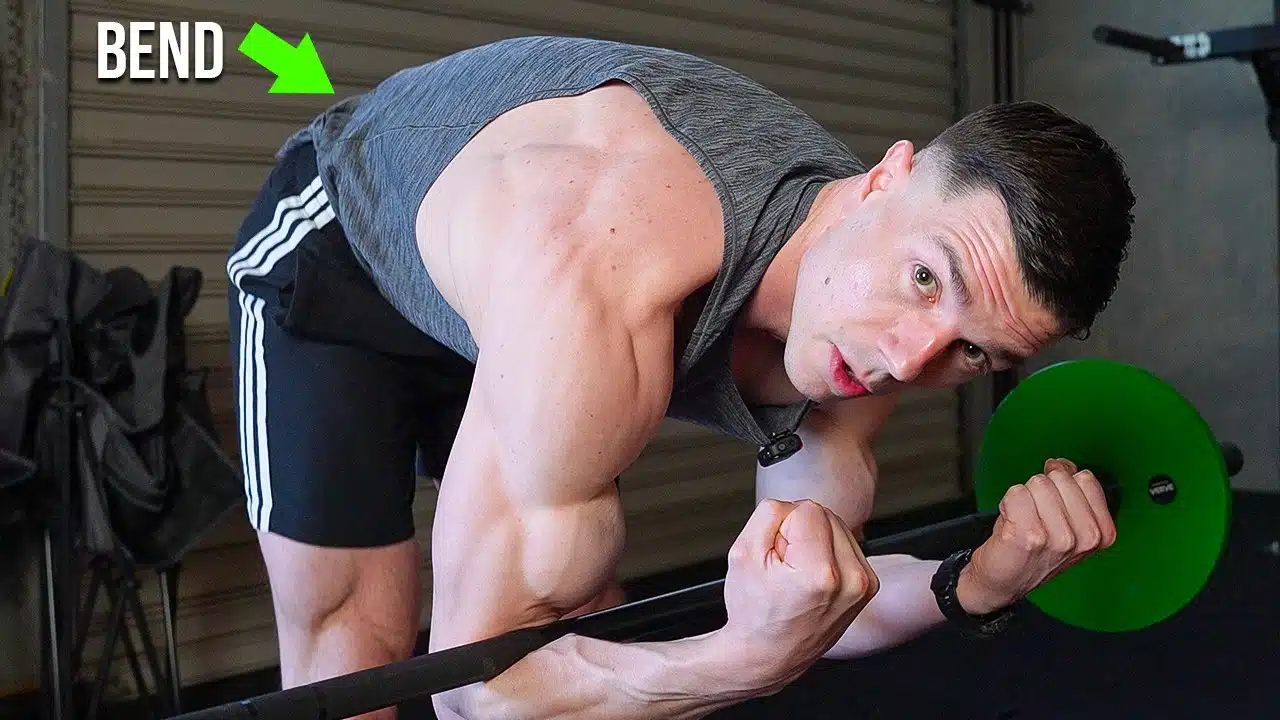
Enter the Jefferson curl, a controversial loaded stretching movement that’s challenging decades of conventional wisdom about back safety.
This deliberately flexed spine exercise promises to build resilience in your posterior chain, unlock mobility you thought was lost forever, and prepare your body for real-world movements that happen outside the gym.
Jump to:
What Is the Jefferson Curl?
The Jefferson curl is a loaded flexibility exercise that strengthens your entire posterior chain—hamstrings, calves, and lower back—while dramatically improving end-range mobility.
Unlike traditional strength exercises that emphasize maintaining a neutral spine, this movement intentionally rounds the back segment by segment. The goal isn’t lifting maximum weight like a deadlift, but rather building strength and control through ranges of motion most people never train.
Imagine picking up your kids or grabbing the groceries in awkward postures with a bent spine. No hesitation, no pain.
The practical applications extend far beyond gym performance. Daily life rarely offers perfect lifting conditions, and training your body to handle less-than-ideal positions may actually reduce injury risk when real-world situations demand it.
Perfecting Jefferson Curl Technique
The Zercher Grip Advantage
Rather than holding weight in your hands, the Zercher position—cradling weight between your elbows—offers several biomechanical benefits for Jefferson curls.
This setup lowers your center of gravity by keeping weight closer to your midline. It reduces shearing forces on the spine while making balance easier to maintain throughout the movement.
This position puts you in a more flexed posture automatically promoting that segmenting of the spine instead of hinging at the hips. This raises your core engagement, increasing that intraabdominal pressure.
The added benefit? Your biceps get worked as a bonus.
Stance and Leg Position
Position your feet shoulder-width apart to give your hips adequate space for movement. This wider stance accommodates tight hamstrings and allows deeper stretching.
Keep your knees locked out throughout the entire movement. Squeeze your quads hard—this muscle engagement actually helps pull you deeper into the stretch by creating reciprocal inhibition in the hamstrings.
The Spinal Articulation Sequence
Here’s where Jefferson curls differ dramatically from traditional lifts.
- Begin by tucking your chin to your chest
- Round through your upper back first
- Continue the curl through your mid-back
- Finally allow your lower back to round
- Move in one smooth, controlled wave
At maximum stretch, reverse the entire sequence. Uncurl from bottom to top, rebuilding your spinal position vertebra by vertebra.
Pro tip: When reaching the bottom position, extend your arms forward and protract your shoulders while keeping weight close. This anteriorly tilts your pelvis and intensifies the hamstring stretch.
Breathing and Tempo
Forget the Valsalva maneuver you’d use for maximum deadlifts. Breathe naturally throughout Jefferson curls, inhaling and exhaling calmly.
Your body will automatically create necessary stiffness while maximizing available range of motion. Control the lowering phase, pause briefly at the bottom stretch, then curl back up with equal control.
Progressive Loading Guidelines
Starting weight represents one of the most common questions about Jefferson curls.
Complete beginners can start with bodyweight alone, focusing purely on learning proper spinal segmentation. Most people can comfortably begin with 5-10 kilograms (11-22 pounds).
You want the weight to permit, not restrict your range of motion. It’s heavy enough to get into that deep stretch, but not so heavy that you’re scared or timid.
Leave your ego at the door. Even if you deadlift multiple plates, your body needs time to adapt to loaded spinal flexion. Progress weight and range patiently—sensible progression builds genuine resilience.
When you can complete your target rep range with full control and comfortable range of motion, consider increasing load by 2.5-5 kilograms. Small jumps keep the movement tolerable while providing adequate challenge.
Common Mistakes to Avoid
Your body will find creative ways to cheat if you let it.
Hinging at the hips transforms Jefferson curls into deadlift variations, reducing lower back emphasis. Even experienced practitioners fall into this pattern—watch your training footage to catch this compensation.
Bending your knees eliminates posterior chain stretch. Watch especially for subtle micro-bends that creep in during sets.
Using excessive weight too quickly remains the most frequent error. Heavy loading prevents deep ranges, breaks down technique, and compromises tempo control. Rushing progression on awkward lifts invites problems.
The Science Behind Spinal Flexion
Challenging Old Assumptions
Traditional thinking suggests rounding your back under load squeezes spinal discs, pushing inner material backward and causing herniations or nerve damage.
Critics often cite animal cadaver studies involving repeated flexion—sometimes 80,000 movements over 24 hours on pig spines without muscles, blood flow, or nervous systems.
But dead animal tissue doesn’t represent how living human bodies function. Living spines adapt, heal, and strengthen when trained progressively.
What Research Actually Shows
If flexion were inherently dangerous, athletes who spend hours in flexed positions—cyclists, rowers, cross-country skiers—should suffer higher back pain rates.
Studies show the opposite. Their spines demonstrate better health and hydration compared to sedentary individuals.
The concept of “perfect neutral spine” lacks consensus definition. Even lifters specifically coached to maintain neutral spines during squats typically flex 20-30 degrees through the lumbar region.
In short, modern research challenges this old assumption that bending your back is dangerous. It’s just not been proven.
Lower back pain risk factors are far more complex than single exercises or movement patterns. Genetics, stress levels, sleep quality, overall activity patterns, and numerous other variables contribute more significantly than specific lifting techniques.
Who Should Avoid Jefferson Curls
Despite impressive benefits, Jefferson curls aren’t appropriate for everyone.
Those experiencing acute lower back pain or sciatica—particularly nerve-related symptoms radiating down one leg—should allow symptoms to settle before attempting this movement.
Always consult qualified health professionals before beginning. You need clearance that you can move without pain and are ready for loaded flexibility training.
Programming Jefferson Curls Effectively
Sets, Reps, and Frequency
The 5-10 rep range works exceptionally well for Jefferson curls. Given the slow eccentric tempo, higher reps become mentally and physically tedious. Conversely, chasing one-rep maxes provides quick social media dopamine but isn’t sustainable long-term.
Programming twice weekly on leg days provides optimal balance between stimulus and recovery. One session focuses on heavier full range-of-motion work, while the second emphasizes lighter Jefferson curl extensions.
Strategic Supersets
Pairing Jefferson curls with hanging leg raises creates powerful synergy.
Activating abs and hip flexors through the crunching motion fires up muscles responsible for spinal flexion. When transitioning to Jefferson curls afterward, those same muscles actively pull you deeper into stretches, allowing fuller posterior chain lengthening.
Hip flexor compression drills strengthen the closing side of the movement—your abs, hip flexors, and deep core. Those ones that draw your torso towards your legs.
Don’t Neglect Your Calves
Calf flexibility plays a surprisingly significant role in forward-bending ability. Since calf muscles cross both ankle and knee joints, tightness here limits how far you can fold forward.
Perform three sets of deep calf raises emphasizing bottom-position stretch before Jefferson curls. Alternatively, static calf stretches work equally well. This preparation particularly helps those experiencing localized tightness behind the knees.
The Jefferson Curl Extension Variation
This advanced variation teaches active compression—using hip flexors to pull yourself deeper rather than relying on gravity alone.
Working at end-range builds both strength and flexibility precisely where it matters most. Extended time under tension makes this variation particularly challenging, so reduce weight accordingly.
Try 10 reps followed by a 10-30 second isometric hold at maximum stretch. The post-workout body sensation is remarkable.
Context Matters
No exercise exists in a vacuum of “good” or “bad.” Jefferson curls, when applied correctly, can genuinely transform posterior chain strength and mobility.
But nuance determines outcomes. Progressive loading, proper technique, appropriate programming, and honest self-assessment of readiness separate transformative training from reckless experimentation.
Modern life steals mobility that our bodies were designed to possess. Jefferson curls offer one evidence-informed pathway to reclaim what’s been lost—building resilience for awkward positions that real life inevitably demands.
Treat each repetition with respect, progress patiently, and your body will adapt in ways that surprise you.