Multi-time CrossFit Games champion Matt Fraser recently teamed up with Dr. Mike Israetel for an intense leg workout that pushed one of fitness’s most decorated athletes to his absolute limits.
The session, filmed in Vermont, featured Fraser tackling hypertrophy-focused training—a stark departure from his typical CrossFit programming.
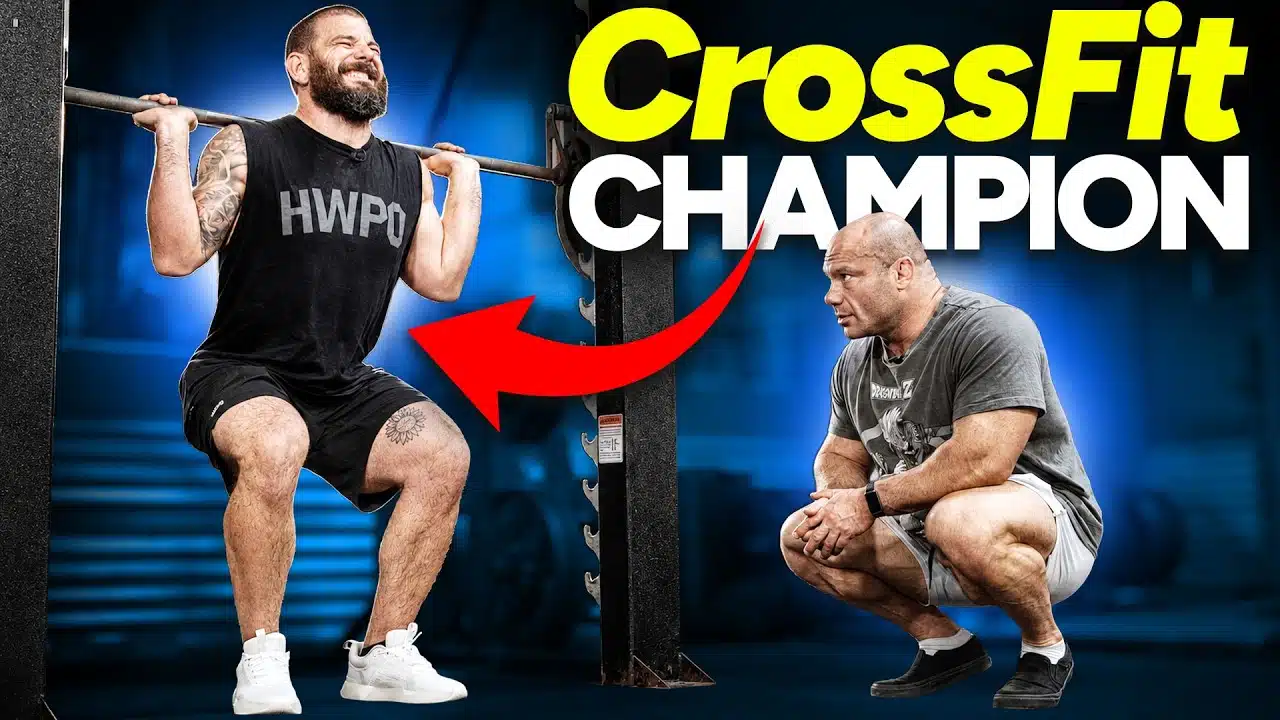
What unfolded was a masterclass in mental fortitude as Fraser discovered entirely new frontiers of muscular fatigue.
His reaction? Pure excitement mixed with the sobering realization that walking might be challenging the next day.
Jump to:
- Fraser Embraces Unfamiliar Territory
- Stiff-Legged Deadlifts: Technical Precision Under Fatigue
- Belt Squats: Finding New Limits With Myo-Reps
- Mental Fortitude: Fraser’s Secret Weapon
- Smith Machine Squats: Modified Mechanics For Maximum Quad Activation
- Key Takeaways From Fraser’s Training Session
- Fraser’s Refreshing Training Philosophy
Fraser Embraces Unfamiliar Territory
Fraser approached the workout with characteristic openness despite years of sport-specific training.
I’m excited for it, you know, I’ve trained one way very specifically for a long time. I’m excited to see how it goes, see what I can learn, and probably going to be walking peg legged tomorrow.
This willingness to explore unfamiliar training methods showcased Fraser’s growth mindset—even after retiring as arguably the greatest CrossFit athlete ever.
No products found.
Stiff-Legged Deadlifts: Technical Precision Under Fatigue
Dr. Israetel started Fraser with stiff-legged deadlifts, emphasizing three sets of 8-12 repetitions with exaggerated technique: expanded chest, hips back, and knees locked back.
The focus was entirely on hamstring engagement through controlled negatives and extended time under tension.
On shit like this it’s always used as accessory work for me. Like I started weightlifting when I was 12, Olympic style. You know, RDLs, stiff-leg deadlifts, anything like that, it was always accessory work. Just some sets of 10, sets of five after. Yeah, and much smaller sets, but never really pushing it to failure.
Fraser revealed his posterior chain had historically been his weakness—a surprising admission from someone known for Olympic lifting background.
The Quad-Dominant Athlete Problem
Fraser acknowledged years of quad dominance from weightlifting that carried into CrossFit.
I was always such a quad-dominant weightlifter, and then that carried over into CrossFit. Like it worked well in CrossFit. My posterior chain was dog shit.
This imbalance, while functional for his sport, highlighted gaps that bodybuilding-style training could address.
Belt Squats: Finding New Limits With Myo-Reps
The workout’s centerpiece involved belt squats using myo-reps—a technique involving multiple mini-sets with 5-10 second rest periods.
No products found.
Dr. Israetel instructed Fraser to descend slowly, pause at depth, come up almost to lockout, then repeat—accumulating reps until mechanical failure approached.
Fraser completed sets totaling 25 reps with strategic micro-breaks, experiencing quad fatigue unlike anything from traditional barbell squats.
So different, like such a different fatigue, cuz it’s like I’m so… Never done anything other than back squat, front squat. You know when your back side’s rounding and you start tipping forward, it’s like that’s your limiting factor. Whereas this, it’s like No, just quads.
Why Belt Squats Create Unique Stimulus
Dr. Israetel explained belt squats attach at the hips rather than shoulders, eliminating spinal loading and postural fatigue.
This allows athletes to accumulate massive quad volume without axial limitations becoming the failure point.
The myo-rep protocol Dr. Israetel recommended:
- Load your 10-rep max weight
- Complete 8 reps initially
- Rest 5-10 seconds
- Perform 3-4 additional reps
- Repeat rest-pause cycles until form degrades
- Condense enormous stimulus into single extended set
Mental Fortitude: Fraser’s Secret Weapon
When asked about fear or dread approaching brutal sets, Fraser revealed his psychological approach.
No products found.
No, not none of that. No, I mean especially with stuff like this, like you know like for me like my place of comfort, my place where I can push myself and like scare myself was always on the rower. And that’s what I always leaned into when I was training for CrossFit of like where can I push the limits and find where can I actually find that line in the sand of failure and like fear doesn’t factor into it. And like for me it was always like no this hurts, but that’s okay.
This mindset—embracing discomfort rather than resisting it—separated Fraser from competitors throughout his career.
Smith Machine Squats: Modified Mechanics For Maximum Quad Activation
The workout concluded with Smith machine squats using hack-squat mechanics.
Dr. Israetel had Fraser position his feet forward from where the bar descended, creating an angle that isolated quads while minimizing glute and hamstring involvement.
Sets included partial reps staying in the bottom two-thirds range of motion, plus agonizing isometric holds.
Fraser’s legs trembled visibly throughout, yet he maintained composure and technique.
Fraser’s Impressive Strength Numbers
During conversation, Fraser mentioned his competition squat best: 497 pounds.
No products found.
The most I’ve ever done is 497. Try to load on 500. This is in a competition. So, like I had probably 505, 510 in the tank. But, it was the CrossFit total at the games. So, it’s like, “Hey, you can’t roll the dice.”
This conservative approach in competition—leaving reps in reserve—contrasted sharply with the all-out effort he gave during hypertrophy work.
Key Takeaways From Fraser’s Training Session
Programming specificity matters. Fraser’s years of CrossFit-specific training left gaps that bodybuilding methods could address, particularly posterior chain development.
Mental approach determines physical limits. Fraser’s ability to reframe pain as acceptable—even welcome—allowed him to push beyond typical stopping points.
Belt squats offer unique advantages. By removing spinal loading, athletes can accumulate quad volume impossible with traditional squats.
Myo-reps condense training stimulus. Rest-pause protocols allow multiple approaches to failure within single extended sets, saving time while maximizing muscle stimulation.
Even elite athletes benefit from novel stimulus. Fraser experienced entirely new fatigue patterns despite world-class conditioning and leg strength.
No products found.
Fraser’s Refreshing Training Philosophy
Perhaps most striking was Fraser’s attitude throughout—curiosity mixed with genuine enthusiasm for discomfort.
Rather than grimacing through sets, he maintained composure and even humor.
Dr. Israetel summarized the session’s lessons: follow intelligent programming principles, but equally important, cultivate mental resilience that views pain as temporary and purposeful rather than threatening.
For recreational athletes, Fraser’s approach offers powerful guidance—you don’t need superhuman genetics or pharmaceutical assistance to train effectively. You need thoughtful programming paired with willingness to embrace discomfort as growth signal rather than stop sign.
The workout demonstrated that even retired champions continue seeking challenges and learning opportunities, proving growth mindset matters more than past accomplishments.