Dr. Mike Israetel, a former exercise science professor and Brazilian Jiu-Jitsu black belt, recently broke down what makes Mike Tyson such a devastating force from a sports science perspective.
Even at 59 years old, Tyson’s training footage reveals biomechanical principles that separate elite combat athletes from everyone else.
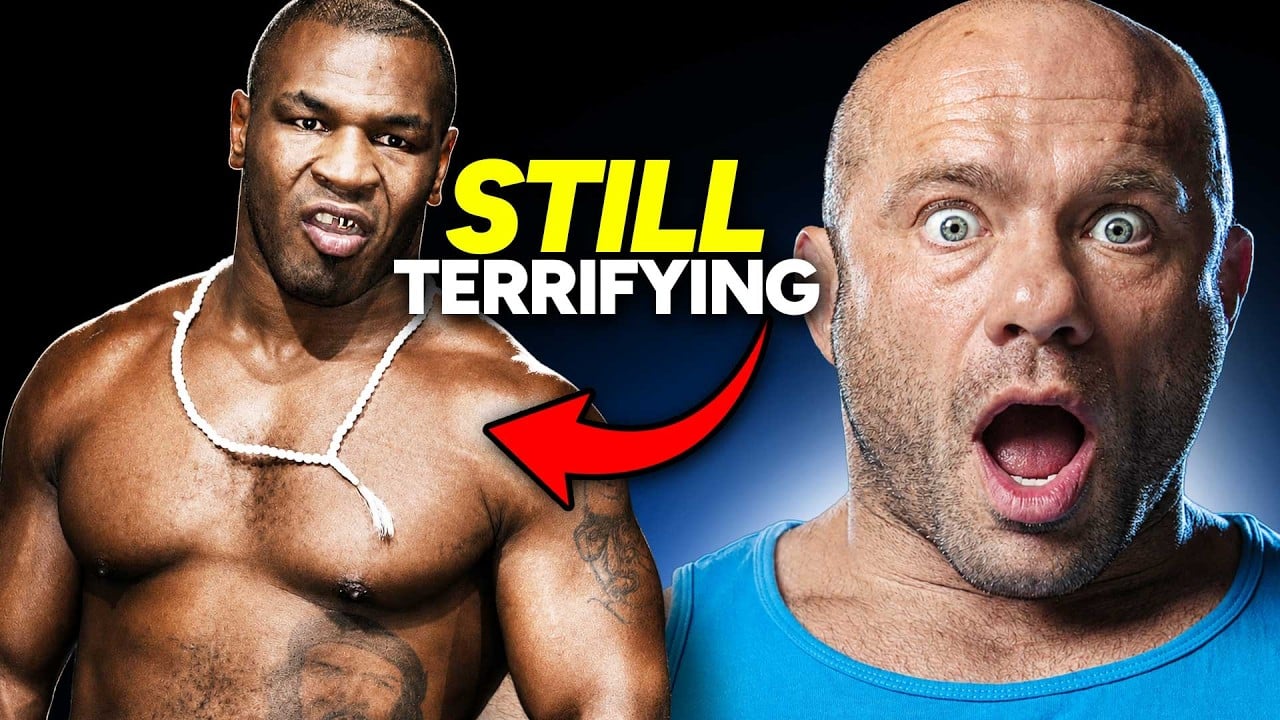
The analysis covers everything from punching power physics to age-related performance decline.
And the science behind why certain training methods transfer better to actual combat than others.
Jump to:
- The Physics Behind Tyson’s Knockout Power
- Age Versus Weight: The Mayweather Matchup Analysis
- Training for Combat Versus Bodybuilding
- Maximum Intent: The Missing Element in Athlete Training
- The Jake Paul Fight: Age as the Ultimate Opponent
- The Chaos of Real Combat
- Tyson’s Current Training Volume
- Key Takeaways for Combat Athletes
The Physics Behind Tyson’s Knockout Power
Body weight creates two distinct advantages in punching power, according to Israetel’s breakdown.
First, greater body mass means more cross-sectional area across pushing muscles—front deltoids, chest, and triceps. This directly translates to harder hits.

If you want something simple that actually works, this is one of the most effective tools I’ve used to build strength, conditioning, and endurance without needing a full gym setup.
- Full-body training with one weight using swings, squats, and presses
- Solid cast iron build that feels stable and lasts for years
- Comfortable grip that makes high-rep workouts easier to handle
Second, body weight acts as ballast behind each punch. When throwing a cross, fighters engage nearly their entire body mass. Heavier fighters generate more momentum, and when that punch connects, it transfers more energy into the target.
The ability to punch and knock someone out or do damage is massively, massively increased with increases in body weight.
At approximately 220-228 pounds, Tyson carries significant mass compared to lighter boxers. Floyd Mayweather, for comparison, typically fights around 150-160 pounds.
That 60-70 pound difference represents enormous striking advantage—if Tyson can land his punches.
Age Versus Weight: The Mayweather Matchup Analysis
Israetel acknowledges the 10-year age gap between Mayweather (49) and Tyson (59) creates massive complications for any potential matchup.
A decade represents significant physiological decline, especially at those ages.
However, Tyson’s weight advantage and lifetime of heavyweight boxing experience counter some of that deficit. Mayweather built his career as a lighter-weight technical boxer focused on defensive genius.
If you want something simple that actually works, this is one of the most effective tools I’ve used to build strength, conditioning, and endurance without needing a full gym setup.
- Full-body training with one weight using swings, squats, and presses
- Solid cast iron build that feels stable and lasts for years
- Comfortable grip that makes high-rep workouts easier to handle
Mike Tyson isn’t known as like a technical, like kind of exploratory boxer, stick and move. He’s known as someone who gets in real quick and does heavy damage.
The stylistic contrast makes prediction difficult. Mayweather’s evasiveness versus Tyson’s aggressive close-range power creates legitimate tension.
Training for Combat Versus Bodybuilding
Watching Tyson’s bench press training revealed critical differences between sport-specific and hypertrophy-focused lifting.
When Tyson’s trainer suggested slowing the eccentric (lowering) portion, Tyson continued explosive concentric (lifting) movements. Israetel explained why this approach optimizes combat performance.
Three Distinct Training Approaches
- Hypertrophy training: Controlled tempo both directions, focused on feeling target muscles work and accumulating fatigue
- Strength sport training: Moderate speed with perfect groove establishment, practicing efficient movement patterns under heavy loads
- Athletic power training: Controlled eccentric to prevent injury, explosive concentric with maximal intent to move
When Mike Tyson hits somebody, it’s the same process as lifting a dumbbell. And if he’s practicing lifting that dumbbell rapidly away from his chest, the transfer to how much force and power he’s going to be able to exert on another human being’s skull or liver is going to be the highest possible.
Tyson threw dumbbells with such force that his upper back lifted off the bench. This demonstrated both proper sport-specific technique and exceptional strength-to-weight ratio.
Maximum Intent: The Missing Element in Athlete Training
Israetel identified a common problem with athletes in weight rooms—lack of explosive intent.
Many athletes train hard at their sport but treat weight room work as simply “getting movements done.” They perform pull-ups, curls, and other exercises without the explosiveness that transfers to competition.
If you want something simple that actually works, this is one of the most effective tools I’ve used to build strength, conditioning, and endurance without needing a full gym setup.
- Full-body training with one weight using swings, squats, and presses
- Solid cast iron build that feels stable and lasts for years
- Comfortable grip that makes high-rep workouts easier to handle
Power development requires operating above 90% of peak power output. Below that threshold, athletes develop endurance rather than explosive capability.
The sprinting analogy clarifies this principle: running at 70% top speed builds endurance for middle-distance events, but never increases maximum sprint velocity.
During medicine ball slams, Tyson generated maximum force with clear intent to break the floor. Leisurely-paced medicine ball work accomplishes almost nothing—the ball isn’t heavy enough to build strength, and low-intensity sets don’t develop power or endurance.
The Jake Paul Fight: Age as the Ultimate Opponent
Tyson’s recent bout against Jake Paul demonstrated physiological realities no training can fully overcome.
Israetel acknowledged Paul as a legitimate fighter despite his social media background. However, prime-era Tyson versus current Paul would have been dramatically different.
Aging is a motherfucker, you guys. It slows your reflexes, slows your reaction time, makes you weaker, makes you less rapidly able to generate force, less powerful. And it makes your exhibition of smooth technique worse.
Tyson fought conservatively, maintaining tight guard and avoiding risky offensive combinations. Every punch thrown creates counter-strike vulnerability. Staying covered reduces knockout probability compared to opening up for aggressive attacks.
If you want something simple that actually works, this is one of the most effective tools I’ve used to build strength, conditioning, and endurance without needing a full gym setup.
- Full-body training with one weight using swings, squats, and presses
- Solid cast iron build that feels stable and lasts for years
- Comfortable grip that makes high-rep workouts easier to handle
This strategic approach likely reflected Tyson’s awareness of age-related limitations rather than any predetermined outcome.
The Chaos of Real Combat
Speculation about fixed fights ignores combat sport realities, according to both Israetel and martial artist Michael Jai White.
Real fighting happens with extreme speed and limited cognitive processing. Athletes experience tunnel vision rather than Matrix-like awareness of all opportunities.
There are hundreds of punches thrown. They both threw punches meant to knock each other out, plain and simple.
Choreographing realistic-looking fight scenes requires extensive practice. Hundreds of thrown punches with knockout intent cannot be reliably scripted while maintaining safety and authenticity.
Several exchanges in the Paul-Tyson fight could have ended in knockouts if timing or positioning shifted slightly—outcomes impossible to consistently control or predict.
Tyson’s Current Training Volume
At 59, Tyson reportedly maintains extraordinary conditioning work.
If you want something simple that actually works, this is one of the most effective tools I’ve used to build strength, conditioning, and endurance without needing a full gym setup.
- Full-body training with one weight using swings, squats, and presses
- Solid cast iron build that feels stable and lasts for years
- Comfortable grip that makes high-rep workouts easier to handle
I get up in the morning. I run 4 miles and I walk 10 miles. Then on that day I come back from my walk and I do 2,500 sit-ups.
While Israetel notes athletes sometimes exaggerate training numbers, the underlying commitment to volume work remains clear. Even discounted figures would represent significant cardiovascular and core endurance training.
This volume supports fight-specific conditioning without the joint stress of excessive sparring or heavy resistance work at an advanced age.
Key Takeaways for Combat Athletes
Weight room work must match sport demands. Controlled eccentrics prevent injury, but explosive concentrics with maximum intent transfer directly to striking power.
Body weight dramatically affects punching power through both increased muscle cross-section and momentum transfer during strikes.
Power development requires near-maximal effort. Training below 90% of peak power output builds endurance rather than explosive capability.
Age-related decline affects multiple systems—reflexes, reaction time, strength, power output, and technical execution all deteriorate over time.
If you want something simple that actually works, this is one of the most effective tools I’ve used to build strength, conditioning, and endurance without needing a full gym setup.
- Full-body training with one weight using swings, squats, and presses
- Solid cast iron build that feels stable and lasts for years
- Comfortable grip that makes high-rep workouts easier to handle
Strategic fighting adjusts for limitations. Conservative approaches can compensate for declining physical capabilities while minimizing catastrophic risk.
The scheduled Mayweather-Tyson matchup remains uncertain, already pushed back once due to Tyson’s hand injury. If it happens, expect significant financial stakes and unpredictable outcomes when elite defensive boxing meets legendary heavyweight power across a 10-year age gap.