Waking up with stiff hips and a tight lower back doesn’t have to be your daily reality.
A simple five-minute floor routine could be the solution you’ve been searching for.
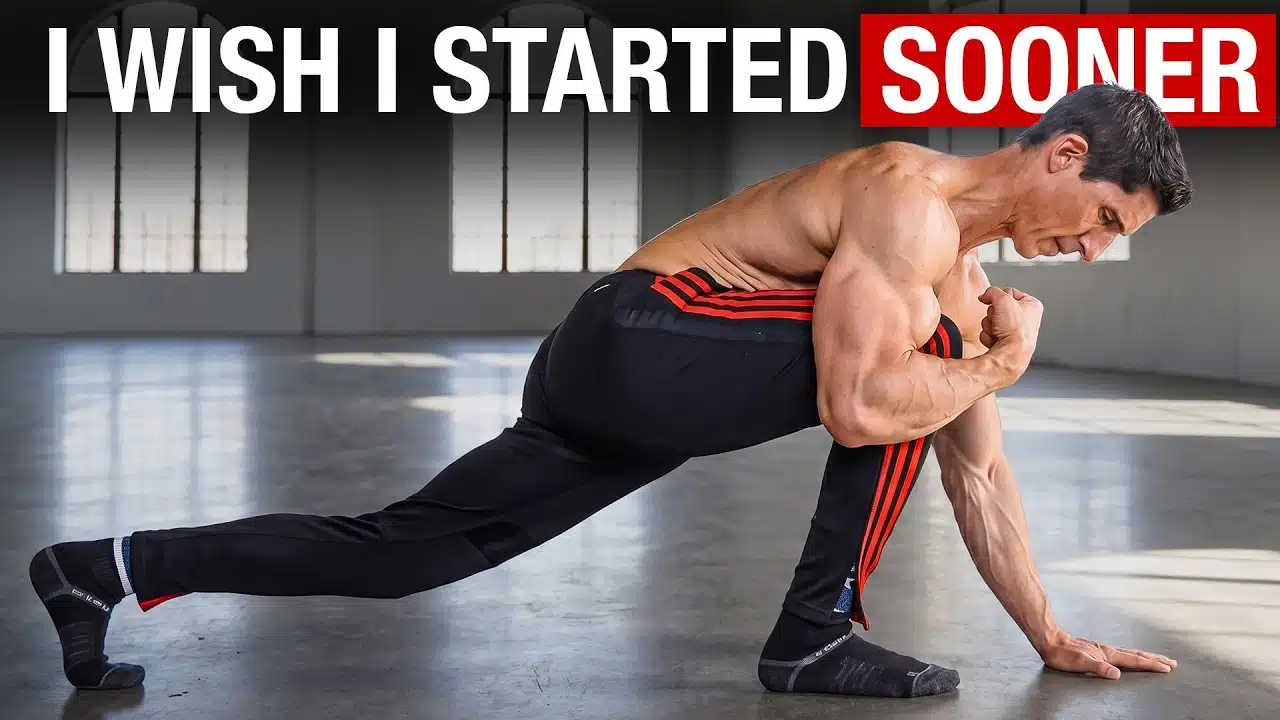
In a recent video, celebrity physical therapist and strength coach Jeff Cavaliere shared his go-to morning mobility sequence designed to combat the stiffness that accumulates overnight.
The best part? It requires minimal space and delivers maximum results when performed consistently.
Jump to:
- Why Morning Stiffness Happens (And Why You Should Care)
- Exercise 1: Hip Internal and External Rotation
- Exercise 2: QL Stretch for Lower Back Relief
- Exercise 3: Squat Reach for Thoracic Mobility
- Exercise 4: Dynamic Hamstring and Thoracic Combination
- Exercise 5: Hip Flexion and Extension Combo
- The Critical Window: Mobility Versus Degeneration
- Implementation Strategy
Why Morning Stiffness Happens (And Why You Should Care)
According to Cavaliere, the positions we hold during sleep create tightness in specific muscles and restrict joint mobility. Left unaddressed, these minor mobility issues can progress into something far more serious.
Hip internal rotation loss, for instance, serves as an early warning sign of hip degeneration. The goal is intervention before bone-on-bone conditions develop.

If you want something simple that actually works, this is one of the most effective tools I’ve used to build strength, conditioning, and endurance without needing a full gym setup.
- Full-body training with one weight using swings, squats, and presses
- Solid cast iron build that feels stable and lasts for years
- Comfortable grip that makes high-rep workouts easier to handle
Similarly, hip flexion becomes compromised as joints degenerate, making early action critical for long-term joint health.
Exercise 1: Hip Internal and External Rotation
Start on hands and knees in a tabletop position. This first movement targets a range of motion many people completely neglect.
Spin both knees to the left, then use your hand and the back of your elbow on the floor to push further into internal rotation. This drives the hip deeper into that rotational movement.
We know about internal rotation loss is it starts to happen as an early indicator of degeneration in the hip. So before it gets too late and that bone on bone condition starts, you want to be able to actually restore that motion.
Complete five repetitions on each side.
For external rotation, spin your knees in the opposite direction and use the inside elbow to push back, driving that hip into external rotation. The key is progressively increasing the range with each repetition.
Both movements occur from hip flexion position because hip flexion itself becomes limited as degeneration progresses.
If you want something simple that actually works, this is one of the most effective tools I’ve used to build strength, conditioning, and endurance without needing a full gym setup.
- Full-body training with one weight using swings, squats, and presses
- Solid cast iron build that feels stable and lasts for years
- Comfortable grip that makes high-rep workouts easier to handle
Exercise 2: QL Stretch for Lower Back Relief
The quadratus lumborum muscle—commonly called the QL—becomes notoriously tight during sleep, especially if you favor one sleeping position.
From the tabletop position, slide one leg back and drop that hip toward the floor while keeping your arm relatively straight. You’ll immediately feel the stretch along the side of your lower back.
Cavaliere explains that this hip-hiking muscle stays contracted in certain sleeping positions for hours, creating morning stiffness that this dynamic stretch effectively eliminates.
Alternate sides, dropping and bending through that muscle. Allow a big bend to occur naturally. Four to five repetitions per side should provide noticeable relief in the lateral lower back region.
Exercise 3: Squat Reach for Thoracic Mobility
Return to that deep hip flexion position—a stance many adults have lost the ability to comfortably maintain.
From a deep squat, post your arm against the inside of your leg for leverage, then rotate upward and reach as high as possible with the opposite arm.
If you want something simple that actually works, this is one of the most effective tools I’ve used to build strength, conditioning, and endurance without needing a full gym setup.
- Full-body training with one weight using swings, squats, and presses
- Solid cast iron build that feels stable and lasts for years
- Comfortable grip that makes high-rep workouts easier to handle
It’s really, really good. It’s really important and that’s why it’s here. You’re reaching and twisting and what this does is it really targets the thoracic mobility that area of your spine above your lower back.
Thoracic extension and rotation must be maintained to preserve natural spinal range of motion. When this area stiffens, forces shift to other spinal regions ill-equipped to handle them.
Prevention is infinitely easier than restoration. Complete five repetitions per side.
Exercise 4: Dynamic Hamstring and Thoracic Combination
Begin in a modified child’s pose position with arms extended. Sink your butt and chest down toward the ground, emphasizing thoracic extension through your midback.
From here, bring hands closer, plant feet down, and drive knees back as far as possible to dynamically stretch hamstrings. Press heels toward the floor if flexibility allows.
Tight calves will make heel contact challenging, but consistent practice improves this limitation over time.
This alternating movement pattern addresses two common problem areas simultaneously—tight hamstrings and restricted thoracic mobility. Five complete repetitions create significant change.
If you want something simple that actually works, this is one of the most effective tools I’ve used to build strength, conditioning, and endurance without needing a full gym setup.
- Full-body training with one weight using swings, squats, and presses
- Solid cast iron build that feels stable and lasts for years
- Comfortable grip that makes high-rep workouts easier to handle
Exercise 5: Hip Flexion and Extension Combo
Position one leg forward, the other extended behind you. Lean as far forward as possible, bringing chest toward the front knee to achieve deep hip flexion.
This position stretches hip flexors on the back leg while driving the front hip into maximal flexion—ideally achieving chest-to-knee contact.
Next, slide forward over the front leg, then push back off that leg. Allow hips to drive forward while hands and torso move backward, creating an exaggerated hip flexor stretch.
By elongating through the torso during this phase, you intensify the psoas stretch considerably. This movement pattern restores lost hip extension—a common casualty of prolonged sitting.
Complete five repetitions per leg, focusing on increasing range gradually.
The Critical Window: Mobility Versus Degeneration
Cavaliere emphasizes a crucial distinction throughout his demonstration: addressing mobility restrictions early prevents them from becoming degenerative issues.
If you want something simple that actually works, this is one of the most effective tools I’ve used to build strength, conditioning, and endurance without needing a full gym setup.
- Full-body training with one weight using swings, squats, and presses
- Solid cast iron build that feels stable and lasts for years
- Comfortable grip that makes high-rep workouts easier to handle
If you wait too long, you lose it. When you lose it, then you have a really hard time bringing it back and restoring that lost function. Once you start to lose the function and the mobility, it becomes something different. It becomes a degeneration issue rather than just a hip tightness or mobility lack.
Stiffness and limited range initially represent mobility problems with straightforward solutions. Ignored long enough, these same restrictions transform into structural degeneration that resists reversal.
Implementation Strategy
This five-exercise sequence requires nothing more than floor space and five minutes. Consistency matters more than perfection.
Morning implementation makes particular sense since the routine directly addresses overnight tightness. However, any consistent daily timing delivers results.
- Total time commitment: 5 minutes daily
- Equipment needed: None
- Space required: Minimal floor area
- Recommended frequency: Daily, preferably upon waking
- Expected timeline for results: Noticeable improvement within days
The progressive nature of these movements means range increases with repetition. What feels challenging initially becomes easier as mobility improves.
For those experiencing persistent stiffness despite reasonable activity levels, this targeted approach addresses root causes rather than symptoms. Joint health represents an investment—one that pays dividends in sustained function and reduced pain as years accumulate.