The bench press has long been seen as the gold standard of upper body strength. But when someone asks, “How much should the average man be able to bench press?”—the answers are all over the place.
In this video, former World’s Strongest Man Mitchell Hooper breaks down the truth behind the numbers.
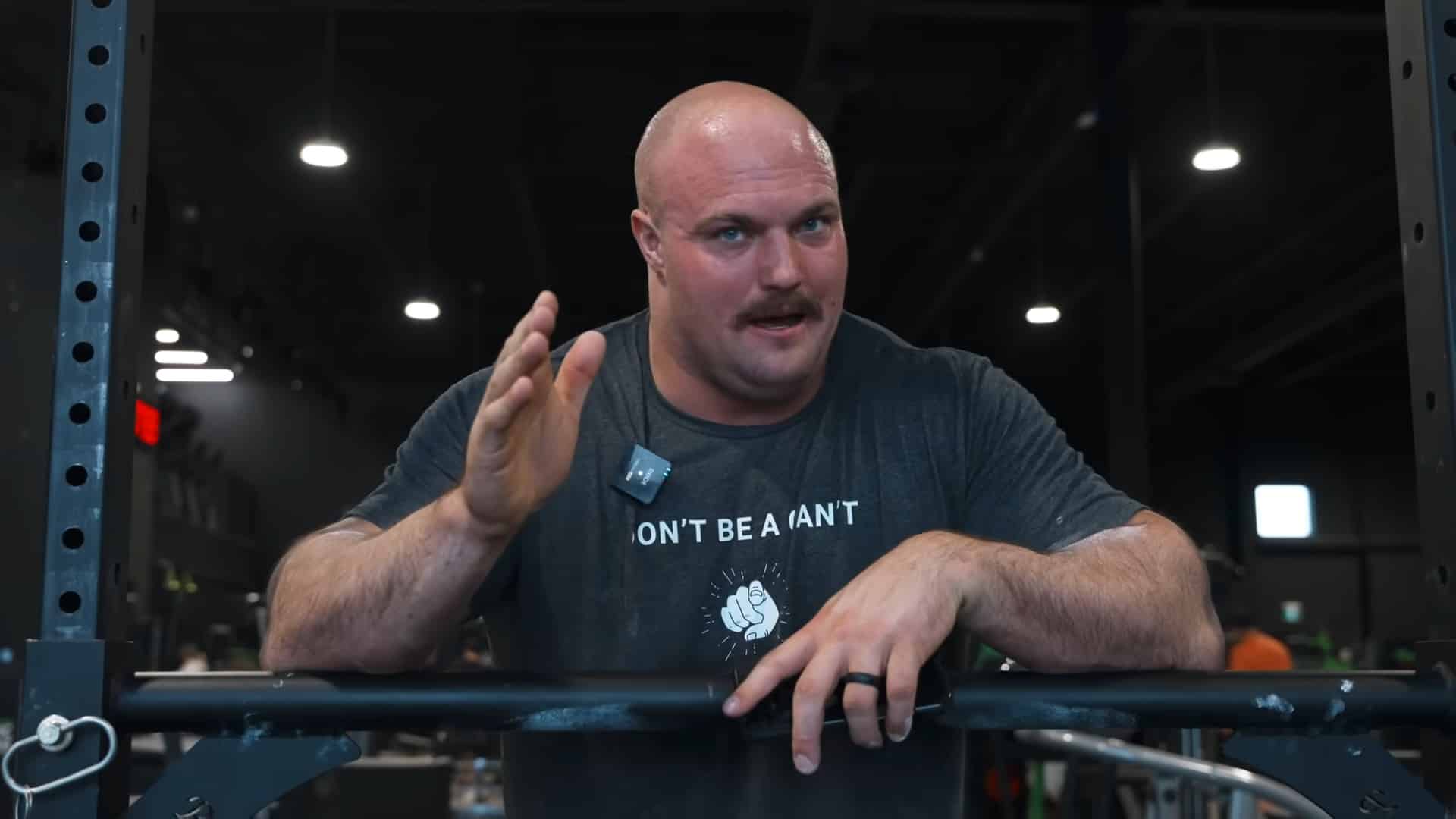
From the origins of the lift to the current world records, gym-floor opinions to expert data, he explores what the average man can bench—and what he should aim for with consistent training.
Backed by research, real-world experience, and no-nonsense analysis, Hooper separates myths from realistic expectations.
This isn’t about ego or unrealistic goals. It’s a practical guide for lifters of all levels to understand where they stand and how to improve.
Whether someone’s just getting started or looking to benchmark their progress, this is everything they need to know about the bench press, minus the hype.
Jump to:
- The Origins of the Bench Press: It Didn’t Start on a Bench
- The Evolution of the Bench Press Record
- The Wide Range of Public Opinion
- What Experts and Research Say
- Let’s Clarify: “Can” vs. “Should”
- Why Gym Perception May Skew Expectations
- What Role Do Genetics and Body Weight Play?
- So, What’s the Final Verdict?
- Final Thoughts: Lift Heavy, Be Kind
The Origins of the Bench Press: It Didn’t Start on a Bench
The bench press may be a Monday gym tradition now, but it didn’t start that way. Its roots began with the pullover and press, a movement where lifters started with the barbell on the floor behind their head and pressed it overhead. One of the earliest strongmen, George Hackenschmidt, reportedly pulled off over 300 pounds using this variation.
The next evolution was the floor press—exactly as it sounds, pressing from the floor without a bench, reported as early as 1899. Hackenschmidt again held records here, achieving a 362-pound press, a record untouched for 17 years until 1916.
By the 1920s, lifters began using homemade benches, and by 1939, rules were introduced to prevent “belly-tossing”—a technique where lifters would use momentum and arching to drive more weight up. Through the decades, modifications in rules, technique, and gear kept influencing the numbers seen on the bar.
The Evolution of the Bench Press Record
- 1973: Don Reinhoudt sets the first raw bench press record under the IPF at 580 lbs after rule restructuring.
- Current Equipped Record: As of 2023, the equipped bench press record stands at a mind-bending 1,041 lbs.
- Current Raw Record: Held by Julius Maddox at 783 lbs, with sights on being the first to hit 800 raw.
While it’s fascinating to see what the human body can achieve at the elite level, the reality is that most people will never come close to these numbers—which brings us back to the average man.
The Wide Range of Public Opinion
To get a closer look at what people believe the average man should bench, we hit the gym floor. Responses ranged from a humble 95 lbs to a very ambitious 405 lbs.
Here are some highlights:
- “At least 135 pounds”
- “185 would be optimal”
- “Double your bodyweight—wait, scratch that…”
- “200 to 225 pounds feels realistic”
- “Honestly, closer to 80 pounds for a lot of guys”
The average of all responses collected? 151 pounds for a one-rep maximum. But even that number only tells part of the story.
What Experts and Research Say
Let’s add some actual data to compare with these estimates. In a 2023 article by Shane Deette and Marco Walker, they suggest the average man should be able to bench press 175-185 lbs for a one-rep max. However, they base this on a man weighing 140 kilograms (that’s over 300 lbs), which doesn’t quite align with the average body weight.
Jeff Nippard, a respected science-based fitness YouTuber, puts beginners in these categories:
- True novices: 45–95 lbs
- Beginners with consistency: 135–185 lbs
It’s clear: the figure shifts significantly depending on whether we’re measuring what a man currently can bench—or what he should aim to bench with regular training.
Let’s Clarify: “Can” vs. “Should”
According to real-world trainers and personal experience, most untrained men will bench under 100 lbs the first time they try the lift. Somewhere between 80–90 lbs is common for a single rep. But how much should the average man aim for after consistent training?
Here’s a fair breakdown of realistic progress with regular training (2–3x per week for 6–12 months):
| Experience Level | Body Weight (lbs) | 1RM Bench Target |
|---|---|---|
| Beginner | 150–190 | 135–185 lbs |
| Intermediate | 150–190 | 185–225 lbs |
| Advanced | 150–190 | 225–315 lbs |
So, if you’re relatively active, regularly hitting the gym, and not dealing with limiting injuries, aiming for a 185 to 225 lb bench press after several months to a year of training is reasonable—and achievable.
Why Gym Perception May Skew Expectations
Walk into any gym and ask people how much a man should bench and you’ll likely hear inflated numbers. That’s due to “selection bias”—those already lifting tend to project their own standards onto others. This creates an unrealistic view of where beginners actually start.
“Too often, we think everyone else is stronger than they are,” says one trainer. “But most people walking into the gym are deconditioned, sedentary, or brand new to strength training.”
What Role Do Genetics and Body Weight Play?
Men with longer arms or leaner body types may find the bench press more difficult, while heavier men with shorter limbs may move more weight early on. Genetics absolutely influence how quickly someone progresses.
That’s why goals should be personal and tailored—not based on what others are doing. Lifting should always be about progress, not ego.
So, What’s the Final Verdict?
If you’re the “average man”—moderately active, not competitive, and not training with dedicated frequency—your first 1RM bench press might hover around 95–115 lbs.
However, you should be able to build up to bench pressing 185 to 225 lbs with consistent effort over 6–12 months. Hitting “a plate and a quarter” (185 lbs) is a great first milestone for most.
As mentioned in the popular “Jelly Bean study”, the crowd’s averaged guess is usually better than any individual. With our informal polling landing around 151 lbs, it seems that collective wisdom might not be far off after all.
Final Thoughts: Lift Heavy, Be Kind
The bench press is more than just a number. It’s a journey—one that should build confidence, not shame. Your only competition is yourself.
Through consistent practice, smart programming, and the right mindset, most men can hit a solid bench press and feel proud doing it. So whether your number is 95 or 225, keep pushing forward.
Want to be part of a more inclusive fitness community? Check out the Lift Heavy, Be Kind gear to show you support everyone’s journey at the gym—no ego, all effort.