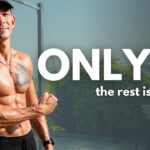
When bodybuilder and fitness influencer Laz Angelov traveled to Las Vegas just days after the Mr. Olympia competition, he wasn’t expecting a typical leg day.
He was training with someone who might possess the most genetically gifted legs in bodybuilding history.

Rubiel “Neckzilla” Mosquera, the Colombian bodybuilder with a documented myostatin deficiency, brought Angelov through an intense leg session that revealed not just freakish muscle size, but surprising mobility, strategic training wisdom, and the challenges of competing with a body that simply won’t stop growing.
What unfolded was a masterclass in calf training, leg development, and what it’s really like living with one-in-a-million genetics.
Jump to:
- The One-in-a-Million Genetic Anomaly
- Training Twice Weekly Despite Uncontrollable Growth
- The Shocking Diet Reality
- Flexibility Training: The Secret Weapon
- The Calf Training Technique That Changes Everything
- Weight Selection Philosophy: Control Over Numbers
- The Dirty Bulk Experiment
- Competing With Uncontrollable Genetics
- Practical Takeaways For Natural Lifters
- The Future of Mosquera’s Bodybuilding Career
The One-in-a-Million Genetic Anomaly
Mosquera isn’t just another massive bodybuilder with impressive legs. He has a confirmed myostatin deficiency, a genetic condition that affects approximately one in one million people.
Myostatin is a protein that regulates muscle growth by preventing muscles from growing too large. Without proper myostatin function, muscle tissue grows with far less limitation than normal.
The myostatin hormone, I have a problem for that. So if you were training a big muscle, man, no control. It’s no control for me, it’s a problem. One in a million people, one person has this problem.
This genetic quirk means Mosquera’s body builds muscle tissue at an accelerated rate compared to typical bodybuilders. His legs, particularly his calves and quadriceps, have reached proportions rarely seen in professional bodybuilding.
During their workout at Colt Fitness in Vegas, Angelov noted that Mosquera’s basketball shorts—designed to be loose—were tight on his massive legs. His calves alone rival most bodybuilders’ quadriceps in circumference.
Training Twice Weekly Despite Uncontrollable Growth
Despite what many assume when seeing Mosquera’s physique, he doesn’t train legs with excessive volume or frequency.
He trains legs twice a week. So sometimes people are saying he never does quads for the big size. But he trains legs twice a week.
This revelation surprised Angelov, who expected Mosquera would need more frequent training to maintain such development. The reality is quite opposite—Mosquera must actually limit his leg training to maintain balance with his upper body.
Judges at the Olympia have been clear about what they want to see from him moving forward. According to his translator and training partner, the feedback focuses on conditioning rather than size.
More condition in the quads. It’s so hard when you have a big size in your legs to find the great condition for the difference between other competitors. They don’t want to say I need more muscle in my legs. I need more in my shoulder, my chest, my back. Balance.
The Shocking Diet Reality
Perhaps even more surprising than Mosquera’s training frequency is his caloric intake during contest prep.
At approximately 133 kilograms (293 pounds) of stage-ready muscle, Mosquera maintains his physique on 5,000 to 7,000 calories daily—even while dieting for competition.
His food sources remain straightforward and clean:
- Rice and rice cream
- Sweet potato
- Chicken breast
- White fish
- Standard bodybuilding staples
By comparison, Angelov revealed his own contest prep involved consuming just 1,200 calories daily for an entire month before his bodybuilding show.
For me, when I was trying to cut for my show, I was around 175, 180 pounds when I started. 1,200 calories for the whole day, every day for a month.
The stark difference illustrates how Mosquera’s myostatin deficiency affects his metabolism. His body requires substantially more energy to maintain muscle tissue, even during aggressive fat loss phases.
Flexibility Training: The Secret Weapon
One aspect that shocked Angelov during their session was Mosquera’s impressive mobility despite carrying such extreme muscle mass.
Mosquera demonstrated deep squat positions and flexibility that many lighter athletes struggle to achieve. When asked about his stretching routine, his answer was simple but consistent.
Ten minutes after cardio. Only ten minutes. But you’re consistent every workout.
This daily commitment to mobility work has allowed Mosquera to maintain functional range of motion despite his quadriceps being so massive that finding leg extension machines that accommodate them presents a genuine challenge.
Angelov, who spent 30 minutes on mobility work during his powerlifting career, acknowledged the importance of Mosquera’s consistency. Even brief daily stretching, when performed without fail, produces remarkable results over time.
The Calf Training Technique That Changes Everything
During their calf raises, Mosquera revealed a technique that most gym-goers overlook—and it might explain why his calves have reached otherworldly proportions.
Rather than performing standing calf raises with locked knees, Mosquera maintains a slight bend in his knees throughout the movement.
If you have straight legs like this, not good contraction. You have compression. You need to focus on the calves. If you feel tension in your tendons, you have tension in the wrong place. To feel that tension in the muscle, you need to bend the knee.
This subtle adjustment shifts tension away from connective tissue and onto the gastrocnemius and soleus muscles themselves. The bent-knee position allows for:
- Greater muscle contraction without relying on heavy weights
- Reduced tendon stress that can lead to Achilles problems
- Better mind-muscle connection throughout the range of motion
- Sustained time under tension rather than momentum-based reps
Mosquera emphasized that feeling the muscle working matters far more than moving heavy weight. His sets extended to 10-15 controlled repetitions with deliberate one-second pauses at peak contraction.
Weight Selection Philosophy: Control Over Numbers
Throughout their leg session, Mosquera demonstrated a training philosophy focused on muscle contraction quality rather than chasing arbitrary weight milestones.
On leg presses, hack squats, and accessory movements, Mosquera selected weights that allowed complete control through full ranges of motion. His translator explained the approach clearly.
It’s only contraction, you know. No need more weight than this. You don’t need more weight. You want to feel contraction in your calves.
This methodology challenges the common belief that freakishly large bodybuilders must constantly lift maximum poundages. Instead, Mosquera’s genetic advantage allows him to stimulate growth with moderate weights and perfect execution.
The strategy also reduces injury risk—critical for someone whose muscle tissue already grows aggressively without the stimulus of extreme mechanical tension.
The Dirty Bulk Experiment
During their conversation, Angelov and Mosquera discussed an intriguing experiment: what would happen if Mosquera consumed 10,000-12,000 calories daily from “dirty” junk food sources?
Angelov shared his own experience attempting a 10,000-calorie daily diet for two weeks, which caused him to balloon from 115 kg to 135 kg—a 20-kilogram (44-pound) gain in just 14 days.
However, Mosquera revealed something unexpected about his own body’s response to food quality.
When he eats dirty food, the body weight goes down. And when he eats healthy food, it goes up.
This counterintuitive reaction suggests that Mosquera’s digestive system doesn’t efficiently absorb nutrients from processed foods. Clean protein sources, complex carbohydrates, and whole foods allow his unique physiology to actually utilize the calories consumed.
Poor-quality nutrition, despite being calorie-dense, passes through without providing the building blocks his muscle tissue requires. This phenomenon explains why he maintains such strict nutritional discipline even at caloric intakes that would cause most people to gain excessive body fat.
Competing With Uncontrollable Genetics
Mosquera’s journey in competitive bodybuilding presents unique challenges that typical competitors never face.
While most bodybuilders struggle to add muscle tissue and maintain it during contest prep, Mosquera must actively prevent certain body parts from overshadowing others.
His myostatin deficiency means that training a muscle group can trigger growth that’s difficult to control or reverse. This creates a delicate balancing act where he must:
- Limit leg training volume to prevent further lower body dominance
- Emphasize upper body development to achieve better proportions
- Focus on conditioning and detail rather than pure size
- Manage nutrition meticulously to control where growth occurs
Despite these challenges, Mosquera qualified for and competed at the Mr. Olympia—the pinnacle of professional bodybuilding—demonstrating that even “too much muscle” can be managed with intelligent programming.
Practical Takeaways For Natural Lifters
While most people don’t share Mosquera’s genetic advantages, several principles from his training apply universally:
Consistency Beats Intensity
Mosquera’s 10-minute daily stretching routine produces better mobility than sporadic longer sessions. Small daily habits compound over months and years.
Mind-Muscle Connection Matters
His emphasis on feeling muscle contraction rather than moving maximum weight represents sound training philosophy. Ego lifting builds ego, not muscle.
Technique Subtleties Create Results
The bent-knee calf raise adjustment demonstrates how small positioning changes dramatically affect which tissues receive tension. Experimentation with angles, tempos, and ranges of motion can unlock stubborn body parts.
Food Quality Impacts Body Composition
Even with extreme genetics, Mosquera must eat clean whole foods to achieve his physique. Junk food provides calories without building blocks for quality muscle tissue.
Recovery Determines Progress
Training legs twice weekly produces Mosquera’s development. More isn’t always better—adequate recovery between sessions allows adaptations to occur.
The Future of Mosquera’s Bodybuilding Career
Following his Olympia appearance, Mosquera continues refining his physique based on judges’ feedback.
His focus has shifted toward bringing up his upper body to match his leg development, while achieving the extreme conditioning required at bodybuilding’s highest level.
He’s also opening a new gym facility in Colombia, where Angelov plans to attend the grand opening. This venture will allow Mosquera to share his unique knowledge with aspiring bodybuilders while continuing his competitive journey.
For someone competing with a genetic condition that makes muscle control challenging, Mosquera’s progress demonstrates remarkable discipline. His willingness to limit what grows easiest (legs) to develop proportionality shows maturity beyond his relatively short competitive history.
The bodybuilding world will be watching closely to see how far the man with the biggest legs on Earth can go.