Navy SEALs don’t accept weakness as inevitable.
DJ Shipley, a retired Navy SEAL with 17 years as a tier 1 operator, has spent recent years proving that men over 40 can build serious strength using just three strategic exercises.
These aren’t random movements plucked from fitness magazines—they’re battle-tested exercises used by elite SEAL trainers to maintain peak performance while minimizing injury risk.
What makes Shipley’s approach different is his belief that your 40s aren’t about managing decline, but about building strength intentionally and intelligently.
Jump to:
Shipley’s philosophy stems from practical experience rather than academic theory. He understands that most men over 40 already have injuries stacked up from years of life and training.
Your physical readiness, it can’t be ignored. That is the one thing that everyone should be able to count on.
His approach prioritizes exercises that deliver maximum results with minimal injury risk. The goal isn’t to break your body down—it’s to build confidence and capability that lasts.
Exercise One: Trap Bar Deadlifts
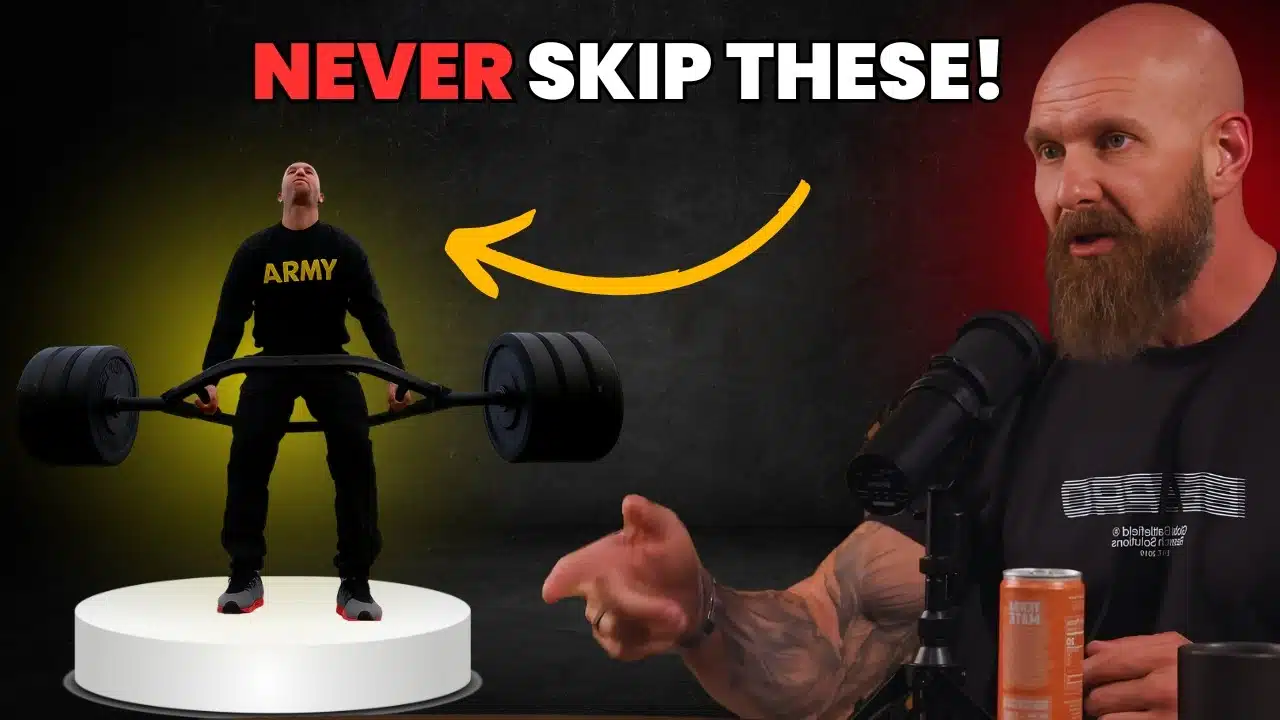
Trap bar deadlifts stand apart from traditional barbell deadlifts in one critical way: they keep weight closer to your center of gravity.
With standard barbells, weight sits in front of your body, shifting excessive stress onto your lower back. Trap bars eliminate this problem entirely.
We use a trap bar because the majority of guys in that career, they’ve already got some injuries stacked up. The big thing we push in that program is we want you to be able to train 52 weeks out of the year.
By standing inside the hexagonal bar, force distribution becomes balanced across your entire posterior chain. Your back, hips, glutes, and legs work together rather than your spine bearing the brunt.
How to Execute Trap Bar Deadlifts Properly
Step inside the trap bar with feet shoulder-width apart. Bend your knees slightly while grabbing handles at your sides.
Keep your chest up and core engaged throughout. Drive through your heels, extending hips and knees simultaneously.
- Starting position: Weight should feel centered, not pulling you forward
- Movement pattern: Bar travels in a straight vertical line from ground to standing
- Speed: Controlled and deliberate—never jerky or rushed
- Progression: Start light, master form, then add weight gradually
SEAL trainers even elevate the starting position using bumper plates for men with longer torsos, further reducing lower back strain.
We’re trying to increase your confidence, never decrease it.
Most men experience significant strength improvements within 6-8 weeks of consistent training. The key is patience with progression rather than ego-driven weight jumps.
Exercise Two: Pull-Ups
Pull-ups terrify many men over 40, and for understandable reasons. If you haven’t done one in years, hauling your full body weight feels impossible.
But here’s what Navy SEALs know that most people don’t: pull-up strength is rebuildable at any age.
Shipley himself proved this after suffering a severe shoulder dislocation requiring major reconstructive surgery. Working with trainer Vernon Griffith, he rebuilt from absolute zero.
Day one, he’s like, “Okay, let’s try to hang from the bar.” I looked right at him. No. I’m done. I’ve done more pull-ups than most people on the planet. My pull-up days are done, man.
Initially, Shipley couldn’t even extend his arm overhead. Through patient progression, he eventually reached sets of 25 pull-ups at 215 pounds bodyweight—at age 61.
Building Pull-Up Strength from Zero
Progression matters more than perfection. Start with resistance bands looped over the pull-up bar.
Place your foot or knee in the band. Pull yourself up as much as possible while the band provides assistance.
- Week 1-4: Heavy resistance band, focus on full range of motion
- Week 5-8: Medium resistance band, increase time under tension
- Week 9-12: Light resistance band or assisted pull-up machine
- Week 13+: Unassisted pull-ups with perfect form
Proper form means grabbing the bar slightly wider than shoulder width. Dead hang with straight arms, then pull elbows down and back.
Raise your body until chest nearly touches the bar. Lower under complete control—no swinging or momentum.
Pull-ups build functional strength that translates directly to real life. Helping someone up, climbing obstacles, or pulling yourself over anything all require this movement pattern.
Do you want to go another 40 years without doing a pull-up?
Exercise Three: Farmer’s Carry
This exercise sounds almost too simple to be effective. Pick up heavy weights and walk with them.
Yet this deceptively straightforward movement builds grip strength, core stability, and mental toughness simultaneously.
We do a farmer’s carry. So, with your body weight, if you weigh 200 pounds, you have 100 pound dumbbell in each hand. You get up and you walk it as far as you can.
Elite-level performance in SEAL training programs means carrying half your bodyweight in each hand for 250-300 feet. That’s not easy, but it’s achievable with consistent training.
Why Grip Strength Matters More Than You Think
Shipley emphasizes grip strength constantly because it’s fundamental to nearly every physical task.
If I’m trying to manipulate a full-grown man through time and space against their will, your grip is a key factor in that.
Farmer’s carries work your forearms, shoulders, back, and core. They teach your body to maintain rigidity under load, which translates to better posture and injury prevention.
Unlike isolation exercises, this movement is functional. Carrying groceries, moving furniture, or helping someone—all require this exact strength pattern.
How to Execute Farmer’s Carries
Pick up dumbbells or kettlebells in each hand. Keep shoulders back, chest up, core tight.
Walk. That’s it.
- Beginners: 50-100 feet with moderate weight
- Intermediate: 150-200 feet with challenging weight
- Advanced: 250+ feet with half bodyweight per hand
Consistency matters more than distance or weight. Perform farmer’s carries once or twice weekly, and strength gains come surprisingly fast.
Starting Your Strength Journey After 40
These three exercises provide your foundation. They’re not random—they’re specifically chosen to build functional strength while minimizing injury risk.
Start where you are right now. Use bands on pull-ups. Choose lighter weights than ego suggests. Focus on consistency over perfection.
Your body adapts quickly when given consistent stimulus. Within weeks, you’ll feel noticeable improvements. Within months, you’ll surprise yourself.
If you think you’re a real asset to your family, why wouldn’t you try to maximize that time? You don’t have to be David Goggins. You can wake up and do a 20-minute walk every single day and you’ll be better off for it.
Shipley’s message isn’t about extreme transformation. It’s about intentional action toward longevity and capability.
Age and previous injuries aren’t permanent barriers—they’re simply starting points. The question isn’t whether you can build strength after 40.
It’s whether you’re willing to start.