Achieving Brad Pitt’s iconic Fight Club physique doesn’t require fancy equipment or complicated workout splits.
In fact, according to one fitness coach, the secret lies in doing the exact opposite of what most gym-goers do.
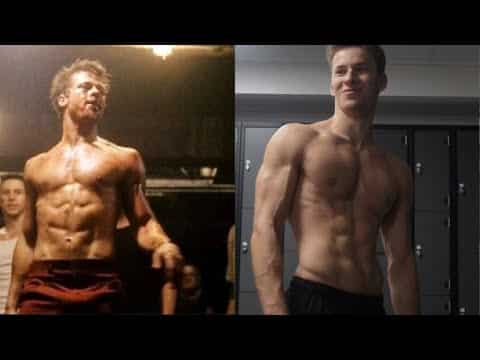
Instead of juggling dozens of exercises and machines, he built his lean, muscular physique using just one or two calisthenics movements per session—trained with brutal intensity.
The results? A shredded, functional physique that turns heads without the bloat.
Jump to:
- Why Calisthenics Build That Fight Club Look
- The Radical Simplicity Approach
- The Intensity Protocol That Changes Everything
- Why Most Gym Programs Actually Hold You Back
- The Real Secret: Intensity Over Volume
- Applying This Approach With Weights
- The Body Fat Component
- Why This Works When Complex Programs Fail
- The Adaptation Principle
Why Calisthenics Build That Fight Club Look
Calisthenics movements create exactly the kind of lean, defined musculature that made Brad Pitt’s Tyler Durden physique legendary.
The coach explains that bodyweight exercises naturally build a stronger core because every single rep requires core engagement for stabilization. Push-ups, dips, pull-ups, muscle-ups—they all force abs and lower back muscles to work overtime.
You’re going to get a really strong core if you’re constantly training calisthenics movements over and over again. Why? Because these movements require your core to be engaged as you’re executing them.
When combined with maintaining lower body fat, this constant core activation creates that chiseled, athletic aesthetic rather than the bulky, bodybuilder look.
The Radical Simplicity Approach
Here’s where things get unconventional.
Instead of the typical bodybuilding approach of hitting multiple exercises per muscle group, this coach structured his training around just two exercises per workout.
Sample Push Day
- Weighted dips
- Handstand push-ups
That’s it. Nothing else.
Sample Pull Day
- Muscle-ups
- Pull-ups
Again, just two movements.
I know I’m only doing two exercises so I can give everything I have to those two exercises and train them to complete failure, train them to a very intense level.
This radical simplification eliminates what the coach calls “decision fatigue”—that mental exhaustion from trying to figure out which exercises to do, how many sets, whether you’re hitting all muscle groups correctly.
The Intensity Protocol That Changes Everything
Simplicity alone won’t build muscle. Intensity will.
The coach structures each workout like one massive drop set, progressively fatiguing muscles through three distinct phases.
Phase 1: Heavy and Low Reps
Start with weighted pull-ups or muscle-ups using significant additional weight. Rep range: 2-3 reps.
Complete several sets at this weight, focusing on maximum strength development.
Phase 2: Moderate Weight, Higher Volume
Drop weight to approximately half. Same exercise, but now hitting 8-10 reps per set.
This phase bridges strength and hypertrophy training.
Phase 3: Bodyweight to Failure
Strip all added weight and perform bodyweight pull-ups until absolute muscular failure.
This final burnout phase maximizes muscle fiber recruitment and metabolic stress.
It’s like the whole workout’s like a massive intense drop set.
The same protocol applies to push days: heavy dips, moderate dips, bodyweight dips to failure.
Why Most Gym Programs Actually Hold You Back
Commercial gyms pack their floors with countless machines and equipment options. Seems beneficial, right?
Not according to this coach.
The gym is a business. And they need to charge you a certain amount for a membership. So if you go to the gym and you only find yourself with a pull-up bar and a barbell, well, you’re going to think that’s a terrible gym.
All those options create paralysis by analysis. Trainees spend mental energy deciding between exercises instead of channeling that energy into training intensity.
The result? People do many exercises moderately well instead of a few exercises exceptionally well.
The Real Secret: Intensity Over Volume
Building muscle fundamentally comes down to one variable: training intensity.
Not exercise variety. Not fancy equipment. Not five-day splits with 20+ exercises per week.
If your body is working hard, it will have to adapt. If it’s not working hard, it doesn’t matter what you’re doing. You could be doing the most optimized workouts in the world.
This principle explains why calisthenics athletes often display such impressive physiques despite limited exercise selection. Their options are constrained, so they master what they can do—and push those movements to absolute limits.
Applying This Approach With Weights
Prefer barbells and dumbbells over bodyweight training? The same principles apply perfectly.
Select just a few compound movements and execute them with maximum intensity using the drop set protocol.
Key Implementation Strategies
- Pick 2-3 exercises maximum per session
- Execute drop sets progressing from heavy/low-rep to light/high-rep
- Track progress meticulously to ensure progressive overload
- Train to genuine failure, not just discomfort
- Leave feeling legitimately fatigued, not just like you checked boxes
The coach emphasizes that individual programming should account for experience level, genetics, and current strength capabilities. Cookie-cutter programs ignore these critical variables.
The Body Fat Component
Building lean muscle represents only half the Fight Club physique equation.
Maintaining lower body fat percentages allows that hard-earned muscle definition to actually show. Brad Pitt’s iconic look wasn’t about massive size—it was about visible muscularity with minimal fat covering.
The combination of intelligent, intense training with proper nutrition creates that coveted aesthetic: athletic, functional, and lean rather than bulky.
Why This Works When Complex Programs Fail
Spending hours cycling through machines and isolation exercises often produces mediocre results because intensity gets diluted across too many movements.
You might complete four sets of ten different exercises, but none receive the focused, brutal intensity required for adaptation.
You can spend hours in the gym doing different exercises, four sets of each, and you may not get anywhere because you’re not training hard enough.
Limited exercise selection forces quality over quantity. When options narrow, execution must improve.
The Adaptation Principle
Human physiology operates on a simple principle: bodies adapt to imposed demands.
Challenge muscles intensely, and they grow stronger and larger to meet future challenges. Fail to provide sufficient stimulus, and adaptation simply doesn’t occur—regardless of exercise selection or program “optimization.”
If it’s not working hard, it does not need to adapt. It will not need to reinvent itself to obtain a hardworking physique.
This fundamental truth cuts through fitness industry noise and complicated programming. Make your body work hard, and it responds. Go through motions without genuine intensity, and results remain elusive.
The Fight Club physique isn’t built in chrome-plated machines or through Instagram-worthy exercise variety. It’s forged through simplicity, consistency, and the kind of intensity that leaves you genuinely questioning whether you can complete another rep.