Neck training often gets overlooked in the gym, but it deserves more attention than most people give it.
Popular fitness educator recently broke down the fundamentals of effective neck strengthening in a comprehensive guide that challenges common misconceptions.
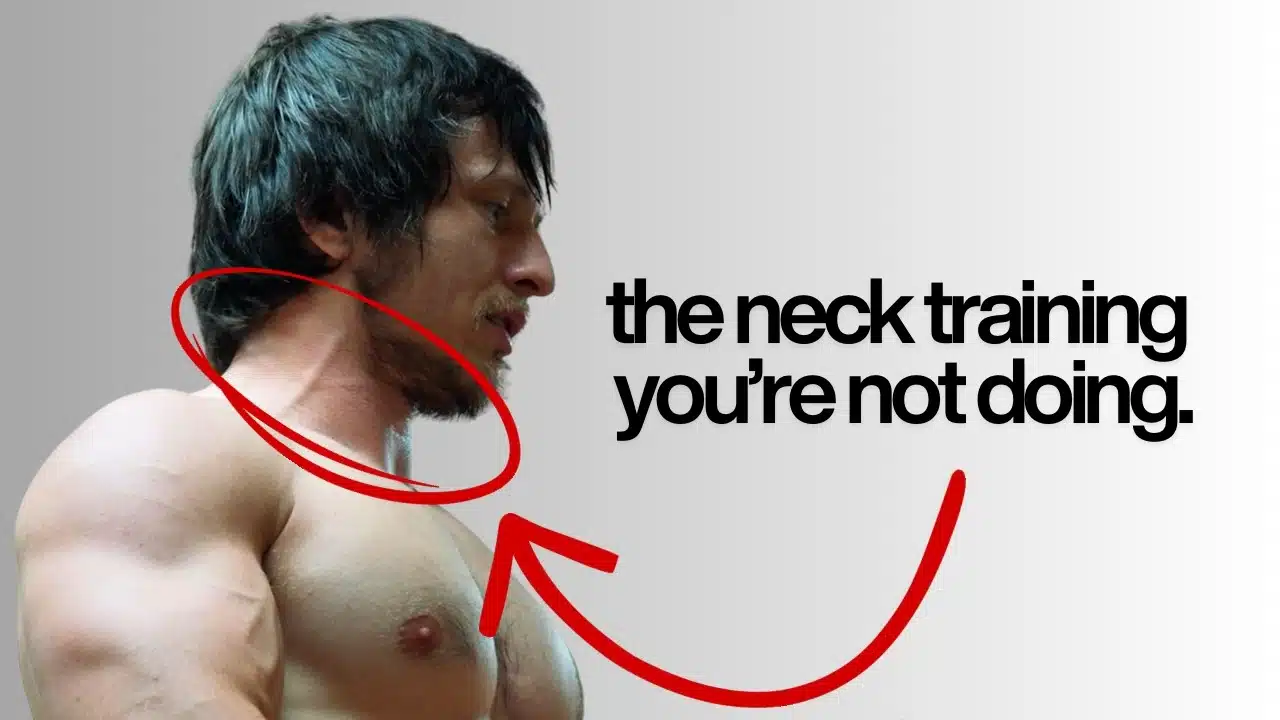
While many assume neck training mirrors core work—hitting flexion, extension, rotation, and lateral movement—the anatomy tells a different story.
Understanding these differences could transform how you approach building a stronger, more resilient neck without expensive equipment or overcomplicated routines.
Jump to:
- Why Your Neck Isn’t Just a Smaller Core
- Optimized for Control, Not Brute Force
- The Two-Exercise Solution
- Equipment: Fancy Harnesses vs. Your Hands
- The Practical Programming Approach
- Minimum Effective Dose
- Addressing the Fear Factor
- The Deep Neck Flexor Debate
- Can Neck Training Help Headaches?
- When to Add Rotation and Lateral Work
- What About Wrestler’s Bridges?
- The Concussion Question
- Sleep Apnea Concerns
- The Simple Starting Point
Why Your Neck Isn’t Just a Smaller Core
The trunk and neck both move through multiple planes of motion, but they’re built fundamentally differently.
With core muscles, there’s clear specialization. The rectus abdominis handles flexion. Obliques take care of rotation and side bending. Each muscle has its dedicated job.

If you want something simple that actually works, this is one of the most effective tools I’ve used to build strength, conditioning, and endurance without needing a full gym setup.
- Full-body training with one weight using swings, squats, and presses
- Solid cast iron build that feels stable and lasts for years
- Comfortable grip that makes high-rep workouts easier to handle
Neck muscles don’t work that way.
We don’t have dedicated muscles that only flex or only rotate or side bend the neck. There’s a ton of overlap, and they all kind of do a little bit of all of it.
Most major neck muscles have an oblique or diagonal orientation, allowing them to contribute to movement across all three planes simultaneously.
When rotating your head to the right, for example, flexor muscles on the front right side contract alongside extensor muscles on the back left side. The flexion and extension components cancel each other out, leaving pure rotation.
This creates what experts call “co-contraction”—muscles working against each other to produce refined movement.
Optimized for Control, Not Brute Force
Having muscles fight against each other sounds inefficient, and metabolically, it is.
But this design prioritizes something more important than efficiency: stability and fine motor control.
If you want something simple that actually works, this is one of the most effective tools I’ve used to build strength, conditioning, and endurance without needing a full gym setup.
- Full-body training with one weight using swings, squats, and presses
- Solid cast iron build that feels stable and lasts for years
- Comfortable grip that makes high-rep workouts easier to handle
The neck is optimized more for that sort of motion, whereas in the trunk, we have less of that redundancy or overlap, and it’s more mechanically efficient for producing large forces.
This doesn’t mean necks are fragile or can’t handle heavy training. Like any other body part, neck muscles are robust and highly adaptable.
What it does mean is you don’t need a dozen different exercises hitting every conceivable angle.
The Two-Exercise Solution
For trunk training, hitting flexion, rotation, and lateral flexion separately makes sense because different muscles handle different movements.
Neck training is simpler.
If you just train basic flexion and extension heavy and hard, you don’t necessarily need to add rotation or lateral flexion as well, at least from a muscular perspective.
Training global extension and global flexion covers all major muscles responsible for even the smallest neck movements.
Combat athletes or those needing specific positional strength might benefit from rotation and lateral work, but for general strength and development, flexion and extension are enough.
If you want something simple that actually works, this is one of the most effective tools I’ve used to build strength, conditioning, and endurance without needing a full gym setup.
- Full-body training with one weight using swings, squats, and presses
- Solid cast iron build that feels stable and lasts for years
- Comfortable grip that makes high-rep workouts easier to handle
Equipment: Fancy Harnesses vs. Your Hands
Walk into certain gyms and you’ll see dedicated neck enthusiasts with harnesses loaded with plates dangling from their heads.
It looks impressive, but is it necessary?
Neck harnesses allow precise load progression—adding small increments week by week in controlled fashion. The downside? They’re expensive, awkward, and one more thing to remember.
Manual resistance—simply pushing against your own head with your hands—can be done anywhere, anytime. The supposed drawback is difficulty tracking exact resistance.
But that criticism misunderstands progressive overload.
Rethinking Progressive Overload
You don’t get stronger by adding a little bit of load every week, you have to add a little bit of load every week because you’re getting stronger. The strength gains happen first, and the load progression comes later.
Progressive overload ensures training remains challenging over time. You could use identical external loads for weeks while adding reps or volume and still make excellent progress.
If you want something simple that actually works, this is one of the most effective tools I’ve used to build strength, conditioning, and endurance without needing a full gym setup.
- Full-body training with one weight using swings, squats, and presses
- Solid cast iron build that feels stable and lasts for years
- Comfortable grip that makes high-rep workouts easier to handle
For simple, single-joint movements like neck extensions, knowing whether you’re at 30 or 32 pounds matters far less than training close enough to failure to trigger adaptation.
Manual resistance offers additional advantages beyond convenience:
- Better pressure distribution: Even contact across the head versus concentrated pressure from harnesses
- Adjustable resistance curves: Push harder at strong points, ease up where you’re weaker
- No equipment slippage: Harnesses tend to shift uncomfortably during sets
The Practical Programming Approach
Most people relegate neck training to the end of workouts, where it gets skipped entirely.
A smarter strategy? Use neck work as “filler” between sets of primary exercises.
Bench press, quick set of manual neck flexion during rest, then back to benching. Low systemic stress, minimal time investment, guaranteed completion.
I’d rather you do something a little bit sub-optimal and just do some manual work between sets of a heavy exercise than put off the optimal training and then end up not doing it at all.
Minimum Effective Dose
Building neck strength doesn’t require massive volume.
If you want something simple that actually works, this is one of the most effective tools I’ve used to build strength, conditioning, and endurance without needing a full gym setup.
- Full-body training with one weight using swings, squats, and presses
- Solid cast iron build that feels stable and lasts for years
- Comfortable grip that makes high-rep workouts easier to handle
For most people, two to three sets per week of global extension and global flexion exercises provides sufficient stimulus.
That could mean one or two sets done twice weekly. Pick any exercise variation—harness, manual resistance, or bodyweight—and train it heavy, pushing close to failure like any other muscle group.
More advanced trainees or athletes with specific demands might incorporate:
- End-range isometric holds for rotation
- Lateral flexion work for positional strength
- Additional volume up to six sets per week per movement pattern
Addressing the Fear Factor
Neck training carries psychological baggage other muscle groups don’t.
After all, this is the body part connecting your brain to everything else. Concerns about injury, stroke risk, or dangerous blood pressure spikes keep many people from training their necks seriously.
But populations that train necks hardest—wrestlers, combat athletes, football players—don’t show epidemic levels of training-related injuries.
If you want something simple that actually works, this is one of the most effective tools I’ve used to build strength, conditioning, and endurance without needing a full gym setup.
- Full-body training with one weight using swings, squats, and presses
- Solid cast iron build that feels stable and lasts for years
- Comfortable grip that makes high-rep workouts easier to handle
In some military context or in wrestling camps, I’ve seen some neck training protocols that frankly are absolutely absurd. And even at these extreme doses, injuries arising from neck training itself, when you ease into it gradually and add load as you get stronger, issues arising from that are exceedingly rare.
Pre-existing conditions warrant medical consultation before beginning any program, but healthy individuals can train necks hard without catastrophic consequences.
That said, necks are sensitive. Excessive soreness can trigger headaches and make daily activities miserable in ways sore biceps never would.
Starting Conservative with Isometrics
Beginning with isometric variations provides a gentler entry point. These static holds can be pushed hard without the soreness risk of full range-of-motion work.
Once tolerance builds, progressive dynamic training becomes more comfortable.
The Deep Neck Flexor Debate
Certain rehabilitation circles emphasize targeting “deep neck flexors” with chin tuck exercises over traditional flexion movements.
The theory sounds compelling—activate deeper stabilizing muscles for better posture and pain reduction.
If you want something simple that actually works, this is one of the most effective tools I’ve used to build strength, conditioning, and endurance without needing a full gym setup.
- Full-body training with one weight using swings, squats, and presses
- Solid cast iron build that feels stable and lasts for years
- Comfortable grip that makes high-rep workouts easier to handle
The evidence? Less convincing.
When it comes to arguing that a neck tuck or chin tuck exercise versus more of a global flexion exercise, as far as arguing that one of those things is going to be better for treating neck pain or treating headaches for example, we just don’t really have strong data to go off of.
Mechanistic studies show different muscle activation patterns, but actual human outcome studies comparing protocols are largely absent.
Chin tucks serve best as low-load entry points for those unable to tolerate heavier training. Global flexion exercises offer better long-term progression potential for developing all neck flexors, superficial and deep.
Can Neck Training Help Headaches?
Some evidence suggests neck strengthening may improve headache outcomes, though the data remains limited.
Paradoxically, excessive training volume can cause headaches in some individuals.
For chronic headache sufferers, exploring neck training represents a worthwhile experiment with manageable risk—just start conservatively and monitor responses carefully.
If you want something simple that actually works, this is one of the most effective tools I’ve used to build strength, conditioning, and endurance without needing a full gym setup.
- Full-body training with one weight using swings, squats, and presses
- Solid cast iron build that feels stable and lasts for years
- Comfortable grip that makes high-rep workouts easier to handle
When to Add Rotation and Lateral Work
Combat athletes face unique demands. Grappling, striking, and collision sports place necks in awkward, loaded positions regularly.
For these populations, expanding beyond flexion and extension makes sense—not necessarily for additional muscle development, but for segmental control and end-range exposure.
If you have the strength to extend and flex with a very heavy load, I think you’re going to have no problem having the strength to rotate through at least a moderate range of motion, but that’s not going to guarantee that you can comfortably go into maximal or end range rotation super comfortably.
Loading rotation exercises heavily proves awkward—often requiring jaw-clenched weight holding that limits intensity.
A more practical approach: end-range isometric holds.
End-Range Isometric Protocol
For rotation: Move into full rotation, apply manual resistance with hand or wall, push maximally for 5-10 seconds. Rest and repeat for 5 sets per side.
For lateral flexion: Same protocol—full side bend, manual resistance, maximal push for 5-10 seconds, repeat.
If you want something simple that actually works, this is one of the most effective tools I’ve used to build strength, conditioning, and endurance without needing a full gym setup.
- Full-body training with one weight using swings, squats, and presses
- Solid cast iron build that feels stable and lasts for years
- Comfortable grip that makes high-rep workouts easier to handle
These variations generate more tension than awkward full range-of-motion setups while specifically targeting the vulnerable end ranges where injuries often occur.
What About Wrestler’s Bridges?
Wrestler’s bridges—supporting full bodyweight or more on top of your head while moving through various positions—represent the extreme end of neck training.
These compressive exercises aren’t inherently dangerous, but they’re not ideal for general development either.
Tolerance for compression-heavy movements limits progression compared to more direct loading methods. Reserve these variations for wrestlers and fighters with sport-specific needs.
That said, if your sport involves extended time with your face pressed into mats while someone attempts to strangle you, getting comfortable in uncomfortable positions holds value.
The Concussion Question
Recent years have seen increased attention on neck strength’s relationship to concussion risk, particularly in football.
If you want something simple that actually works, this is one of the most effective tools I’ve used to build strength, conditioning, and endurance without needing a full gym setup.
- Full-body training with one weight using swings, squats, and presses
- Solid cast iron build that feels stable and lasts for years
- Comfortable grip that makes high-rep workouts easier to handle
Observational studies show athletes with bigger, stronger necks experience fewer concussions.
But correlation isn’t causation.
What’s very likely happening in these studies is that athletes with the biggest, strongest necks are just bigger and stronger overall. They’re the bigger athletes delivering the hits. They’re in a better position in terms of general physical preparedness to avoid those sorts of situations where they might get concussed in the first place.
Concussive impacts occur too quickly for muscular response to matter much. Overall size, strength, and athleticism likely explain the protective effect more than specific neck preparedness.
Neck training probably offers more protection against strains and “stingers”—those nerve-related sensations following impacts—than actual concussions.
Sleep Apnea Concerns
Neck circumference predicts obstructive sleep apnea risk more reliably than most other factors.
Does this mean building neck muscle causes breathing problems during sleep?
If you want something simple that actually works, this is one of the most effective tools I’ve used to build strength, conditioning, and endurance without needing a full gym setup.
- Full-body training with one weight using swings, squats, and presses
- Solid cast iron build that feels stable and lasts for years
- Comfortable grip that makes high-rep workouts easier to handle
Probably not.
Muscles developed through training don’t typically sit close to airway structures. Training-based neck growth likely differs mechanistically from circumference increases caused by excess body fat or other factors.
From my understanding of how airway collapse happens and where that hypertrophy is occurring from training, I don’t think that training-based increases to neck circumference are going to contribute in the same way as lifestyle-related increases to neck circumference.
Those with pre-existing sleep apnea should monitor symptoms throughout any training program and consult physicians with concerns, but neck training alone shouldn’t deter otherwise healthy individuals.
The Simple Starting Point
Despite all the nuance and special considerations, effective neck training boils down to straightforward principles.
Start conservative: One set of flexion and extension, once or twice weekly. Monitor soreness and tolerance before adding volume.
Build to maintenance: Two to three sets per week of each movement pattern sustains development for most people.
If you want something simple that actually works, this is one of the most effective tools I’ve used to build strength, conditioning, and endurance without needing a full gym setup.
- Full-body training with one weight using swings, squats, and presses
- Solid cast iron build that feels stable and lasts for years
- Comfortable grip that makes high-rep workouts easier to handle
Push for performance: Combat athletes and those with specific demands can work up to six sets weekly, adding end-range isometrics for rotation and lateral flexion.
The beauty of neck training lies in its simplicity. No need for elaborate exercise libraries or complicated periodization schemes.
Pick a flexion variation you can perform consistently. Pick an extension variation that feels comfortable. Train them hard, add them between sets of exercises you actually care about, and watch your neck grow stronger without overthinking the details.
Whether using expensive harnesses, manual resistance, or bodyweight variations matters far less than simply doing the work consistently over time.