Jump to:
- Who Faces The Greatest Risk
- The Exercise That Protects Against Sleep Deprivation Damage
- Why HIIT Works When Sleep Fails
- How To Implement HIIT For Sleep-Deprived Schedules
- HIIT Isn’t A Sleep Replacement
- Taking Action This Week
- How Poor Sleep Destroys Blood Sugar Control
- Who Faces The Greatest Risk
- The Exercise That Protects Against Sleep Deprivation Damage
- Why HIIT Works When Sleep Fails
- How To Implement HIIT For Sleep-Deprived Schedules
- HIIT Isn’t A Sleep Replacement
- Taking Action This Week
Who Faces The Greatest Risk
Everyone needs quality sleep, but certain groups can’t simply choose to sleep more.
- Night shift workers (nurses, doctors, police officers, factory staff)
- New parents navigating disrupted sleep schedules
- Caregivers with unpredictable demands
- People with chronic insomnia
Dr. George worked permanent night shifts for years because they paid roughly 30% more per hour, helping him save for his farm and home.
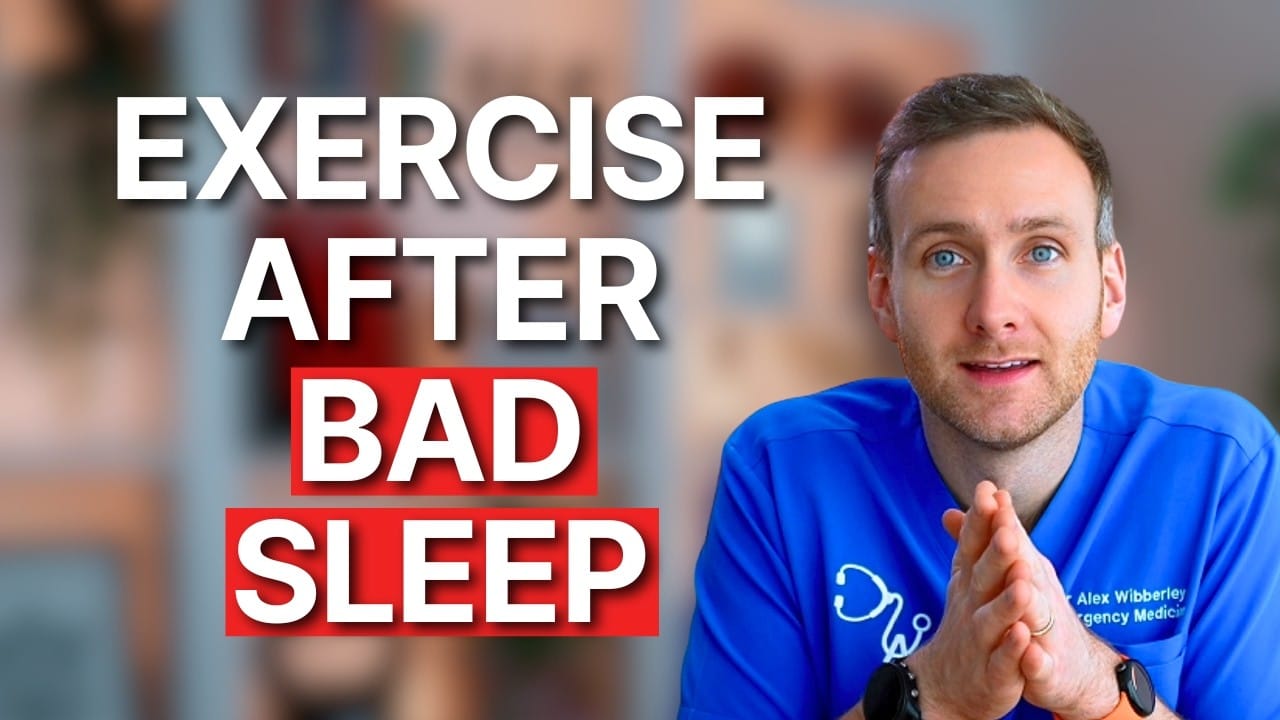
In terms of my health though, it has absolutely suffered as a result of all of those years of night shifts and I’m so glad I stopped them when I did.
Research backs his concern. A large 2024 review combining 10 studies found night shift workers faced approximately 30% higher risk of developing type 2 diabetes compared to daytime workers. Rotating shift workers showed even greater risk.
Small metabolic hits don’t disappear—they accumulate night after night, year after year.
The Exercise That Protects Against Sleep Deprivation Damage
Telling exhausted shift workers or new parents to “just sleep more” offers zero practical value.
High-intensity interval training (HIIT) provides something actionable—a way to offset harm from unavoidable poor sleep.

If you want something simple that actually works, this is one of the most effective tools I’ve used to build strength, conditioning, and endurance without needing a full gym setup.
- Full-body training with one weight using swings, squats, and presses
- Solid cast iron build that feels stable and lasts for years
- Comfortable grip that makes high-rep workouts easier to handle
The 2017 Study That Started Everything
Researchers tested 11 healthy young men under different conditions, with each participant serving as his own control.
In one scenario, participants stayed awake for 24 hours with no prior exercise. Glucose, insulin, and blood fats climbed sharply—classic insulin resistance markers.
In another scenario, participants faced identical sleep deprivation but after completing two weeks of HIIT—just six short, intense sessions. The difference was striking: metabolic damage from sleeplessness was significantly blunted.
Additional Supporting Research
The 2017 findings aren’t isolated.
Another study examined 19 men after one night of restricted sleep, which decreased insulin sensitivity. Short, hard sprint intervals helped soften that metabolic drop.
A 2022 review concluded that exercise—particularly high-intensity training—protects glucose tolerance during periods of poor sleep. Since blood sugar control represents one of the biggest factors determining healthy aging, this protection matters enormously for heart, brain, kidney, and blood vessel health.
If you want something simple that actually works, this is one of the most effective tools I’ve used to build strength, conditioning, and endurance without needing a full gym setup.
- Full-body training with one weight using swings, squats, and presses
- Solid cast iron build that feels stable and lasts for years
- Comfortable grip that makes high-rep workouts easier to handle
Why HIIT Works When Sleep Fails
The biology is beautifully straightforward.
Muscles represent the body’s largest glucose storage and burning site—think of them as massive sponges for blood sugar. Normally, glucose needs insulin to enter muscle cells.
But during hard exercise, contracting muscles open a completely separate pathway and pull sugar directly from blood without requiring insulin. Poor sleep cannot touch this mechanism.
Even when insulin isn’t working properly due to sleep deprivation, intense exercise still drags glucose from blood and burns it off.
HIIT also leaves muscles more insulin-sensitive for one to two days afterward. This effect doesn’t vanish when exercise stops—it persists for many hours. Over time, HIIT builds VO2 max, one of the strongest predictors of longevity and healthy aging.
A short workout does two jobs at once. It clears the sugar from a bad night right now, and it slowly rebuilds the very system that poor sleep keeps wearing down.
How To Implement HIIT For Sleep-Deprived Schedules
HIIT workouts suit chaotic schedules perfectly because they’re quick.
If you want something simple that actually works, this is one of the most effective tools I’ve used to build strength, conditioning, and endurance without needing a full gym setup.
- Full-body training with one weight using swings, squats, and presses
- Solid cast iron build that feels stable and lasts for years
- Comfortable grip that makes high-rep workouts easier to handle
Sessions require only short bursts of near-maximal effort with easy recovery between intervals—typically 15 to 20 minutes total, or even just 10 minutes if that’s all available.
Sample HIIT Protocols
- Cycling: 30 seconds hard pedaling, followed by 1-2 minutes easy spinning, repeated 6-8 times
- Running: Sprint as fast as possible for intervals, with recovery walks between
- Hill sprints: Maximum effort uphill bursts
- Rowing: Hard pulls alternating with gentle recovery
- Stair running: Sprint up flights at maximum intensity
The goal: be properly out of breath during hard intervals—90-100% maximum effort, not just warm and slightly winded.
Anyone can slot sessions into their day: before shifts, after school runs, during baby naps. Two to three sessions weekly produces noticeable differences, though more frequency yields better results.
Important Safety Considerations
Older individuals, those with health conditions, exercise beginners, or anyone with heart problems should build up gradually and get medical clearance first.
HIIT Isn’t A Sleep Replacement
Exercise cannot completely out-train chronic sleep deprivation.
Research suggests HIIT limits damage—it’s damage control, not a cure. Quality sleep remains the foundation supporting all other health pillars.
If you want something simple that actually works, this is one of the most effective tools I’ve used to build strength, conditioning, and endurance without needing a full gym setup.
- Full-body training with one weight using swings, squats, and presses
- Solid cast iron build that feels stable and lasts for years
- Comfortable grip that makes high-rep workouts easier to handle
Standard sleep advice still applies: dark cool bedrooms, no screens before bed, limiting caffeine and alcohol, maintaining consistent sleep and wake times.
But for shift workers, new parents, and others whose lives dictate disrupted sleep patterns, the problem isn’t laziness or poor habits—it’s circumstances beyond immediate control.
For these individuals, goals should be twofold: use HIIT to limit harm during unavoidable sleep disruption, and return to proper sleep routines as quickly as life circumstances allow—whether through job changes, promotions, or babies finally sleeping through the night.
Taking Action This Week
Inability to fix broken sleep doesn’t mean powerlessness.
A few short, intense exercise sessions weekly genuinely shield the body from significant blood sugar and metabolic harm caused by poor sleep.
For shift workers, new parents, or anyone running on insufficient sleep: start today with one short HIIT session, then build from there.
If you want something simple that actually works, this is one of the most effective tools I’ve used to build strength, conditioning, and endurance without needing a full gym setup.
- Full-body training with one weight using swings, squats, and presses
- Solid cast iron build that feels stable and lasts for years
- Comfortable grip that makes high-rep workouts easier to handle
The simplest approach: sprint at maximum intensity for one minute (or walk as fast as possible for beginners or older individuals), rest for two minutes, then repeat for 15-20 minutes total.
Sleep schedules aren’t always controllable, but providing the body with powerful tools to fight back and protect itself absolutely is.
Poor sleep doesn’t just make people irritable and foggy-headed.
It damages metabolism, heart health, and brain function in ways most don’t realize.
Dr. Alex George, an emergency medicine doctor who worked permanent night shifts for years, recently shared research showing one specific type of exercise can blunt metabolic damage from sleep deprivation—particularly crucial for shift workers, new parents, and healthcare professionals who can’t simply “fix” their sleep schedules.
The solution is surprisingly quick and accessible.
If you want something simple that actually works, this is one of the most effective tools I’ve used to build strength, conditioning, and endurance without needing a full gym setup.
- Full-body training with one weight using swings, squats, and presses
- Solid cast iron build that feels stable and lasts for years
- Comfortable grip that makes high-rep workouts easier to handle
How Poor Sleep Destroys Blood Sugar Control
Sleep deprivation triggers insulin resistance—and the evidence is ironclad.
Just a few consecutive nights of inadequate sleep make cells resistant to insulin, the hormone that acts like a key unlocking cells so glucose can enter and fuel them. When cells stop responding to insulin, blood sugar accumulates and stays elevated.
High blood sugar damages blood vessel linings—the endothelium—setting the stage for heart attacks, strokes, kidney damage, and type 2 diabetes.
Why Sleep Loss Triggers This Response
Sleep allows the body to repair and reset. Hormones rebalance, stress systems wind down.
Without adequate sleep, the body interprets deprivation as a threat and remains stuck in fight-or-flight mode. Stress hormones like cortisol and adrenaline stay elevated, instructing the liver to release extra glucose while simultaneously making cells ignore insulin.
Sleep deprivation also increases inflammation and disrupts hunger hormones, causing cravings for sugar and fat combinations the body now struggles to process properly.
If you want something simple that actually works, this is one of the most effective tools I’ve used to build strength, conditioning, and endurance without needing a full gym setup.
- Full-body training with one weight using swings, squats, and presses
- Solid cast iron build that feels stable and lasts for years
- Comfortable grip that makes high-rep workouts easier to handle
A tired body is very much a stressed body and a stressed body runs its blood sugar really high.
Who Faces The Greatest Risk
Everyone needs quality sleep, but certain groups can’t simply choose to sleep more.
- Night shift workers (nurses, doctors, police officers, factory staff)
- New parents navigating disrupted sleep schedules
- Caregivers with unpredictable demands
- People with chronic insomnia
Dr. George worked permanent night shifts for years because they paid roughly 30% more per hour, helping him save for his farm and home.
In terms of my health though, it has absolutely suffered as a result of all of those years of night shifts and I’m so glad I stopped them when I did.
Research backs his concern. A large 2024 review combining 10 studies found night shift workers faced approximately 30% higher risk of developing type 2 diabetes compared to daytime workers. Rotating shift workers showed even greater risk.
Small metabolic hits don’t disappear—they accumulate night after night, year after year.
The Exercise That Protects Against Sleep Deprivation Damage
Telling exhausted shift workers or new parents to “just sleep more” offers zero practical value.
High-intensity interval training (HIIT) provides something actionable—a way to offset harm from unavoidable poor sleep.
If you want something simple that actually works, this is one of the most effective tools I’ve used to build strength, conditioning, and endurance without needing a full gym setup.
- Full-body training with one weight using swings, squats, and presses
- Solid cast iron build that feels stable and lasts for years
- Comfortable grip that makes high-rep workouts easier to handle
The 2017 Study That Started Everything
Researchers tested 11 healthy young men under different conditions, with each participant serving as his own control.
In one scenario, participants stayed awake for 24 hours with no prior exercise. Glucose, insulin, and blood fats climbed sharply—classic insulin resistance markers.
In another scenario, participants faced identical sleep deprivation but after completing two weeks of HIIT—just six short, intense sessions. The difference was striking: metabolic damage from sleeplessness was significantly blunted.
Additional Supporting Research
The 2017 findings aren’t isolated.
Another study examined 19 men after one night of restricted sleep, which decreased insulin sensitivity. Short, hard sprint intervals helped soften that metabolic drop.
A 2022 review concluded that exercise—particularly high-intensity training—protects glucose tolerance during periods of poor sleep. Since blood sugar control represents one of the biggest factors determining healthy aging, this protection matters enormously for heart, brain, kidney, and blood vessel health.
If you want something simple that actually works, this is one of the most effective tools I’ve used to build strength, conditioning, and endurance without needing a full gym setup.
- Full-body training with one weight using swings, squats, and presses
- Solid cast iron build that feels stable and lasts for years
- Comfortable grip that makes high-rep workouts easier to handle
Why HIIT Works When Sleep Fails
The biology is beautifully straightforward.
Muscles represent the body’s largest glucose storage and burning site—think of them as massive sponges for blood sugar. Normally, glucose needs insulin to enter muscle cells.
But during hard exercise, contracting muscles open a completely separate pathway and pull sugar directly from blood without requiring insulin. Poor sleep cannot touch this mechanism.
Even when insulin isn’t working properly due to sleep deprivation, intense exercise still drags glucose from blood and burns it off.
HIIT also leaves muscles more insulin-sensitive for one to two days afterward. This effect doesn’t vanish when exercise stops—it persists for many hours. Over time, HIIT builds VO2 max, one of the strongest predictors of longevity and healthy aging.
A short workout does two jobs at once. It clears the sugar from a bad night right now, and it slowly rebuilds the very system that poor sleep keeps wearing down.
How To Implement HIIT For Sleep-Deprived Schedules
HIIT workouts suit chaotic schedules perfectly because they’re quick.
If you want something simple that actually works, this is one of the most effective tools I’ve used to build strength, conditioning, and endurance without needing a full gym setup.
- Full-body training with one weight using swings, squats, and presses
- Solid cast iron build that feels stable and lasts for years
- Comfortable grip that makes high-rep workouts easier to handle
Sessions require only short bursts of near-maximal effort with easy recovery between intervals—typically 15 to 20 minutes total, or even just 10 minutes if that’s all available.
Sample HIIT Protocols
- Cycling: 30 seconds hard pedaling, followed by 1-2 minutes easy spinning, repeated 6-8 times
- Running: Sprint as fast as possible for intervals, with recovery walks between
- Hill sprints: Maximum effort uphill bursts
- Rowing: Hard pulls alternating with gentle recovery
- Stair running: Sprint up flights at maximum intensity
The goal: be properly out of breath during hard intervals—90-100% maximum effort, not just warm and slightly winded.
Anyone can slot sessions into their day: before shifts, after school runs, during baby naps. Two to three sessions weekly produces noticeable differences, though more frequency yields better results.
Important Safety Considerations
Older individuals, those with health conditions, exercise beginners, or anyone with heart problems should build up gradually and get medical clearance first.
HIIT Isn’t A Sleep Replacement
Exercise cannot completely out-train chronic sleep deprivation.
Research suggests HIIT limits damage—it’s damage control, not a cure. Quality sleep remains the foundation supporting all other health pillars.
If you want something simple that actually works, this is one of the most effective tools I’ve used to build strength, conditioning, and endurance without needing a full gym setup.
- Full-body training with one weight using swings, squats, and presses
- Solid cast iron build that feels stable and lasts for years
- Comfortable grip that makes high-rep workouts easier to handle
Standard sleep advice still applies: dark cool bedrooms, no screens before bed, limiting caffeine and alcohol, maintaining consistent sleep and wake times.
But for shift workers, new parents, and others whose lives dictate disrupted sleep patterns, the problem isn’t laziness or poor habits—it’s circumstances beyond immediate control.
For these individuals, goals should be twofold: use HIIT to limit harm during unavoidable sleep disruption, and return to proper sleep routines as quickly as life circumstances allow—whether through job changes, promotions, or babies finally sleeping through the night.
Taking Action This Week
Inability to fix broken sleep doesn’t mean powerlessness.
A few short, intense exercise sessions weekly genuinely shield the body from significant blood sugar and metabolic harm caused by poor sleep.
For shift workers, new parents, or anyone running on insufficient sleep: start today with one short HIIT session, then build from there.
If you want something simple that actually works, this is one of the most effective tools I’ve used to build strength, conditioning, and endurance without needing a full gym setup.
- Full-body training with one weight using swings, squats, and presses
- Solid cast iron build that feels stable and lasts for years
- Comfortable grip that makes high-rep workouts easier to handle
The simplest approach: sprint at maximum intensity for one minute (or walk as fast as possible for beginners or older individuals), rest for two minutes, then repeat for 15-20 minutes total.
Sleep schedules aren’t always controllable, but providing the body with powerful tools to fight back and protect itself absolutely is.