Popular fitness expert Dr. Mike Israetel is challenging everything you thought you knew about building muscle.
In a recent video, the Renaissance Periodization founder made a controversial claim that’s turning heads across the fitness community.
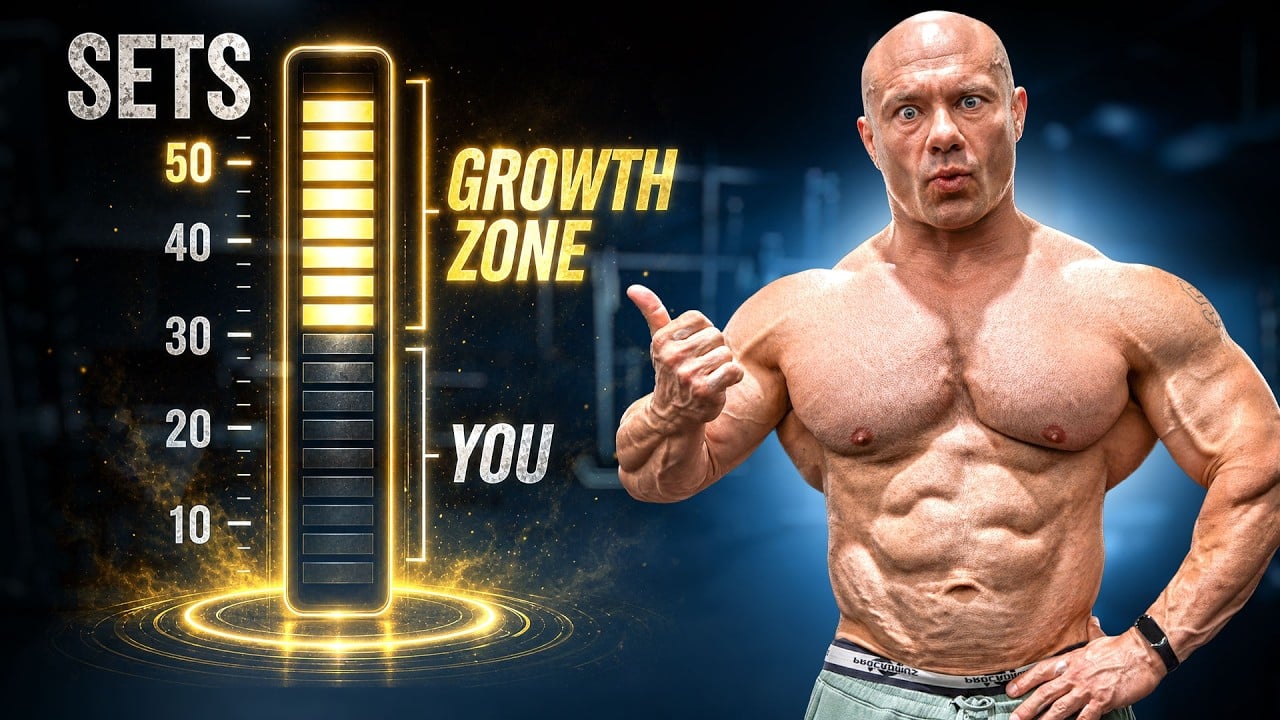
The message? Most people aren’t training enough to maximize muscle growth, especially in stubborn body parts that refuse to grow.
What follows is a deep dive into why the minimalist training approach might be holding you back—and what science actually says about volume and hypertrophy.
Jump to:
The Conspiracy of Minimalism
Israetel opened with a tongue-in-cheek warning about what he calls “the club of sevens”—a global movement promoting minimalist training principles.
Guys, I regret to inform you there is a global conspiracy amongst us. The best training to gain muscle is 5 to 10 sets of 5 to 10 reps done twice a week per muscle.
This approach—5 to 10 reps per set, 5 to 10 sets per session, twice weekly—has become gospel in many training circles.
And Israetel admits it has merit, particularly for beginners and intermediate lifters who don’t yet need massive volumes to progress.
But when muscles stop responding, that’s where minimalism falls short.
Understanding Volume Landmarks: MEV and MRV
To understand why more volume often equals more growth, Israetel breaks down two critical concepts: Minimum Effective Volume (MEV) and Maximum Recoverable Volume (MRV).
MEV is the smallest number of weekly sets that produce detectable muscle growth. Anything below that? You’re spinning your wheels.
MRV is the upper limit—the point where your body can no longer recover from additional volume.
So long as you can still recover, which means your strength goes up a little bit from session to session to session, the more volume you do and still preserve that relationship of getting a little bit stronger every time, usually the more muscle growth gains you will experience.
Between MEV and MRV lies a wide spectrum where more volume generally produces more growth—as long as recovery is maintained.
What Research Actually Shows About High Volume Training
Israetel admits he used to be a skeptic of extremely high training volumes.
In fact, he coined the term “maximum recoverable volume” because he believed anything beyond 20 sets per muscle per week would hinder growth.
Then the science caught up.
Multiple studies since then, dozens of studies since then have shown that compared with doing 5, 10, or even 20 sets per muscle per week, in the research environment 30, 40, and in one landmark study at its peak even 52 sets of working sets per muscle per week caused better gains.
These findings were game-changing. Higher volumes consistently outperformed lower volumes in controlled university studies.
But before you panic and start doing 52 sets for every muscle, Israetel offers important caveats.
Why You Don’t Need 52 Sets Per Muscle
Three major factors prevent most people from needing—or tolerating—that kind of volume:
- Individual differences: Some muscles and some people thrive on lower volumes. Fast-twitch dominant muscle groups like chest and hamstrings often respond well to moderate volume.
- Systemic fatigue: Training one muscle group in isolation (like in a study) is very different from training your entire body. Total systemic fatigue limits how much volume you can handle across all muscle groups.
- Time constraints: Maxing out volume for every muscle would require 12+ hours per week in the gym—unrealistic for most people.
Israetel notes that in practice, 20 to 30 working sets per muscle per week is about the upper limit most people can sustain when training their whole body.
When You Need More Volume
So how do you know if you need more volume?
Israetel provides clear indicators that a muscle group is likely under-stimulated:
- Stubborn muscles that won’t grow: Research consistently shows lagging body parts respond better to higher volumes than lower ones.
- Muscles that don’t get pumped or sore: If a muscle feels fine after training, it probably wasn’t disrupted enough to trigger growth.
- Muscles that recover by the next day: Shoulders are a classic example—many people can train delts daily without issue.
- Muscles that perform well set after set: If your lateral raises feel just as strong on set four as set one, you likely need more total volume to fatigue that muscle.
The hypothesis there is that you’re either doing too much volume or not enough volume. Not enough is almost always the case.
Why Minimalism Is So Seductive
If higher volume works better, why is low-volume training so popular?
Israetel doesn’t mince words: because it’s easier and more fun.
Low-volume training allows you to lift heavier weights, which feels more impressive. You do fewer reps, which means less discomfort and burning sensations.
You accumulate less fatigue, so you can add weight to the bar more frequently—feeding your ego with visible strength gains.
Lower volume training is more fun, less painful, less work, and gives you bigger short-term ego boosts by strength gains. Well, where the fuck do I sign up?
But when muscles stop responding, that’s when reality sets in.
Sometimes thankless labor is what produces results.
Three Smart Ways to Add Volume
Instead of simply piling on straight sets, Israetel recommends three strategic methods to increase training volume without burning out.
1. Increase Training Frequency
Rather than doing eight sets of curls twice per week (which feels like junk volume), do five sets three times per week.
You’ve just increased weekly volume by 50%—from 10 sets to 15—without making individual sessions feel overwhelming.
This approach works especially well for muscles that recover quickly.
2. Use Myo-Rep Sets
Myo-reps are a brutally efficient way to accumulate volume in less time.
Here’s how they work:
- Perform a set of 15-20 reps close to failure
- Rest only 5-10 seconds
- Do mini-sets until you’ve matched your initial rep count
- Repeat for multiple rounds
For example: 18 reps, then 14 + 4, then 12 + 4 + 2, then 10 + multiple mini-sets to hit 18 total.
You’re approaching failure multiple times within a single “set,” creating massive stimulation without endless straight sets.
3. Agonist Supersets
Pair an isolation exercise with a compound movement targeting the same muscle.
Israetel’s example: cable tricep pushdowns immediately followed by dips or deficit push-ups with only 5-10 seconds rest.
Every single set becomes a double-whammy of volume and stimulus, without requiring twice the gym time.
You might need to do some higher volumes, especially to bring up lagging muscle groups, because that’s the answer for growth more times than it’s not.
The Bottom Line
Minimalist training has its place—especially for beginners, time-crunched individuals, or those prioritizing strength over size.
But when muscles refuse to grow despite consistent effort, insufficient volume is almost always the culprit.
Israetel’s message is clear: don’t assume you’re doing too much when you’re probably doing too little.
Science supports higher volumes for hypertrophy. Real-world results confirm it. And strategic implementation makes it sustainable.
It may not be as sexy as “just lift heavy twice a week,” but building muscle rarely is.