A powerlifter who spent a year running nearly 5 miles every single day has finally revealed what happened to his strength and muscle mass.
And the results might completely change how you think about cardio and gains.
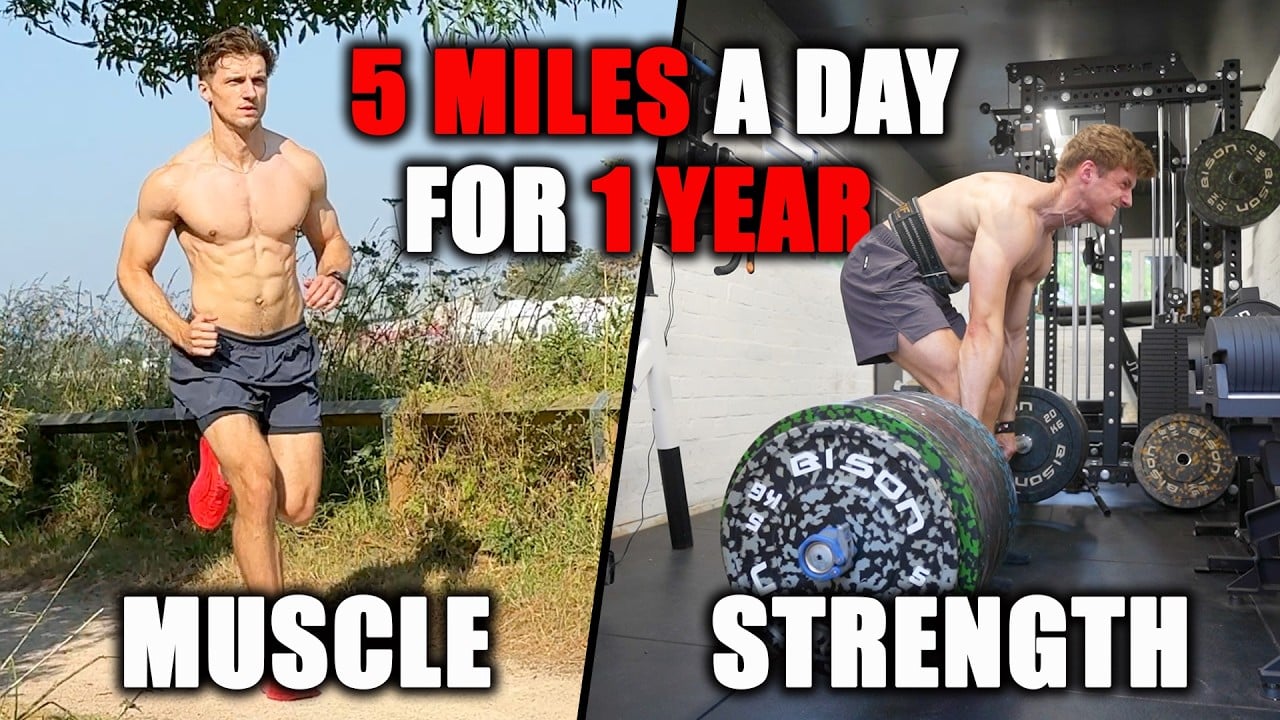
In April of last year, the athlete competed in powerlifting where he lifted an impressive 577.5 kg—over 1,270 lbs combined across squat, bench press, and deadlift.
Since then, he ran 2,877 km in 12 months, a 34% increase from the previous year, all while wondering if those “hundreds of hours of catabolic cardio” would destroy everything he’d built.
Jump to:
The Big Shift: From Pure Strength to Hybrid Training
The decision to prioritize running wasn’t random.
After years of balancing strength training with running since 2023, he made significant progress in both disciplines. But entering 2025, cardiovascular fitness became the primary focus while maintaining existing strength and muscle.

If you want something simple that actually works, this is one of the most effective tools I’ve used to build strength, conditioning, and endurance without needing a full gym setup.
- Full-body training with one weight using swings, squats, and presses
- Solid cast iron build that feels stable and lasts for years
- Comfortable grip that makes high-rep workouts easier to handle
I’m going to prove that you can definitely be pretty strong and fit at the same time. Like I was running a 5K in 19 minutes last year when I managed that 242.5 kg deadlift, my all-time PR.
To optimize running performance, he reduced weight training intensity dramatically. Heavy squatting dropped from twice weekly to just once, and heavy deadlifting became far less frequent.
This created crucial recovery space for two hard running workouts weekly—tempo runs and interval sessions—alongside easy and long runs.
Training Smarter, Not Just Harder
The reduced lifting intensity meant fresher legs for quality running workouts.
Like last week for example, I did this brutal workout. It was 3×3 km at my target 10k pace. So 3:42 per km, just under 6-minute miling. And there is no way I would have been able to attempt that workout if I’d squatted or deadlifted heavy in like the previous three days.
His current running goals include breaking 37 minutes in the 10k and hitting sub-3 hours in September’s Richmond Marathon.
The Moment of Truth: Body Weight and Physique Check
After four months without weighing himself—scales so unused they needed new batteries—the result came in at 86 kg.
Roughly one kilogram lighter than four months prior, well within normal weekly fluctuation range.
If you want something simple that actually works, this is one of the most effective tools I’ve used to build strength, conditioning, and endurance without needing a full gym setup.
- Full-body training with one weight using swings, squats, and presses
- Solid cast iron build that feels stable and lasts for years
- Comfortable grip that makes high-rep workouts easier to handle
Most importantly, side-by-side physique comparisons showed minimal visible difference from a year ago. Perhaps slightly less muscular or slightly less lean, but nothing dramatic.
I know that at most I’m only ever about 4 weeks away of clean eating and hard work in the gym from getting back to my best. So, although it’s very easy to find faults with yourself, if I try to be objective, I don’t think that’s too bad for someone that’s ran 5 miles a day for the last year.
Debunking the Cardio Kills Gains Myth
As a teenager, he bought into the widespread belief that cardio destroys muscle gains—a myth perpetuated by first-generation fitness influencers.
Many of those influencers were semi-professional bodybuilders, often secretly using anabolic steroids, operating at extremes of muscle building where running genuinely would interfere with singular hypertrophy goals.
But for regular people? The interference effect between endurance and strength training exists but remains remarkably small.
The formula for maintaining muscle while running extensively:
- Lift weights that challenge you
- Eat enough total calories and protein
- Allow adequate recovery between harder workouts
Fueling High Mileage: The Nutrition Factor
Leading up to London Marathon earlier in the year, weekly training peaked at 90 km—not extreme mileage, but substantial calorie expenditure for someone at 86 kg.
If you want something simple that actually works, this is one of the most effective tools I’ve used to build strength, conditioning, and endurance without needing a full gym setup.
- Full-body training with one weight using swings, squats, and presses
- Solid cast iron build that feels stable and lasts for years
- Comfortable grip that makes high-rep workouts easier to handle
Standard four-meal daily routine expanded to four meals plus significant snacks on high-volume or double training days. Peanut butter toast, hot cross buns, and sweet treats became regular additions.
Gym frequency averaged twice weekly with mostly low-volume squats and deadlifts, plus higher-volume upper body work.
Result? Still 86 kg with muscle mass intact.
Strength Testing After 365 Days: The Numbers Don’t Lie
After over a year without maxing out, strength testing day arrived with tempered expectations.
He hadn’t squatted anything heavier than 95 kg since marathon training six to seven weeks prior. Low bar squats hadn’t happened in four to five months. Squatting frequency sat at just once weekly.
Squat: 170 kg
This matched his December 2024 one-rep max—achieved when squatting heavy twice weekly with proper peaking.
If you want something simple that actually works, this is one of the most effective tools I’ve used to build strength, conditioning, and endurance without needing a full gym setup.
- Full-body training with one weight using swings, squats, and presses
- Solid cast iron build that feels stable and lasts for years
- Comfortable grip that makes high-rep workouts easier to handle
After attempting 180 kg unsuccessfully, he maintained 170 kg as the day’s maximum. A respectable showing considering months of minimal heavy squatting.
Bench Press: 140 kg—A Personal Best
Perhaps the day’s most shocking result.
He’d never hit 140 kg for a paused rep before—only touch-and-go. He failed this weight at last year’s powerlifting competition when benching far more frequently.
All right. Extremely confused what I have done over the last couple of months to suddenly pull that one out of the bag. Like that is definitely 140 kilos.
An attempt at 145 kg failed, but the personal record at 140 kg stood as undeniable proof that reduced training volume hadn’t destroyed upper body strength.
Deadlift: 220 kg
Using straps instead of hook grip—thumbs unconditioned after 12+ months—he pulled 220 kg after jumping straight to the weight from 200 kg.
An attempt at 230 kg failed, leaving 220 kg as the final number. Down from his all-time PR of 242.5 kg, but remarkably solid considering virtually no heavy deadlifting since early in the year.
If you want something simple that actually works, this is one of the most effective tools I’ve used to build strength, conditioning, and endurance without needing a full gym setup.
- Full-body training with one weight using swings, squats, and presses
- Solid cast iron build that feels stable and lasts for years
- Comfortable grip that makes high-rep workouts easier to handle
What Running Actually Does to Your Gains: The Verdict
The comprehensive year-long experiment produced clear conclusions.
Muscle mass remained virtually unchanged. Physique comparisons showed minimal differences, and body weight held steady at 86 kg despite running nearly 3,000 km.
Strength showed surprising resilience. Squat and deadlift dropped 20-30 kg—attributed entirely to reduced training frequency and intensity, not running itself. Bench press actually improved to a personal best.
The strength losses aren’t permanent neural adaptations or muscle atrophy. They represent simple detraining from lower volume work, easily reversible with a focused strength block.
If you can maintain most of your muscle mass, you’re going to be maintaining most of your strength, too. More muscle equals more strong.
The Indirect Effect: Training Prioritization
Running didn’t directly steal gains through some mysterious catabolic process.
Instead, optimizing running performance required strategic training adjustments. Heavy compound lifts create fatigue that prevents hitting target paces in interval and tempo runs—workouts essential for improving VO2 max and anaerobic threshold.
If you want something simple that actually works, this is one of the most effective tools I’ve used to build strength, conditioning, and endurance without needing a full gym setup.
- Full-body training with one weight using swings, squats, and presses
- Solid cast iron build that feels stable and lasts for years
- Comfortable grip that makes high-rep workouts easier to handle
The first couple years of hybrid training? Mostly easy zone 2 running that fit perfectly around intense gym schedules, building massive aerobic base with huge running progress.
But continuing improvement demanded more quality work, requiring reduced lifting intensity to arrive fresh for harder running sessions.
Practical Takeaways for Hybrid Athletes
Nobody needs to run 5 miles daily for a year—that’s quarter-life crisis territory for someone approaching 30 trying to maximize physical prime years.
Key lessons for combining running and strength training:
- The interference effect is overblown. Maintaining muscle while running substantial mileage proves far easier than fitness culture suggests
- Nutrition becomes crucial. Increased calorie expenditure demands increased intake—simple equation often overlooked
- Strategic training organization matters. Place harder running sessions when legs are fresh from lifting
- Reduced lifting frequency doesn’t equal muscle loss. Lower volume maintenance work preserves mass remarkably well
- Strength adaptations are specific. Less frequent heavy lifting means less practice with maximal loads, but muscle tissue remains
Perhaps most importantly, early-stage hybrid athletes can build aerobic capacity primarily through easy running that barely interferes with strength training at all.
Only when chasing specific ambitious endurance goals does the need for intense quality workouts create genuine scheduling conflicts with heavy lifting.
If you want something simple that actually works, this is one of the most effective tools I’ve used to build strength, conditioning, and endurance without needing a full gym setup.
- Full-body training with one weight using swings, squats, and presses
- Solid cast iron build that feels stable and lasts for years
- Comfortable grip that makes high-rep workouts easier to handle
The bottom line? Running’s impact on muscle and strength is almost certainly far less than you think. With proper nutrition, intelligent programming, and adequate recovery, maintaining impressive physique and respectable strength while running serious mileage isn’t just possible—it’s surprisingly straightforward.