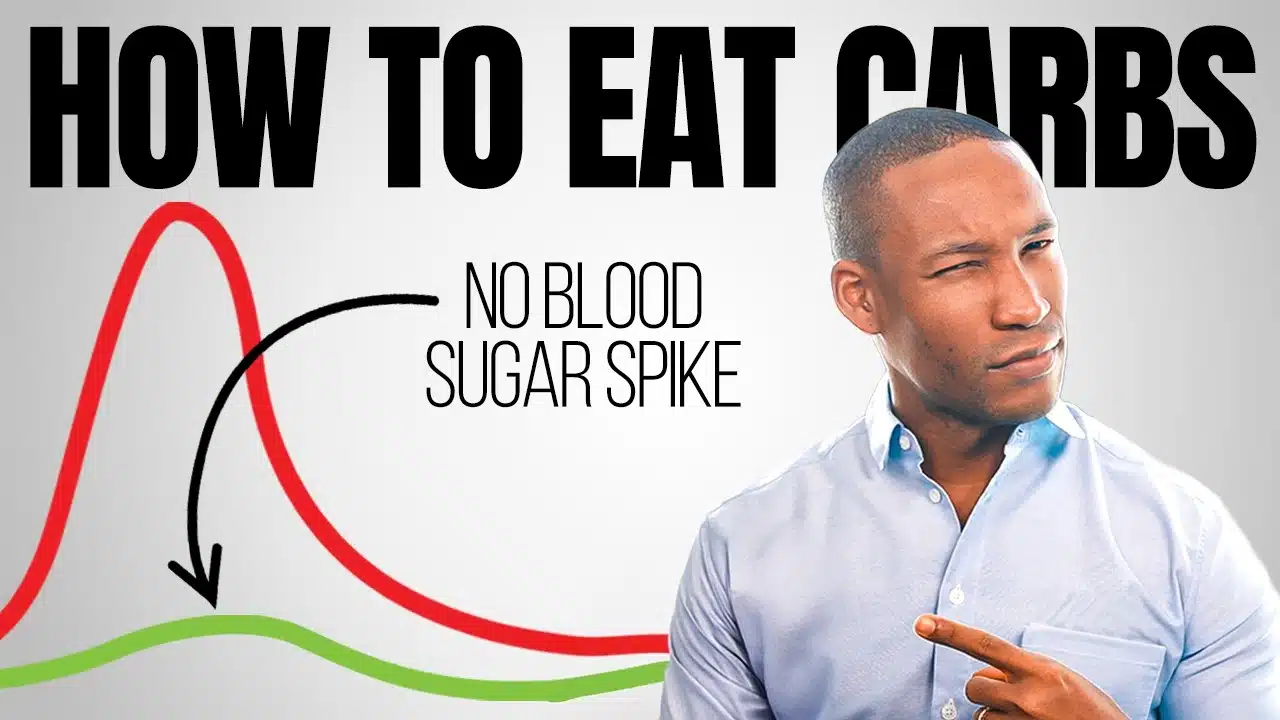
Carbs don’t have to sabotage blood sugar levels or derail fat loss goals.
Dr. Michael Diamonds, a medical doctor and scientist with degrees in biochemistry and microbiology, has developed what he calls the “triprandial protocol”—three science-backed strategies that allow people to enjoy bread, pasta, rice, and potatoes while keeping insulin spikes in check.
His client Michael, 53, went from 23% body fat to 9% in six months while eating 300 grams of carbs daily.
Studies suggest these simple tweaks can lower insulin by 20 to 40%, improve blood sugar control, and even help target visceral fat—all without eliminating favorite foods.
Jump to:
The Triprandial Protocol Explained
The term “prandial” comes from the Latin word prandium, meaning meal or lunch. Dr. Diamonds breaks his protocol into three phases: preprandial (before eating), prandial (during), and postprandial (after eating).
Each phase includes specific hacks designed to prime the body for carbohydrate intake, minimize blood sugar spikes, and optimize insulin response.
Protocol One: Preprandial Phase
What happens before eating carbs sets the stage for how the body handles them.
Hack #1: Resistant Starch—Cook, Cool, Reheat
Most people have never heard of resistant starch, but it’s a game-changer. When potatoes, rice, and pasta are cooked, their starch chains break apart, making sugar easy for the body to absorb quickly.
But cooling those foods in the fridge triggers a process called retrogradation. Broken starch chains relink into tight, crystal-like clumps that digestive enzymes struggle to break down.
Instead of flooding the bloodstream as sugar, most resistant starch passes through undigested, behaving more like fiber than a regular carb. This results in a much gentler rise in blood sugar and insulin—perfect for steady energy and metabolic control.
Bonus: Once resistant starch reaches the large intestine, gut bacteria ferment it into short-chain fatty acids, compounds that improve insulin efficiency.
Here’s the process:
- Cook rice, pasta, or sweet potatoes as normal
- Cool to room temperature, then refrigerate for at least 2–4 hours (overnight is even better)
- Reheat when ready to eat—microwave, air fryer, pan fry, or bake; the resistant starch remains intact
This method works with white rice, brown rice, sweet potatoes, and pasta. Freezing also preserves the effect.
Studies show this simple trick can reduce blood sugar spikes by 20 to 25%—without changing what’s eaten, just when and how it’s prepared.
Hack #2: Apple Cider Vinegar Before Meals
Diluted apple cider vinegar consumed before meals can dramatically influence glucose and insulin response. The key compound is acetic acid.
Acetic acid slows gastric emptying, meaning food enters the small intestine more gradually, preventing the instant blood sugar surge that drives large insulin spikes. It also activates AMPK, the body’s metabolic regulator, improving insulin sensitivity and reducing the amount of insulin needed to process a meal.
Dr. Diamonds recommends this approach:
- Mix 1–2 tablespoons of raw, unfiltered apple cider vinegar (the kind with “the mother”) into 8–12 ounces of water
- Drink it 10–15 minutes before a meal
- Use a straw to protect tooth enamel
- Start with one tablespoon if new to this practice, gradually increasing to two
Apply this strategy before the two largest meals of the day—usually lunch and dinner. Lemon juice can serve as an alternative, though apple cider vinegar has the most research backing.
Benefits compound over time, with studies showing the greatest improvements after 8–12 weeks of consistent use.
Important: Never drink apple cider vinegar undiluted. Always mix it with water.
Protocol Two: Prandial Phase
What happens during meals matters just as much as what’s eaten.
Hack #1: No Naked Carbs
Eating carbs alone—bread by itself, plain pasta, or just rice—causes blood sugar to spike rapidly. But pairing those same carbs with protein, fat, or fiber dramatically lowers the insulin response.
Protein and fat act like a jacket, slowing digestion and absorption of carbohydrates. Fiber creates a physical barrier in the digestive tract, preventing blood sugar spikes.
Practical examples:
- Bagel in the morning? Add eggs and avocado
- Bowl of pasta? Include ground turkey or chicken with vegetables
- White rice? Pair it with salmon and broccoli
Never eat carbs alone. Always pair them with something. When combined with cooled and reheated carbs (resistant starch), the effects stack powerfully.
Hack #2: Food Sequencing
A landmark 2015 study from Weill Cornell Medical College tested food order on type 2 diabetics—people who are extremely insulin resistant. By simply changing the sequence in which they ate their food, postmeal glucose levels dropped by:
- 29% at 30 minutes
- 37% at 60 minutes
- 17% at 120 minutes
Same meal. Same portions. Different sequence.
Here’s the optimal eating order:
- Eat fiber-rich vegetables first—leafy greens, broccoli, cauliflower, Brussels sprouts, asparagus, any non-starchy vegetables. Spend at least 5–10 minutes here.
- Eat protein and healthy fats next—chicken, fish, beef, eggs, tofu, avocados, oils, nuts
- Eat carbohydrates last—rice, pasta, bread, potatoes
Why does this work?
- Protein triggers GLP-1, a hormone that slows gastric emptying and signals the pancreas to release insulin gradually (the same hormone drugs like Ozempic mimic—obtained naturally by eating protein first)
- Fiber acts as a physical barrier in the digestive tract, slowing carbohydrate absorption so glucose enters the bloodstream more gradually
- Protein and fat stimulate peptide YY (PYY), a satiety hormone. By the time carbs are reached, fullness has already set in, naturally reducing intake
Both “vegetables first” and “protein first” sequences work. Starting with vegetables may offer a slight advantage because the fiber barrier forms earlier, but protein first also triggers powerful hormonal benefits.
This strategy works anywhere—restaurants, family weddings, on planes. No special foods needed. Just a better sequence.
Protocol Three: Postprandial Phase
What happens after eating completes the protocol.
Walk for 10 Minutes
Walking after eating is one of the most underrated insulin hacks available. Even a short 10-minute walk drastically reduces insulin spikes.
When muscles contract during walking, they activate GLUT4 transporters through contraction-mediated glucose uptake. Think of GLUT4 as gates that absorb glucose—muscles contract, gates open, and energy flows in.
The pancreas relaxes, insulin stays low, and the body remains in a fat-burning mode. This is one of the most powerful insulin-independent pathways the body uses.
How to make it a habit:
- Set a phone alarm for 15 minutes after starting a meal. When it goes off, walk.
- Make it social—take a post-dinner walk with family or a partner
- Walk around the office or neighborhood after lunch
No need to speed walk or break a sweat. Just move at a comfortable pace for 10–15 minutes.
The first 30–60 minutes after eating is when insulin typically peaks. This is the prime window to take action. Walking ensures carbohydrates go straight into muscle instead of being stored as fat.
Training that I come from is get in the gym, throw on a hoodie, 45 minutes sweating. When Max said to me, ‘Hey, listen. We’re going zone 2 here. I don’t want you running. Nothing crazy.’ I was like, ‘This is not going to work.’ But I said, ‘All right. I’ll walk. I’ll get my steps.’ Steps was a whole another part of my fitness journey.
Real Results: Michael’s Transformation
Michael, 53, started at 23% body fat. Over six months, he dropped to 9%—while eating 300 grams of carbs daily.
If you had told me in the past that I was going to eat 300 grams of carbs a day and stay lean and stay strong and have energy, I would have called BS on you all day long.
At his peak, Michael was consuming 2,400 calories per day: approximately 300 grams of carbs, 165–180 grams of protein, and 58 grams of fat. During the process, calories dropped as low as 1,700, but the emphasis remained on working with the body—not against it.
Over the last six months that I’ve spent with Sculpt by Science, my wife and I have been to several weddings. I’ve played in many golf tournaments. I’ve had many events come up with friends that were pre-planned. Life never stopped. Max and I strategized as we went through—okay, what do you got coming up this week? This is how we’re going to handle it.
The Bigger Picture: Precision Over Guesswork
Dr. Diamonds emphasizes that every person is unique. At Sculpt by Science, clients begin with medical-grade diagnostics: full health history, DEXA scan for body fat and visceral fat measurement, and a 100+ biomarker blood panel to assess hormones, metabolism, and inflammation.
When needed, cortisol mapping and gut testing are added. From there, a customized “nucleus system” is built: precision nutrition based on labs and goals, optimized recovery (sleep, stress, environment), and peak performance training that builds muscle without burnout.
Weekly adjustments are made based on real data—labs, DEXA scans, stress levels, digestion, sleep. Not vibes. Not guesses.
This level of precision creates permanent results, not temporary ones—and it happens without pulling people out of their normal lives.
Three Hacks, One Protocol
The triprandial protocol offers a practical, science-backed approach to enjoying carbs without the metabolic consequences typically associated with them.
- Before eating: Use resistant starch (cook, cool, reheat) and drink diluted apple cider vinegar
- During eating: Pair carbs with protein, fat, or fiber—and eat in the right order (vegetables or protein first, carbs last)
- After eating: Walk for 10 minutes to activate muscle glucose uptake
These strategies stack. Combining them amplifies their effects, turning ordinary meals into metabolic advantages.
Carbs aren’t the enemy. Poor timing, poor pairing, and lack of movement are.