Finding an accurate body fat scale can feel like searching for a needle in a haystack.
One dedicated researcher spent 12 weeks testing six popular eight-electrode scales to determine which devices actually deliver on their promises.
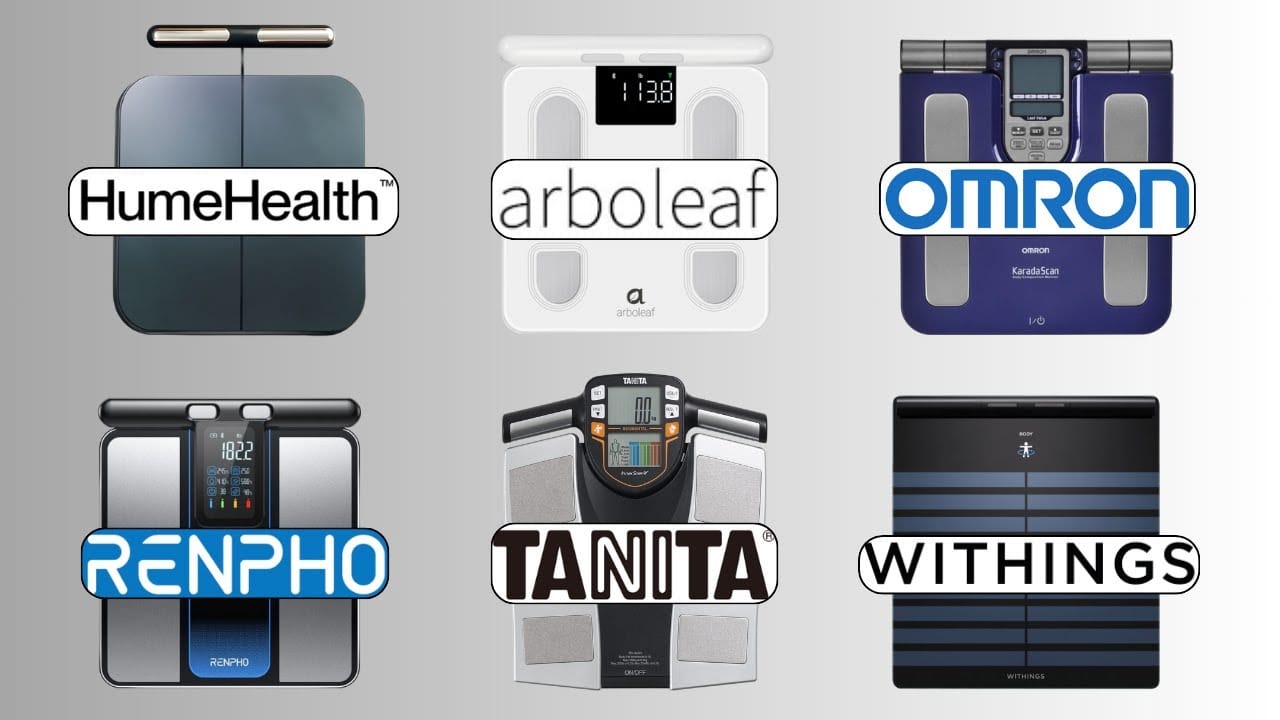
The experiment included daily weigh-ins, a DEXA scan for validation, measurements of friends and family, and even deliberately training just one arm to test if scales could detect muscle imbalances.
What he discovered might surprise anyone considering investing in one of these devices.
Jump to:
- Why Eight Electrodes Matter More Than Four
- Weight Tracking: Where All Scales Agree
- Body Fat Percentage: Where Things Get Messy
- The Hydration Problem Nobody Talks About
- Muscle Mass Measurements and Mathematical Tricks
- The One-Arm Training Experiment
- DEXA Scan: The Moment of Truth
- The Athlete Mode Advantage
- Which Scales Failed the Test
- The Final Three: Choosing Your Winner
- Which Metrics Actually Matter
- The Bottom Line on Body Fat Scales
Why Eight Electrodes Matter More Than Four
Traditional four-electrode scales only send electrical currents through your lower body. Eight-electrode models add handles to the equation, allowing currents to pass through your upper body as well.
This theoretically provides more precise measurements of body fat percentage, muscle mass, and overall body composition changes over time.
The researcher tested scales from Hume Health, Arbelief, Omron, Renfo, Tanita, and Wings, weighing himself each morning in identical clothing while following manufacturer best practices for consistency.
Weight Tracking: Where All Scales Agree
The good news? All six scales accurately tracked weight changes.
Over 12 weeks of deliberately gaining weight, every device agreed he’d added roughly 2 kilograms (4.5 pounds). This consistency provides a reliable baseline for tracking progress.
Body Fat Percentage: Where Things Get Messy
Body fat measurements told a dramatically different story across devices.
Tanita reported the lowest body fat at around 9-10%, while Arbelief registered the highest at 14%. That’s a massive 4-5 percentage point spread between devices supposedly measuring the same person.
Some graphs showed significant noise and fluctuation. The culprit? Hydration levels.
The Hydration Problem Nobody Talks About
Hydration emerged as the biggest source of measurement inconsistency.
These scales work by sending electrical currents through your body to measure bone, fat, and everything else. Since muscle tissue contains more water than fat, hydration directly affects readings.
Salt intake and carbohydrate consumption both influence water retention, creating daily fluctuations in reported muscle and fat percentages.
When analyzing Tanita’s data specifically, the correlation was striking:
- More hydration = higher reported muscle mass
- More hydration = lower reported body fat percentage
- 1% increase in body water = 1% decrease in body fat reading
To test this effect deliberately, the researcher intentionally hydrated and dehydrated himself on consecutive days. Only three devices (Tanita, Hume Health, and Wings) picked up these changes.
Interestingly, the three cheaper scales that didn’t show hydration fluctuations might seem more stable, but this stability could indicate they’re less responsive to real body composition changes.
Muscle Mass Measurements and Mathematical Tricks
Since scales can’t measure skeletal muscle directly, they use formulas to estimate it.
Different manufacturers use different calculations. Renfo appeared to use 61% of total muscle mass for skeletal muscle estimates, while Arbelief and Lunar used 68%.
A more reliable metric? Appendicular lean mass — the total muscle in your arms and legs.
This measurement is more trustworthy because arms and legs contain no organs, meaning everything that isn’t bone or fat is likely muscle tissue.
The One-Arm Training Experiment
To test whether scales could detect localized muscle changes, the researcher trained only his left arm for six weeks.
According to his DEXA scan results, he successfully added 108 grams more muscle to his left arm compared to his right.
Most scales correctly reported more muscle in the left arm around scan time. Wings went rogue and favored the right arm. Arbelief was completely off, showing the opposite of reality.
For other users tested, Arbelief reported differences of up to 700 grams between left and right arms when no such imbalance existed.
DEXA Scan: The Moment of Truth
In week 11, a DEXA scan provided the gold standard comparison. To account for hydration variability, readings were averaged across three measurements including directly before and after the scan.
Total muscle mass according to DEXA was 59.5 kg. Every scale underestimated this number, with Tanita coming closest.
Appendicular lean mass (arms and legs only) showed tighter agreement across most devices, except Arbelief which was significantly off.
Body fat percentage from Tanita was almost spot-on with DEXA results, while other scales skewed too high.
Bone mass revealed problems with Renfo in particular, which measured over 1 kilogram (2.5 pounds) higher than the DEXA scan across all users.
The Athlete Mode Advantage
Some devices offer “athlete mode” to improve accuracy for physically active users.
Standard formulas tend to overestimate body fat in athletic populations. Athlete mode adjusts calculations based on confirmed physical activity thresholds.
Three of six scales offered this feature. With athlete mode enabled, Tanita reported body fat about 3% lower than standard mode. For Wings, enabling it would have dropped readings by approximately 3.5%.
Among seven non-athlete users tested, Tanita consistently reported 5% higher body fat readings, suggesting the mode makes meaningful differences.
Which Scales Failed the Test
Omron BF511: Immediately Eliminated
- Body fat percentage consistently too high
- No segmental analysis despite having handles
- No companion app for this model
- Doesn’t offer total muscle mass or bone mass readings
Arbelief: Accuracy Issues
While the extra decimal place provided helpful granularity, overall accuracy simply wasn’t there.
It incorrectly showed 300 grams more muscle in the untrained right arm and displayed wildly inconsistent arm measurements across multiple users.
Renfo Morpho Scan: Bone Mass Problems
Despite having the nicest handle design, Renfo’s bone mass measurements were consistently off.
For all 10 users tested, it reported the highest bone mass — approximately 1 kilogram more than other scales and 1.2 kilograms more than DEXA results.
Since total body weight is fixed, overestimating bone mass means muscle or fat measurements (or both) must be inaccurate.
The Final Three: Choosing Your Winner
Three scales emerged as solid options, each with distinct advantages.
Hume Health Body Pod: Most User-Friendly
Pros:
- Extremely easy-to-navigate app
- Clear plotting of daily, weekly, or monthly trends for any metric
- Accurately detected arm muscle differences
- Nearly perfect leg muscle measurements compared to DEXA
- Closely matched Wings readings across multiple users
Cons:
- Handle lacks separate thumb electrodes
- Handle feels somewhat thin
- Under-reported arm muscle compared to DEXA
- Subject to hydration-related noise
Tanita BC545N: Most Accurate Body Fat
Pros:
- Closest match to true body fat percentage from DEXA
- Consistently favored trained left arm as weeks progressed
- Reliable directional trends despite fluctuations
Cons:
- No app for this particular model
- Design dates back to 2012, feels dated
- Athlete mode gives potential unfair advantage in testing
- May not be as accurate for non-athletes (5% higher readings)
- Regular fluctuations require tolerance for data noise
Wings Body Scan: Premium Features at Premium Price
Pros:
- Similar accuracy to Tanita and Body Pod
- Six-lead ECG capability for detecting atrial fibrillation
- Medical-grade features for users over 55 or with cardiovascular risk factors
Cons:
- Twice the price of competitors
- Difficult app navigation
- Athlete mode hidden until week 8 of testing
- Data collection failures (6 out of 24 measurements required redoing)
- Premium features may not justify cost for younger, healthy users
Which Metrics Actually Matter
Rather than obsessing over absolute numbers, focus on directional trends over time.
The most reliable measurements to track:
- Total weight (all scales nail this)
- Appendicular lean mass (arm and leg muscle combined)
- Segmental analysis trends (watching individual limbs change over weeks)
- Body fat percentage trends (direction matters more than exact number)
Less reliable measurements:
- Skeletal muscle mass (formula-based estimates vary widely)
- Trunk measurements (organs complicate calculations)
- Visceral fat scores (reported as ranges rather than precise measurements)
- Single-day readings (hydration creates too much noise)
The Bottom Line on Body Fat Scales
Eight-electrode scales represent a genuine improvement over four-electrode models, providing added depth through arm and leg measurements.
All three recommended scales (Hume Health Body Pod, Tanita BC545N, and Wings Body Scan) can track meaningful body composition changes over time, generally staying within a few percentage points of true values.
For most users, the Hume Health Body Pod offers the best combination of accuracy, usability, and value. Those seeking maximum body fat accuracy might prefer Tanita, while users over 55 or with cardiovascular concerns could justify the premium for Wings.
Expect regular fluctuations from hydration. Take measurements consistently (same time, same conditions) and focus on multi-week trends rather than day-to-day changes.
These devices won’t match DEXA scan precision, but they’ll reliably show whether your training and nutrition strategies are moving your body composition in the right direction.