Peptides have exploded across social media, promising everything from dramatic fat loss to superhuman healing and even anti-aging benefits.
Some of these claims sound too good to be true, and often, they are.
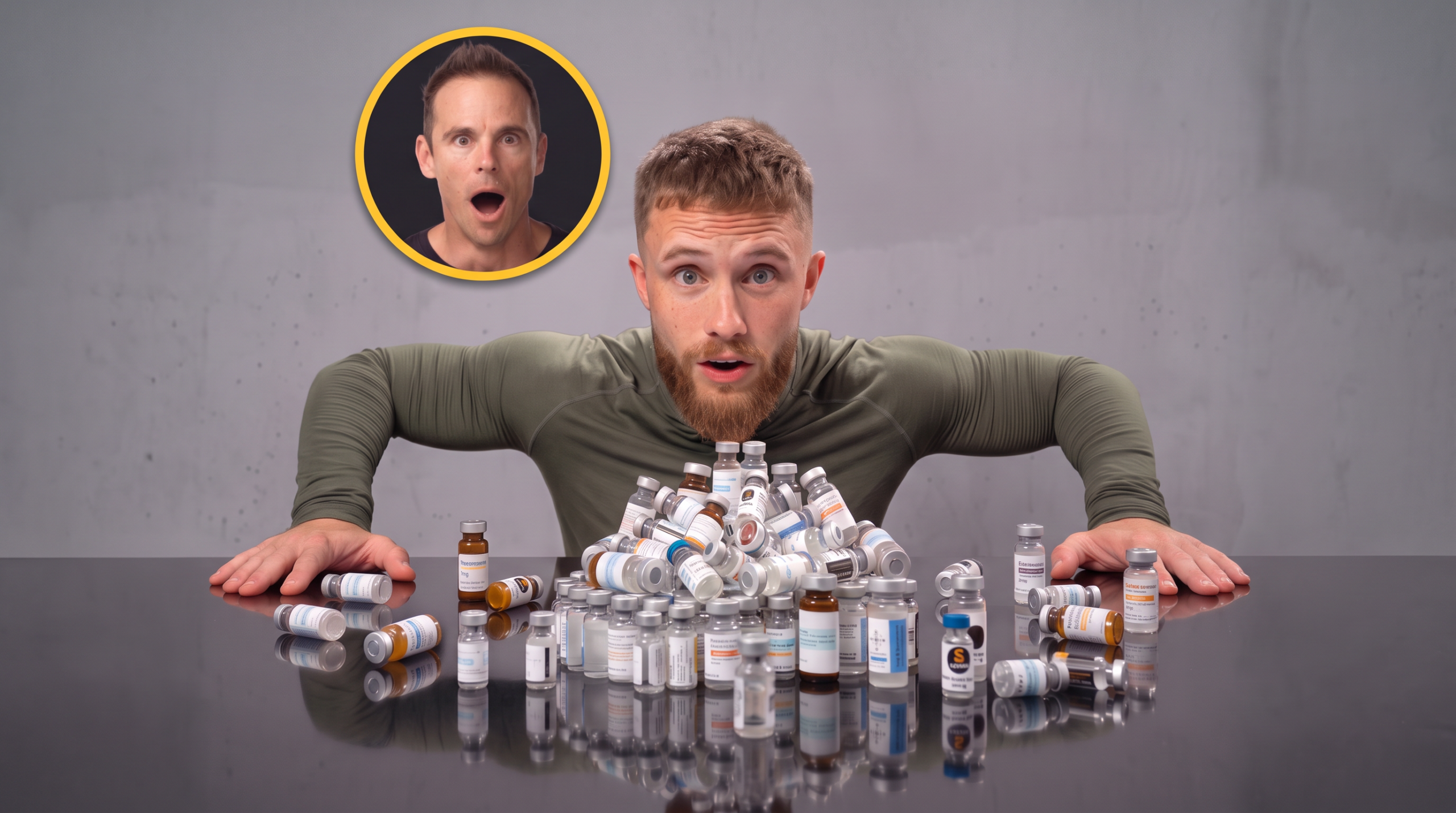
But here’s the twist: certain peptides genuinely deliver on their promises, backed by thousands of participants in rigorous clinical trials.
In a recent deep-dive video, popular fitness YouTuber Jeff Nippard sorted through the science to separate peptide fact from fiction, examining which compounds are worth the hype and which fall flat.
Jump to:
What Peptides Actually Are
Many people mistakenly think of peptides as mini steroids or stimulants, but chemically they’re neither.
Peptides are short chains of amino acids, essentially smaller versions of proteins. While a protein molecule consists of long, tangled chains of amino acids, peptides are shorter, untangled sequences.

If you want something simple that actually works, this is one of the most effective tools I’ve used to build strength, conditioning, and endurance without needing a full gym setup.
- Full-body training with one weight using swings, squats, and presses
- Solid cast iron build that feels stable and lasts for years
- Comfortable grip that makes high-rep workouts easier to handle
With about 20 amino acids that can combine in countless ways, millions of different peptides exist. For health and fitness purposes, three categories dominate the conversation: fat loss peptides, injury healing peptides, and anti-aging peptides.
The Fat Loss Peptides That Actually Work
One in eight U.S. adults now reports using fat loss peptides, with tens of millions taking them worldwide. The most famous is semaglutide, sold under brand names Ozempic and Wegovy.
How Semaglutide Works
Semaglutide is typically injected because stomach acid destroys it when swallowed, though oral versions are improving. After injection into fat tissue, the peptide enters blood vessels and travels to three key locations: the pancreas, stomach, and brain.
It activates GLP-1 receptors at each site, triggering coordinated effects: stabilized blood sugar from the pancreas, slowed stomach emptying, and reduced hunger signals from the brain.
The result? You simply feel less hungry and eat fewer calories without consciously restricting food.
Unlike pretty much every other fat loss supplement, semaglutide works in a pretty unique way. It doesn’t claim to burn more fat. It also doesn’t claim to boost your metabolism. Instead, what it does is it simply lowers your appetite.
The Clinical Evidence
In 2018, before peptide hype peaked, 2,000 volunteers participated in a landmark trial. Some received real semaglutide while others got a placebo, with neither group knowing which they received.
If you want something simple that actually works, this is one of the most effective tools I’ve used to build strength, conditioning, and endurance without needing a full gym setup.
- Full-body training with one weight using swings, squats, and presses
- Solid cast iron build that feels stable and lasts for years
- Comfortable grip that makes high-rep workouts easier to handle
All participants received dietary counseling and exercise guidance. Starting from an average weight of 232 pounds, the semaglutide group lost 34 pounds over 16 months, while the placebo group lost just 6 pounds.
That’s a 28-pound difference from a single peptide.
Newer, More Powerful Options
Semaglutide’s 15% average weight loss is impressive, but newer peptides surpass it significantly.
- Tirzepatide caused 23% weight loss in similar timeframes
- Retatrutide, which recently passed phase three trials, achieved 28% weight loss
For someone starting at 250 pounds, retatrutide would be expected to produce roughly 71 pounds of weight loss over 18 months.
These enhanced results come from activating multiple receptor pathways. Semaglutide activates only GLP-1 receptors, while tirzepatide activates both GLP-1 and GIP receptors. Retatrutide hits three receptors, further blunting hunger and potentially boosting metabolism.
Safety and Side Effects
Jeff consulted with board-certified physicians who prescribe these medications. Dr. Spencer Nadolsky, fully certified since 2014, confirmed their effectiveness and relative safety.
If you want something simple that actually works, this is one of the most effective tools I’ve used to build strength, conditioning, and endurance without needing a full gym setup.
- Full-body training with one weight using swings, squats, and presses
- Solid cast iron build that feels stable and lasts for years
- Comfortable grip that makes high-rep workouts easier to handle
They are the most effective non-surgical way for weight loss, yes. There doesn’t seem to be any big smoking gun. They’re extremely safe, especially in the indicated population.
The most common side effects include nausea and vomiting, particularly when starting the medication. These symptoms typically decrease over time. Constipation is another frequent issue that tends to persist throughout treatment.
Rarer side effects include UTI-like symptoms and gallstone development, though gallbladder attacks remain uncommon.
Semaglutide and tirzepatide have received approval from the FDA, Health Canada, and European Medicines Agency. Retatrutide is completing phase three trials and shows similar tolerability.
The Dark Side of Peptide Weight Loss
This January, many gyms noticed fewer New Year’s resolution crowds than usual. Some speculate that people who previously would have joined gyms are now simply taking peptides instead.
This matters because exercise provides irreplaceable mental health benefits.
Without resistance training and adequate protein, about 40% of weight lost on GLP-1 peptides is lean muscle mass. This isn’t necessarily caused by the peptides themselves, but rather by rapid weight loss without proper strength training or protein intake.
If you want something simple that actually works, this is one of the most effective tools I’ve used to build strength, conditioning, and endurance without needing a full gym setup.
- Full-body training with one weight using swings, squats, and presses
- Solid cast iron build that feels stable and lasts for years
- Comfortable grip that makes high-rep workouts easier to handle
Awareness of muscle loss risk has driven protein powder use to all-time highs, contributing to shortages and price increases in some regions.
More concerning, many people obtain these peptides from black and gray market sources with zero quality control, bypassing medical oversight. Already-lean individuals are using them to become even thinner, potentially shifting societal expectations around healthy body composition.
Addressing the “Shortcut” Criticism
Critics often dismiss peptide use as cheating or taking shortcuts. Dr. Nadolsky, who treats his own hypothyroidism and Hashimoto’s with medication, draws a parallel to blood pressure treatment.
Nobody shames anybody for taking an antihypertensive or tells them it’s a shortcut. Obesity has biological drivers in it that we can’t just necessarily out-discipline or out-willpower. It goes and hits the receptors in the brain to basically not have those same biological drivers anymore, kind of evens the playing field.
He compares it to choosing between flying from New York to Los Angeles versus walking. When safe, effective technology exists, utilizing it makes sense.
The Injury Healing Peptide: BPC-157
BPC-157, nicknamed the “Wolverine peptide,” promises accelerated healing for muscles, tendons, and ligaments. Reviews across social media are overwhelmingly enthusiastic.
BPC 157 is a miracle compound. It has anti-inflammatory properties, also blood driving properties. It tells damaged tissues how to heal.
What BPC-157 Is
BPC stands for “body protection compound.” It’s a simple 15-amino-acid sequence taken from a larger protective protein found in human gastric juice.
If you want something simple that actually works, this is one of the most effective tools I’ve used to build strength, conditioning, and endurance without needing a full gym setup.
- Full-body training with one weight using swings, squats, and presses
- Solid cast iron build that feels stable and lasts for years
- Comfortable grip that makes high-rep workouts easier to handle
Croatian researchers developed it in the early 1990s while studying potential healing effects in stomach tissue. When scientists tested BPC-157 on rats with injured legs, 50% more blood vessels formed in damaged tissue compared to untreated injuries.
Additional animal studies showed accelerated healing across multiple tissue types, including muscles, tendons, and ligaments.
The Evidence Gap
Here’s the catch: all those promising studies were conducted on rats, rabbits, and dogs, not humans.
BPC-157 has been formally studied in just 30 people total, across three small pilot studies. Compare this to semaglutide and tirzepatide, which have been tested on tens of thousands of participants in multi-year, placebo-controlled phase three trials.
Those pilot studies showed some promise for knee pain, bladder pain, and safety, but they suffer from tiny sample sizes and lack proper placebo or control groups.
Anecdotal Reports
Personal testimonials flood the internet with claims of rapid healing.
If you want something simple that actually works, this is one of the most effective tools I’ve used to build strength, conditioning, and endurance without needing a full gym setup.
- Full-body training with one weight using swings, squats, and presses
- Solid cast iron build that feels stable and lasts for years
- Comfortable grip that makes high-rep workouts easier to handle
I was in a really bad car accident. I immediately started taking BPC that day. I was back at work in like two or three days.
I’ve been running the BPC cuz I had some pretty bad elbow inflammation. Within a few days of being back on that, I have no issues, no inflammation, no pain.
While these stories are compelling, most injuries heal naturally with time. Without placebo-controlled trials, it’s impossible to determine whether improvements result from the peptide or natural healing processes.
The mechanism makes biological sense, and animal data is intriguing. But BPC-157 isn’t FDA approved, is banned by the World Anti-Doping Agency, and sourcing remains sketchy.
For now, managing training loads, finding pain-free exercise variations, and working with qualified physical therapists remains the evidence-based approach to injury recovery.
The Anti-Aging Peptide: Epitalon
Epitalon represents the most ambitious category of peptides, targeting aging itself rather than specific symptoms or conditions.
How Epitalon Works (In Theory)
This four-amino-acid peptide works at the most fundamental level of biology: DNA. Every cell in your body follows instructions encoded in DNA, which is packaged into chromosomes with protective caps called telomeres.
As we age, telomeres progressively shorten, potentially contributing to aging processes. Much anti-aging research focuses on preserving telomere length.
If you want something simple that actually works, this is one of the most effective tools I’ve used to build strength, conditioning, and endurance without needing a full gym setup.
- Full-body training with one weight using swings, squats, and presses
- Solid cast iron build that feels stable and lasts for years
- Comfortable grip that makes high-rep workouts easier to handle
Epitalon activates an enzyme called telomerase, which helps rebuild protective telomeres as they shorten over time.
Does It Work?
Yes, in flies, mice, and rats. Epitalon extends lifespan in these animal models.
But for humans, only two studies exist, both from a single Russian research group in 2003 and 2006. Neither has been independently replicated outside Russia.
While telomere shortening clearly plays a role in aging, overactivating telomerase may increase cancer risk, creating a delicate balance that’s poorly understood.
The human evidence on anti-aging peptides simply isn’t there.
What Actually Works for Longevity
Humans already live exceptionally long compared to similarly sized mammals, and virtually all marketed anti-aging compounds follow the same pattern: they work in rats, sometimes in pigs or other primates, then do basically nothing in humans.
If you want something simple that actually works, this is one of the most effective tools I’ve used to build strength, conditioning, and endurance without needing a full gym setup.
- Full-body training with one weight using swings, squats, and presses
- Solid cast iron build that feels stable and lasts for years
- Comfortable grip that makes high-rep workouts easier to handle
Science is already clear on what genuinely slows human aging:
- Strong social relationships with friends, family, and community
- Regular exercise
- Quality sleep
- Not smoking
- Moderate alcohol consumption
- Maintaining healthy body weight
Not as exciting as a new peptide, but these fundamentals genuinely move the needle on longevity.
The Bottom Line on Peptides
Just because certain peptides deliver dramatic results for weight loss doesn’t mean everything labeled “peptide” will work for every promised benefit.
GLP-1 peptides like semaglutide and tirzepatide have robust evidence supporting their use for weight loss in appropriate populations. When prescribed and monitored by qualified physicians, they represent genuinely effective tools for people struggling with obesity.
BPC-157 and injury healing peptides have promising animal research but lack quality human trials. The mechanism makes sense, but sourcing is problematic and evidence insufficient to recommend use.
Anti-aging peptides like epitalon have minimal human research and shouldn’t be relied upon when proven longevity interventions already exist.
If you want something simple that actually works, this is one of the most effective tools I’ve used to build strength, conditioning, and endurance without needing a full gym setup.
- Full-body training with one weight using swings, squats, and presses
- Solid cast iron build that feels stable and lasts for years
- Comfortable grip that makes high-rep workouts easier to handle
For those considering GLP-1 peptides, the decision should involve thorough discussion with a healthcare provider. Diet and exercise remain first-line interventions, but for people who’ve struggled to lose weight through conventional means, these medications may offer legitimate help.
The key is remembering that daily habits ultimately determine long-term health outcomes, regardless of which supplements or medications you might use.