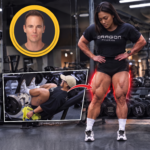
In a recent YouTube video on the Dragon Pharma channel, NPC wellness competitor Ena unpacked the quad exercises and cues that built her legs over 6 to 7 years.
Her routine barely changed during that stretch.
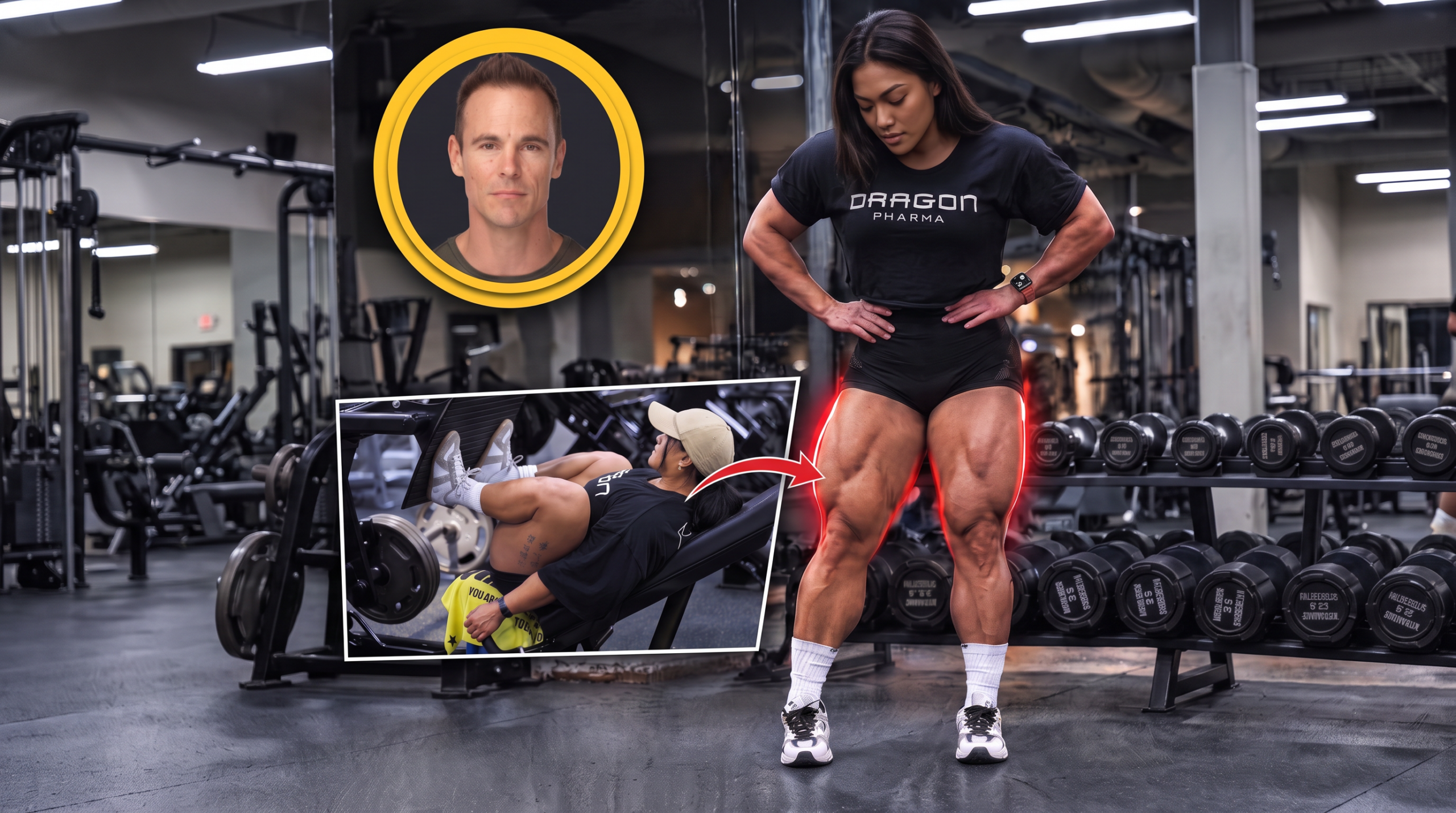
Her heaviest Smith machine squat? Six plates total.
So what actually made the difference?
One small positional tweak and one tension trick, both coming up below.
Jump to:
- The One Cue That Shifts Squats Onto Your Quads
- Open Your Hips Before Touching a Barbell
- Exercise 1: Leg Extensions to Prime Muscle and Joints
- Exercise 2: Smith Machine Squat
- Exercise 3: Leg Press With Low Foot Placement
- Heel Elevation: Her Must-Have Hack
- Exercise 4: Hack Squat, Evenly Loaded
- Why Less Volume and Constant Tension Won
- Quick Takeaways for Your Next Leg Day
The One Cue That Shifts Squats Onto Your Quads
Ena’s number-one rule for quad-focused squatting: send knees forward instead of shoving hips backward.

If you want something simple that actually works, this is one of the most effective tools I’ve used to build strength, conditioning, and endurance without needing a full gym setup.
- Full-body training with one weight using swings, squats, and presses
- Solid cast iron build that feels stable and lasts for years
- Comfortable grip that makes high-rep workouts easier to handle
When you do a squat movement, don’t try to drive your hips back, but actually remember to push the knee forward. And that way you’re going to feel a lot of tension in the quad.
Hips-back squatting, she explains, turns a lift into a glute and hamstring movement. That is exactly where her own training has pivoted this year.
Worth remembering: comfortable knee travel depends on individual mobility and anatomy. Ena herself frames this as a personal emphasis cue, not a universal law.
Open Your Hips Before Touching a Barbell
Her warm-up runs 5 to 10 minutes of dynamic stretching. Priority number one is tight hips and adductors, since stiffness there limits squat depth.
- Frog stretch: rock gently back and forth to open adductors and hips.
- Bench stretch: rear foot up on a bench, then drive the front knee forward and return to hit quads and hip flexors.
- Lean-back stretch: sit back as far as comfortable to lengthen the quads.
Her reasoning is simple. Better hip mobility means deeper knee flexion, and deeper flexion means a bigger quad stretch under load.
Exercise 1: Leg Extensions to Prime Muscle and Joints
Isolation comes first in Ena’s sessions, and it targets the rectus femoris, the V-shaped quad muscle.
It’s very, very helpful to have an isolating exercise like leg extensions to warm up your knees so you don’t feel achy when you do a squatting movement and add more weights.
Setup and Execution Details
- Align the pivot: machine pivot point should sit level with the knee joint.
- Add a shin pad: Ena finds it allows a bit more stretch at the bottom.
- Keep knees and feet parallel: no flaring. She admits she once obsessed over foot angles but now just keeps everything straight.
- Resist on the way down: never drop the weight.
- Use wrist wraps on heavy sets: they let her pull her butt into the seat despite what she calls terrible grip strength.
Her Sets and Reps
Two warm-ups of just 5 to 6 reps, then two working sets in the 10 to 20 range. Her target is usually 12 to 15.
If you want something simple that actually works, this is one of the most effective tools I’ve used to build strength, conditioning, and endurance without needing a full gym setup.
- Full-body training with one weight using swings, squats, and presses
- Solid cast iron build that feels stable and lasts for years
- Comfortable grip that makes high-rep workouts easier to handle
Warm-ups stay light on purpose. Pre-exhausting leaves nothing for working sets.
Between sets, a few seconds of light quad stretching helps when pumps run high. Longer holds, she warns, just add fatigue.
Exercise 2: Smith Machine Squat
Plenty of lifters insist free squats are mandatory. Ena disagrees.
I personally really prefer the Smith machine squat just because it’s much more controlled and I can really, really focus on building the tension only on my quads.
Her checklist:
- Keep the torso as upright as possible.
- Place feet shoulder-width, toes angled slightly out, and not too far forward.
- Sit straight down, letting knees travel over toes.
- Pause one second near the bottom without fully sinking, since bottoming out dumps tension.
Treat Your Foot Like a Tripod
Pressure should spread across the whole foot, never just heel or just toes. Ena links uneven pressure to knee pain over time.
Knees should also track wherever toes point. Caving inward is a red flag.
If you want something simple that actually works, this is one of the most effective tools I’ve used to build strength, conditioning, and endurance without needing a full gym setup.
- Full-body training with one weight using swings, squats, and presses
- Solid cast iron build that feels stable and lasts for years
- Comfortable grip that makes high-rep workouts easier to handle
Exercise 3: Leg Press With Low Foot Placement
Ena swapped her old Hammer Strength press for a Cybex model that feels smoother on her joints. Plate count, she says, never mattered to her.
What we focus on here for our quads is to place our feet lower on the platform. And again, like we had it before, to get more knee flexion.
Middle or high foot positions restrict knee bend, which is where adductor mobility pays off. Hands push the butt into the seat while spine and head stay neutral.
Breathing Pattern
- Inhale lowering the weight.
- Hold briefly during the pause.
- Exhale pressing up.
Heel Elevation: Her Must-Have Hack
Ena trains with 7 mm insoles from her coach Aaron. Too lazy to haul a second pair of squat shoes, she says.
Her logic: limited ankle mobility makes heels pop up as knees move forward, and a slight lift keeps them planted. Squat shoes are an alternative.
Once, she trained barefoot in socks for better platform grip. Her verdict now is that knee flexion beats barefoot grip if both cannot coexist.
Exercise 4: Hack Squat, Evenly Loaded
Same principles apply on the hack squat: even foot pressure, controlled lowering, breath hold at the bottom, exhale on the way up. A small pad or foam roll behind the back can encourage more knee bend and a more upright torso.
If you want something simple that actually works, this is one of the most effective tools I’ve used to build strength, conditioning, and endurance without needing a full gym setup.
- Full-body training with one weight using swings, squats, and presses
- Solid cast iron build that feels stable and lasts for years
- Comfortable grip that makes high-rep workouts easier to handle
No matter how much weight you use, always try to control the eccentric.
Why Less Volume and Constant Tension Won
Early on, Ena piled on sets and reps. Structure arrived through RP Strength principles and coach Aaron’s mesocycles.
I took out a lot of junk volume. So, now I really focus on quality sets.
Current quad work: two leg press sets and two hack squat sets, plus one or two warm-ups.
Her explanation for stalled progress in others is a surprise. Too much resting mid-set, rather than too little effort.
I find it very, very helpful to keep constant flow and constant tension during a set. So, you’re never going to see me completely lock out within a set.
Her powerlifting friends can lift roughly triple her squat weights. Her answer is not more load but tension on every single rep.
Quick Takeaways for Your Next Leg Day
- Loosen hips and adductors before squatting.
- Start with leg extensions to warm knees and pre-load quads.
- Drive knees forward, keep torso tall, and use low foot placement on the press.
- Press through the whole foot, and elevate heels if mobility limits depth.
- Control every descent and avoid locking out mid-set.
- Cut junk volume in favor of a few hard, high-quality sets.
Ena’s results come from one athlete’s eight years of experience, so adjust stance, depth, and volume to your own body. Her emphasis on tension, control, and smart setup is a solid template to build from.