Building muscle doesn’t require endless exercise variations.
In a recent collaboration video, fitness YouTuber Jeremy Ethier teamed up with Dr. Mike Israetel to reveal six exercises that target every major muscle group.
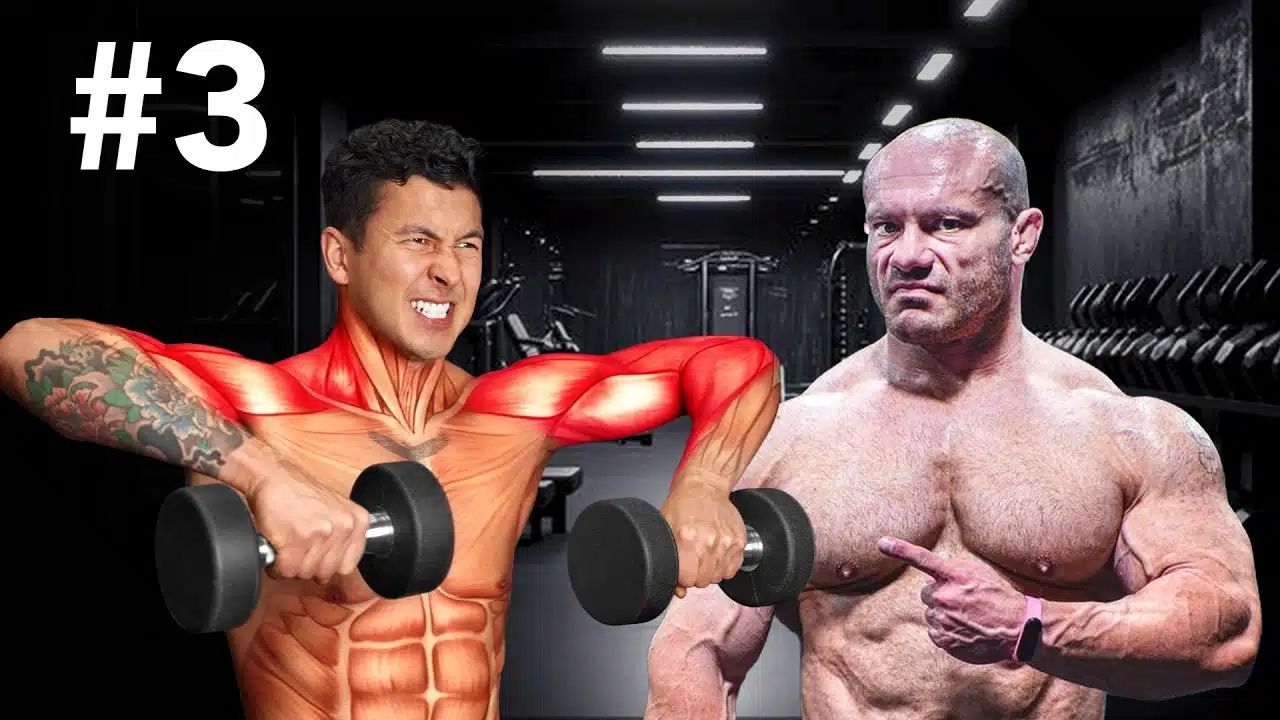
The approach focuses on compound movements that hit multiple muscles simultaneously, making workouts more efficient without sacrificing results.
These aren’t random picks—they’re strategically chosen to cover all eight muscle groups in the human body with minimal overlap and maximum efficiency.
Jump to:
- Close Grip Incline Bench Press: Triple Threat for Upper Body
- Underhand Pull-Ups: Complete Back Development
- Camber Bar Bench Press: Maximum Chest Stretch
- Combo Movement: Stiff-Legged Deadlift Row
- High Bar Squats: Complete Lower Body Development
- Dumbbell Upright Rows: Finishing Touch For Shoulders
- Programming These Six Exercises
Close Grip Incline Bench Press: Triple Threat for Upper Body
Starting with upper body pressing, the close grip incline bench press simultaneously targets chest, front delts, and triceps.
Traditional incline pressing hits pecs and front delts well but leaves triceps underworked. The close grip variation changes that equation.
So the close grip incline bench allows us to hit our upper pecs. Think girls like them or something. The front delts and then the triceps.
Dr. Israetel emphasizes that close grip is highly individual. Grip width depends entirely on body structure—larger frames require wider grips, smaller frames need narrower positioning.
Finding Your Perfect Grip Width
The test? Whether you can touch the bar to your upper chest at the bottom of each rep.
The only way to catalog if you’re doing it right is can you get the bar to touch your upper chest at the bottom.
Proper form requires shoulders pulled back, chest elevated, and elbows tucked. Press up and slightly back toward your forehead rather than straight forward.
One crucial detail: wrists positioned inside elbows creates leverage for greater tricep involvement, though wrists directly over elbows works too for maximum pressing strength.
Incline angle ranges from 30 to 60 degrees—whatever feels most comfortable and allows proper form throughout the movement.
Underhand Pull-Ups: Complete Back Development
Vertical pulling comes next with underhand pull-ups, chosen specifically because they involve biceps more than traditional overhand variations.
With only six exercises available, efficiency matters tremendously.
Any kind of pull-up is great, but remember, we have six exercises and a whole lot more muscle groups. So, we need to get the pull-up to involve the biceps a bit more than normal, which is where the underhand pull-up really shines.
This single movement hits lats, entire vertical pulling musculature, rear delts, and biceps. That’s four muscle groups checked off one list.
The Dead Hang Makes All The Difference
Starting from complete dead hang—shoulders elevated toward ears—creates maximum lat stretch. Reverse this position by actively shrugging downward during the pull.
Ethier noted this adjustment significantly improved his back engagement compared to maintaining constant shoulder tension throughout.
You can do more pull-ups like that, but no one gives a [care]. People only care about how big your back is.
Control descent smoothly rather than dropping quickly. Tempo matters more than rep count for building muscle.
Camber Bar Bench Press: Maximum Chest Stretch
Horizontal pressing addresses chest development with camber bar bench press, though standard barbells, dumbbells, or machines work perfectly fine.
Research consistently shows deep stretch under tension produces superior muscle growth. Camber bars allow greater range of motion than straight bars.
The reason I have the camber bar here is because it’s been shown time and again now that the deep stretch and pushing a lot of tension through that deep stretch really just does grow more muscle.
Key technique: actively lift chest to meet the bar during descent. Pause one second at bottom stretch, then press.
Equipment Alternatives That Work Just As Well
Most people lack access to specialty bars. That’s completely fine.
- Dumbbells: Allow deep stretch by reaching chest forward at bottom position
- Standard barbell: Works excellently with proper form and chest elevation
- Chest press machines: Control deep stretch, pause, press back up
- Deficit push-ups: Use elevated platforms when equipment unavailable
You really, really have to be in a bind workout equipment wise to not be able to do some kind of horizontal press.
The reaching cue applies universally—whether using barbells, dumbbells, machines, or bodyweight. Reach chest toward resistance at stretch position for maximum muscle fiber recruitment.
Combo Movement: Stiff-Legged Deadlift Row
Exercise four introduces creative efficiency by combining two movements into one hybrid exercise.
Stiff-legged deadlifts paired with bent-over rows knock out hamstrings, glutes, lower back, and horizontal rowing muscles simultaneously.
This next exercise, number four, addresses two of those problems right up front. This is a combo movement that does rowing and it does the stiff-legged deadlift at the same time. It’s kind of cheating, you guys.
Execution Breakdown
Using overhand grip on barbell, maintain tight lordotic curve in lower back throughout entire movement.
Lower into full stiff-legged deadlift position—chest up, knees pushed back, hamstrings stretched. Hold this bottom position longer than comfortable.
From stretched position, row barbell to stomach, then lower bar. Stand back up from deadlift while rowing simultaneously.
So, at the very bottom here, I’m totally loose in my upper back. I’m totally tight in my hamstrings, totally tight in my lower back.
Two critical cues: chest elevated throughout and knees pushed backward for nasty hamstring tension.
Weight selection becomes easier because standing upright provides mechanical advantage for rowing portion, allowing heavier loads during the hamstring-dominant bottom position.
Dumbbell Variation
No barbell available? Dumbbells work excellently with slight modification.
Lower into stretched position as usual, but during rowing motion, pull dumbbells into hip pockets rather than straight up. This creates better leverage and maintains tension across target muscles.
Ethier highlighted why combination exercises deserve respect despite criticism from purists focused on exercise specificity.
I’m getting four exercises in one here. Maybe it’s not hitting each of those muscles at 100%. But maybe each of them are hit at 70%. That’s an amazing use of your time.
High Bar Squats: Complete Lower Body Development
Addressing remaining lower body needs requires exercise targeting quads, adductors, and additional glute work.
High bar squats check every box while also hitting core, lower back, and mid-back stabilizers.
This is my favorite leg exercise of all time. It hits quads, adductors, glutes, even lower back, even a little mid back for stability. It does target your abs at heavier loads substantially.
Bar placement sits right above traps where neck ends, distinguished from low bar position below traps intersecting rear delts.
Why High Bar Instead Of Low Bar
High bar positioning allows more upright torso angle, shifting emphasis toward quads rather than posterior chain.
Since stiff-legged deadlift rows already hammered glutes and hamstrings, high bar squats balance program by prioritizing front-side leg development.
Stance width approximately matches shoulder width with toes pointed slightly outward for natural sitting motion.
Technique sequence: Push hips backward first while maintaining completely upright chest. Bend knees allowing them to travel over toes. Descend until full depth reached, pause briefly, stand back up.
So, butt back, but chest up. And then bend your knees and let your knees do the rest. All the way over your toes with the knees.
Knees traveling forward over toes isn’t dangerous—it’s necessary for proper quad development and full range squatting.
Dumbbell Upright Rows: Finishing Touch For Shoulders
Final exercise addresses side delts, upper traps, and additional bicep/forearm work through dumbbell upright rows.
Side delts dramatically impact physique appearance. Research on ideal shoulder-to-waist ratio (approximately 1.6) confirms their importance for attractive proportions.
Side delts have been rated by scientists as the single most sexually attractive muscle in the male physique.
Proper Upright Row Form
Primary focus: drive elbows as high as physically possible. Everything else follows from this single cue.
Pull dumbbells up front of body—not wrong, completely acceptable. For greater bicep involvement, keep dumbbells closer, almost dragging up chest.
Hold briefly at top position to connect with shoulders, then control descent slowly. Body wants to drop weight quickly; resist this urge for maximum side delt engagement.
This right here, this little guy, this elbow, I want it right here.
Some individuals experience shoulder discomfort with upright rows. Standard lateral raises substitute perfectly without compromising program effectiveness.
Programming These Six Exercises
Executing six exercises across two or three weekly full-body sessions builds impressive physiques when programmed intelligently.
Dr. Israetel recommends alternating rep ranges between sessions for variety and reduced injury risk.
Day one is all of these six exercises, but in the 5 to 10 rep range, pretty heavy. Day two, halfway through the week, the same exercises, but sets of 10 to 15.
Lower rep sessions build strength and density. Higher rep sessions provide psychological novelty while reducing tendon stress.
Each workout lasts approximately one hour. Performing multiple sets of these six movements twice weekly creates sufficient stimulus for substantial muscle development.
Two days a week of training an hour. In each one of those hours, you do these exercises for a few sets. I think you can establish a wonderful physique.
This minimalist approach proves more isn’t always better. Strategic exercise selection targeting multiple muscle groups simultaneously produces remarkable results without requiring gym marathons or complicated split routines.
Six exercises. Eight muscle groups. Complete physique development.