For decades, the fitness industry pushed a seductive lie: train every set to absolute failure, leave nothing in the tank, and watch strength skyrocket.
It sounds logical—maximum effort should equal maximum results.
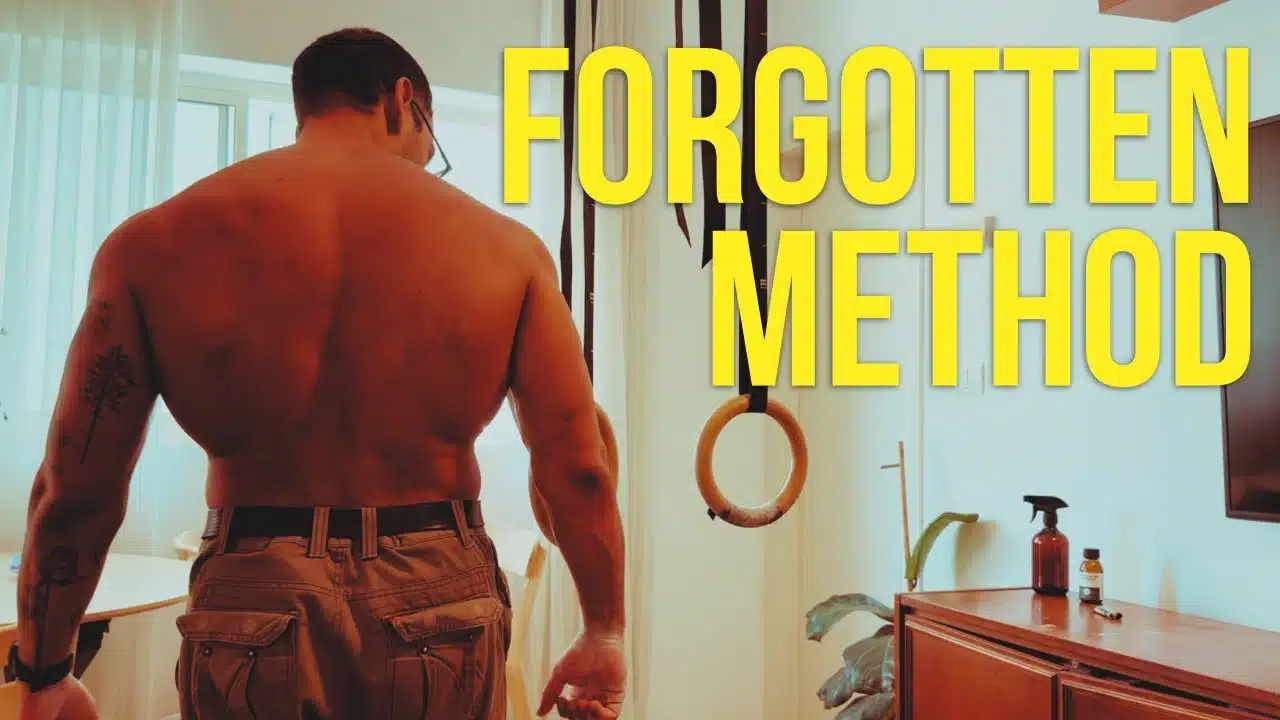
But the strongest athletes in history, from Olympic weightlifters to gymnasts with jaw-dropping natural physiques, rarely trained to failure.
They understood something critical: total workload beats maximum effort every single time.
Jump to:
- The Soviet Secret to Superhuman Strength
- Legendary Coaches Built Empires on This Principle
- Where Training to Failure Actually Makes Sense
- The Real Question Nobody Asks
- Natural Physique Legends Proved This Decades Ago
- Apply This to Your Calisthenics Training Right Now
- Your Practical Framework Starting Today
- Why You’ve Been Stuck
The Soviet Secret to Superhuman Strength
Soviet strength researchers developed a system that produced more world records than any other training methodology in history. Their approach contradicted everything modern fitness culture preaches.
Take 80% of your one-rep max on weighted pull-ups, handstand push-ups, or planche progressions. Most people can squeeze out eight reps before hitting failure at this intensity.
The Soviet system? They performed only two to five reps.
If you can do eight reps, you should perform about three reps. If you can do five, you do two. If you can do four, you do one or two reps.
This wasn’t conservative training. This was strategic accumulation.
They repeated these submaximal sets across 5, 10, even 20 sets. The reasoning was bulletproof: total workload equals sets multiplied by reps multiplied by load.
Why Submaximal Training Destroys Failure Training
Lower your working weight by just 10%, and you can perform four times the volume. Your cumulative workload becomes significantly higher than one brutal all-out set.
Sure, pushing to failure might squeeze out one or two extra reps per set. But if you can slightly reduce intensity and accumulate four times more work, you create exponentially more adaptation signals.
That’s precisely why classic strength programs recommended five sets of five, not one grueling set to failure.
Legendary Coaches Built Empires on This Principle
Vasily Alexeev, former European weightlifting legend and one of the 20th century’s most influential strength coaches, built his entire system around sets of three to five reps.
Never above five reps—the load needed to stay heavy enough for genuine strength adaptation. Never singles either, because singles test strength rather than build it.
You cannot accumulate enough workload with singles to actually build strength. You’re just demonstrating what you already have. That’s peaking.
In calisthenics circles, singles are called “attempts.” When you constantly practice attempting, constantly operate at your absolute limit while grinding and failing, that becomes your performance pattern.
The way you practice is the way you perform.
Legendary researchers like Verkhoshansky, Medvedev (who documented four Soviet Olympic cycles), and Tudor Bompa never programmed training to failure. Not once.
Their programs used percentage-based loading, submaximal intensity, and strategic reps in reserve—never RPE 10 as standard protocol.
Where Training to Failure Actually Makes Sense
Training to failure wasn’t born from stupidity. It emerged from specific context that made perfect sense.
Imagine having only 30 minutes to train with one or two sets per exercise maximum. In that scenario, squeezing every last rep from each set becomes logical.
Add slow eccentrics, get partner assistance past failure, maximize yield from minimal sets. This approach works beautifully with:
- Limited training time
- Restricted set volume
- Isolation movements on stable machines where failure carries less injury risk
The fitness industry stripped away context and sold maximum intensity as universal truth.
The Mike Mentzer Trap
Mike Mentzer popularized high-intensity training: one or two sets to absolute failure per exercise. Initially, it works brilliantly.
When you’ve been crushing yourself with excessive volume, slashing fatigue creates an immediate recovery response. Strength rebounds dramatically, and the method gets all credit.
But once that stabilizes? You’re trapped.
Adding stress requires more sets, but every set already reaches absolute failure. You can’t add volume without breaking down. Progress stops cold.
Inflammation creeps in. Joint pain follows, especially with calisthenics movements that stress tendons and ligaments intensely.
The Real Question Nobody Asks
People argue endlessly about high volume versus high intensity. They’re debating the wrong variable entirely.
The actual question: What produces the most total stress your body can genuinely recover from and adapt to?
The answer has always been submaximal volume.
Sets spread across training sessions, workload accumulated intelligently, enough left in reserve that you can train again tomorrow and the next day with quality.
You’ll recover better without grinding to failure. Your technique stays crisp. Your form remains tight. This matters tremendously in calisthenics, where technical complexity and movement quality determine both results and injury prevention.
Natural Physique Legends Proved This Decades Ago
Marvin Eder, Leroy Colbert, Doug Hepburn, Reg Park, John Grimek—these natural bodybuilding and strength pioneers built physiques that remain unmatched today.
They trained with high volume but didn’t take every set to failure. They combined intensity with volume intelligently, pushing hard while spreading work across numerous sets.
Total stress was enormous. Individual set intensity stayed controlled.
Even the golden era bodybuilders of the 1970s—admittedly not natural—produced superior physiques compared to today’s competitors despite having less equipment, fewer machines, and less advanced research.
They understood workload.
Apply This to Your Calisthenics Training Right Now
Say you’re working toward one-arm pull-ups. Your current max is four archer pull-ups—a common progression point.
The fitness industry tells you to grind out all four reps every set, maybe attempt a fifth, feel the burn, embrace failure.
The Soviet approach says perform only two reps.
Execute two clean, controlled reps. Rest. Repeat. Do 10 sets of two.
Your total volume becomes 20 quality reps instead of one brutal set of four plus three grinding failure sets. Your cumulative workload is higher, your nervous system isn’t fried, and your tendons aren’t screaming.
You can repeat this workout in three days with identical quality.
Same Principle for Every Movement
Can you do eight handstand push-ups against a wall? Perform only three to five reps per set across many sets.
Leave training feeling like you could have done more. Return fresher, accumulate more weekly volume than you ever could grinding to failure.
This applies to planche progressions, ring dips, front levers—everything. This isn’t bodyweight versus barbell methodology. It’s resistance training.
The rules remain identical. Physiology doesn’t change because equipment does.
Your Practical Framework Starting Today
Here’s how to implement this immediately:
- Find your current maximum for each movement
- Take 75% of that effort—the load or progression where you could do 8-10 reps
- Perform only 3-5 reps per set
- Execute many sets at this level (start with three, build to five or more)
- Increase difficulty only when you can consistently hit high-quality sets of five across all sets
You earn progression by building genuine capacity at your current level first. That’s accumulation training—wide base, solid foundation, consistent workload week after week.
After spending months building, then you can briefly peak. Test. Do attempts. Pick the fruit you spent time growing.
Then return to building.
Why You’ve Been Stuck
If progress has stalled, injuries keep appearing, or you feel like you’re training hard but going nowhere, this explains why.
You’re spending your year attempting rather than building. You’re peaking constantly, grinding maximum effort into movements that need systematic development, not repeated testing.
Stop attempting, start building. The strength will come. It always comes when you give it the right environment to grow.
This methodology built Des Souben’s champions. It dominated Soviet weightlifting for decades. It created Marvin Eder’s legendary pound-for-pound strength and physique combination.
Every serious strength athlete who lasted decades in their sport trained this way: submaximal, consistent workload rather than grinding RPE 10 every session.
Give your body the right environment, and strength becomes inevitable.