Core weakness might not be what you think it is.
According to Gabby, founder of Body Alignment Training, if your pelvis is tilted, your abs literally cannot activate properly—you’re stretching them while asking them to fire.
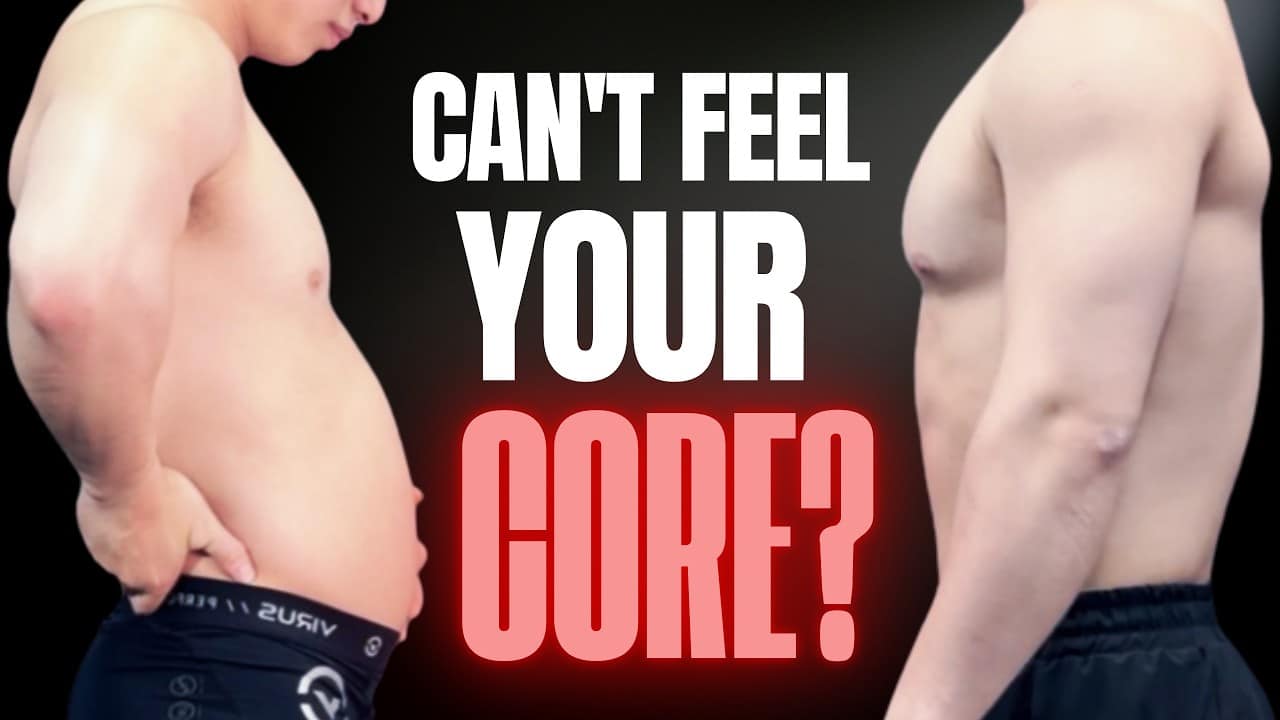
In a recent video, he explained that most people don’t have a weak core at all.
They have a body position that’s preventing their core from working the way it was designed to.
Jump to:
Your Core Is Not What You Think
Gabby, who has worked with everyone from office workers to Olympic gold medalists over the past decade, breaks down core function using a simple analogy: think of your core like a can.
The lid is your diaphragm. The bottom is your pelvic floor. The sides are your abs and spinal erectors.
All of them form a pressure container that maintains stability during movement. But here’s the catch—your core isn’t solid like an actual can.
It’s fluid, shaped by your thoracic cavity and fascial structure. That means your rib cage position and foot alignment directly influence whether your abs can even turn on.
How Desk Work Destroys Core Function
If you sit 8 to 12 hours a day, there’s a good chance your upper chest has collapsed forward.
When that happens, your chest caves right into your abdomen, taking over space. Your belly has no choice but to protrude forward—not because of weak abs, but because your rib cage is literally sitting on top of it.
Your core position can also be influenced by your feet. That’s because the bottom of your core, your pelvis, has a direct connection with the position of your foot arch.
Gabby identifies two common scenarios:
- Leaning outward and forward on your feet: This tilts your pelvis anteriorly (forward)
- Collapsed arches rolling inward: This tilts your pelvis posteriorly (backward)
Both patterns prevent proper core activation. You’re not creating an environment where your abs can fire naturally.
Stop Trying to Fix Pain
Gabby is blunt about this: pain is not the problem.
It’s the signal. Until you rebuild the structure creating it, pain will keep coming back.
People aren’t stuck in pain because they haven’t tried hard enough. They’ve stopped because they’ve been solving the wrong problem.
Stretching, foam rolling, and mobility drills don’t address structural root causes. Instead, Gabby recommends three exercises designed to restore chest position and ground force mechanics—creating an environment where your abs activate automatically.
Exercise 1: Supine Spinal Twist
This movement restores spinal mobility and resets oblique tension so your chest and pelvis can align.
How to do it:
- Lie on your back with hips, knees, and ankles at 90 degrees
- Squeeze a pillow between your thighs to keep your lower body stable
- Grab your kneecap to prevent unnecessary spinal tension
- Rotate your lower body to one side first, then exhale gently until no air remains
- Inhale and return to neutral
Keep the range of motion minimal—just a few centimeters. The goal isn’t dramatic rotation. It’s controlled breathing with spinal movement.
Rotate first, exhale second as gently as you can. Keep your neck relaxed. When there is no air left in your belly, inhale and restore to the setup position.
Perform 10 reps per side, elongating each exhale.
Exercise 2: Lateral Expansion Breathing
This drill uses resistance to activate rib and shoulder muscles, training lateral breathing mechanics.
How to do it:
- Hold a dumbbell or weighted object at the root of your palm
- Distribute weight 50/50 between thenar (thumb side) and hypothenar (pinky side) to avoid wrist rotation
- Press the weight overhead
- Cross the same-side knee toward the opposite side
- Exhale to align your ribs with your pelvis—no flared ribs
- Push upward actively and breathe in this position for 30 seconds to 1 minute
Repeat twice per side. Focus on rib alignment, not knee height.
Exercise 3: Lower Body Alignment Training
This movement rebuilds foot tripod mechanics and corrects pelvic position from the ground up.
How to do it:
- Place two books of equal width on the floor
- Position your feet so the books cut them in half, shifting weight to your heels
- Distribute weight: 60% heels, 30% big toe ball, 10% pinky toe ball
- Flex hips, knees, and ankles simultaneously—don’t just bend your knees
- Lower only until your ankles feel tension (often just a quarter squat)
- Push the floor away to stand, using ground reaction force—don’t just raise your butt
Perform 10 to 20 controlled reps. This realigns your entire lower body.
Structure Before Strength
Gabby’s philosophy is simple: your pelvis doesn’t work in isolation.
It’s connected to your rib cage, feet, and breathing. When one part loses position, the entire system adapts through compensation.
The body follows structure before it follows strength. That’s why doing more crunches won’t fix the real problem.
More ab exercises won’t help if your body can’t position itself to activate those muscles properly. You need to restore alignment first.
Be the Ferrari first, then press the accelerator.
Gabby’s approach emphasizes human function before athletic performance. If you’ve been foam rolling, stretching, and strengthening without results, structural misalignment may be the missing piece.
Try these three drills consistently. They’re designed not to make your core stronger, but to allow your core to work the way it was designed to.